Reasons for choosing our testing services
ZHONGXI Testing has obtained inspection qualification certifications from multiple countries and regions worldwide. We possess a senior testing team and advanced testing methods, providing independent, impartial, and professional third-party verification services for global carbon projects.

Internationally recognized authority
Certified by multiple international standards such as CNAS, VCS, and GS, with reports universally applicable worldwide.

Global service capability
Covering 140+ countries and regions, it supports on-site detection and remote verification in multiple languages.

Professional experimental methods
Adopt standard experimental methods to ensure accurate and reliable data.
Comprehensive Substation Distribution Cabinet Testing – Advanced Diagnostic and Performance Verification for Power Infrastructure Reliability
Substation distribution cabinets (also known as low‑voltage switchgear or power distribution panels) are critical nodes in the electrical grid, responsible for safely distributing, protecting, and controlling power to downstream loads. Their failure – whether due to insulation degradation, contact resistance increase, thermal overload, or mechanical wear – can lead to catastrophic outages, equipment damage, and safety hazards. Routine visual inspections and basic continuity checks are insufficient to guarantee long‑term reliability. Our substation distribution cabinet testing service provides a systematic, multi‑parameter assessment that combines electrical, thermal, mechanical, and environmental diagnostics, using both on‑site portable instruments and laboratory‑grade analysis of component materials. We deliver a comprehensive health index and predictive maintenance roadmap, ensuring that your distribution assets operate within design margins and comply with international standards (IEC 61439, IEEE C37.20, etc.).
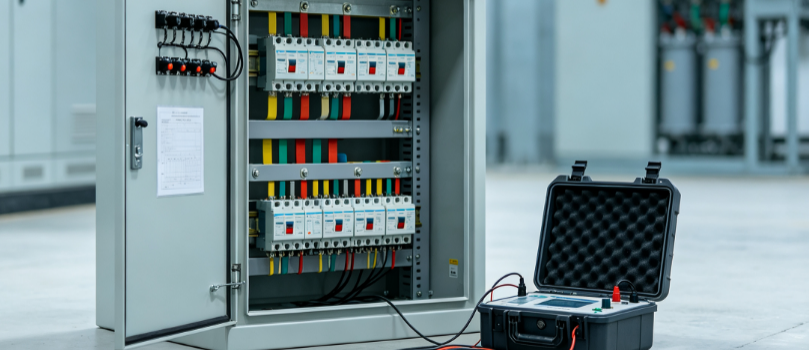
Who Needs Substation Distribution Cabinet Testing and Why?
Customers seeking this testing typically include utility asset managers responsible for transmission and distribution substations, industrial facility engineers operating captive power systems, renewable energy plant operators (solar/wind farms) requiring grid‑connection switchgear, and third‑party maintenance providers offering condition‑based monitoring. Common challenges include: unexplained tripping, hot spots detected by infrared surveys, high partial discharge activity, or simply the need to establish baseline data for aging equipment. Our service addresses these by providing quantified risk assessments and trendable data for each compartment – from the main busbar to individual feeder breakers – enabling prioritised maintenance and informed replacement decisions.
Our Advanced Testing Framework – From Electrical Integrity to Environmental resilience
We adopt a tiered, modular approach that covers all critical aspects of distribution cabinet health, from live‑line diagnostics (safely performed with remote sensors) to de‑energised contact measurements and material characterisation. All tests are performed in accordance with IEC 61439‑1/‑2, ANSI/NEMA, and local grid codes, with tailored procedures for fixed‑mounted, draw‑out, and intelligent electronic device (IED)‑equipped cabinets.
1. Insulation Resistance and Dielectric Strength Assessment
Insulation integrity is paramount. We perform megger tests (500 V, 1000 V, or 2500 V depending on rated voltage) between phases, phase‑to‑earth, and across open contacts, measuring Insulation Resistance (IR) and Polarisation Index (PI) and dielectric absorption ratio (DAR) to detect moisture ingress, contamination, or ageing of insulating materials. For comprehensive evaluation, we conduct high‑potential (Hi‑Pot) AC/DC withstand tests at specified test voltages (e.g., 2× rated voltage + 1 kV) for 1 minute, with Leakage Current monitoring to identify partial discharge precursors. We also perform step‑voltage tests to determine breakdown thresholds without destructive failure.
2. Contact Resistance and Micro‑Ohm Measurement of Busbars and Breakers
High resistance at bolted connections, busbar joints, or moving contacts generates localised heating and accelerates oxidation. Using four‑terminal micro‑ohmmeters (DC current up to 600 A), we measure contact resistance (in μΩ) for all main and branch connections, comparing results against baseline values and manufacturer specifications. We also perform dynamic resistance measurement (DRM) during breaker opening/closing to assess contact wear and alignment – a technique that detects pitting or asymmetry in arcing contacts.
3. Partial Discharge (PD) Detection and Localisation
PD activity is an early indicator of insulation defects. We deploy a suite of complementary sensors: ultrasonic acoustic detectors for surface discharges, high‑frequency current transformers (HFCT) on earthing leads, and transient earth voltage (TEV) sensors for internal cavity discharges. For critical cabinets, we perform phase‑resolved partial discharge (PRPD) analysis using a high‑bandwidth oscilloscope and pattern recognition software to distinguish between corona, surface tracking, and void discharges. We also offer ultra‑high‑frequency (UHF) PD monitoring with sensor arrays for 3D localisation of discharge sources, enabling targeted maintenance.
4. Thermal Imaging and Temperature Profiling
Infrared thermography under normal load conditions (ideally > 30% of rated current) is used to identify hot spots caused by loose connections, overloaded circuits, or unbalanced phases. We use high‑resolution thermal cameras (640×480 pixels) with temperature sensitivity of ≤ 0.03 °C, and we correct for emissivity and reflected temperature. We provide thermal rise curves for each compartment, compare with calculated temperature limits (per IEC 61439, max 70 °C for copper connections), and recommend corrective actions such as torque tightening or conductor upsizing.
5. Mechanical and Operational Integrity Verification
Distribution cabinets contain numerous mechanical components (latches, interlocks, springs, and racking mechanisms) that affect safety and operational reliability. We test operation force and travel distance for draw‑out breakers, verify padlocking and interlock functions per safety schematics, and perform contact timing and travel analysis for circuit breakers using a contact travel‑time analyser. We also assess auxiliary contact reliability (e.g., for trip/close coils) and check spring‑charged mechanism performance under simulated low‑voltage conditions.
6. Environmental and Corrosion Assessment
Substation cabinets are exposed to humidity, temperature cycling, and corrosive atmospheres (especially in coastal or industrial areas). We carry out relative humidity and dew‑point monitoring inside enclosures, alongside salt spray and dust ingress tests (IP rating verification) using calibrated borescopes and particle counters. For metallic components, we perform coating thickness measurement (magnetic/eddy current) and visual plus microscopic inspection for pitting, crevice corrosion, or galvanic effects, referencing ISO 9223 corrosivity categories. We also analyse tightening torque of all bolted connections to ensure they remain within specified ranges.
7. Protective Device Coordination and Secondary Injection Testing
For cabinets equipped with protection relays (overcurrent, earth fault, etc.), we perform secondary injection testing using a multi‑function relay test set (Omicron or equivalent) to verify pickup/operate values, timing curves, and logic functions. We also test tripping and closing circuits for correct voltage levels, continuity, and anti‑pumping features. The results are compared with the protection coordination study to ensure selective tripping and avoid nuisance outages.
8. Power Quality and Harmonic Distortion Analysis
We use class A power quality analysers to record voltage and current waveforms over 24–72 hours, evaluating total harmonic distortion (THD), individual harmonics, unbalance, and flicker. This data is correlated with cabinet loading to identify potential resonance conditions or excessive harmonic currents that cause additional heating in neutral conductors and transformers. We provide recommendations for passive or active filtering where needed.
Our Distinctive Advantages – Why Choose Us for Distribution Cabinet Testing?
Our field‑deployable laboratory is equipped with calibrated instrumentation that meets or exceeds the accuracy requirements of IEC 61557 and IEEE Standard 400. We maintain a fleet of modular test sets that allow simultaneous testing of multiple cabinets, minimising outage time. Our team comprises chartered electrical engineers and certified relay technicians with extensive experience in high‑voltage substations up to 245 kV, as well as low‑voltage distribution systems (≤ 1000 V).
We differentiate ourselves by integrating data analytics and machine learning into our reporting. Instead of a simple pass/fail, we generate a health index score for each cabinet, based on weighted contributions from Insulation Resistance, contact resistance, PD magnitude, thermal gradient, and operating history. We also provide trend analysis across multiple campaigns, enabling predictive rather than reactive maintenance. Moreover, we offer remote monitoring solutions using IoT‑enabled sensors that continuously stream PD, temperature, and humidity data to our cloud platform, with alerting based on dynamic thresholds.
All our procedures are documented and follow strict safety protocols (safe approach distances, lockout/tagout, and arc‑flash PPE). We deliver risk‑based inspection plans that align with your asset criticality and regulatory requirements (e.g., NERC PRC‑005, OSHA 1910.269). We also provide training and knowledge transfer to your in‑house team, empowering them to interpret test results and perform basic routine checks.
Deliverables – A Complete Condition Assessment and Action Plan
Your final report will be a comprehensive document structured as follows:
Section 1 – Executive summary: Overall health index, critical findings (high‑risk items), and recommended immediate actions.
Section 2 – Electrical test results: Insulation Resistance (IR/PI/DAR), contact resistance (μΩ) with deviation from baseline, and dielectric withstand test voltages/Leakage Currents.
Section 3 – PD and thermal analysis: PRPD phase‑resolved patterns, PD magnitude (pC), thermal maps with ΔT values, and localisation coordinates for PD sources.
Section 4 – Mechanical and environmental: Operation force, contact travel times, IP verification, corrosion grading, and torque compliance.
Section 5 – Protection and power quality: Relay pickup/timing, harmonic spectra (THD and individual harmonics), and unbalance factors.
Section 6 – Prioritised maintenance schedule: Recommended actions for each cabinet (cleaning, retorquing, component replacement, or further specialist investigation) with urgency ratings.
All raw data (waveforms, thermal images, PD phase‑resolved plots) are provided in digital formats for import into your asset management system.
Industries and Applications Served
Our service is essential for electric utilities (transmission and distribution substations), large industrial plants (petrochemical, steel, cement, data centres), commercial building complexes with critical power distribution, and transportation infrastructure (railways, airports). We also support renewable energy projects (solar PV, wind farms) where distribution cabinets interface with inverters and grid transformers.
How to Engage Our Testing Services
Our standard engagement model includes:
1. Site survey and scope definition: We visit your site to inventory cabinets, review single‑line diagrams, and understand your operational constraints (e.g., allowed outage windows).
2. Customised test plan and quotation: We propose a matrix of tests based on criticality and age, with a fixed price and timeline – typically 2–5 days on‑site for a medium‑sized substation.
3. On‑site execution: Our certified team performs the tests during scheduled outages, with minimal disruption. We use temporary bypass or alternate feeds where required.
4. Data analysis and reporting: Within 7‑10 working days, we deliver the comprehensive report with clear recommendations.
5. Follow‑up consultation: We present findings to your engineering and management teams, answer questions, and assist in planning corrective actions.
We offer annual maintenance agreements for ongoing condition monitoring, which include periodic testing and real‑time remote diagnostics. All data is treated as confidential and stored securely in our ISO‑27001‑compliant data centre.
Conclusion – Ensure Substation Reliability with Rigorous, Data‑Driven Cabinet Testing
Distribution cabinets are the backbone of power delivery, yet they are often under‑monitored until a failure occurs. Our substation distribution cabinet testing service provides the depth, accuracy, and actionable intelligence needed to prevent unplanned outages, extend asset life, and maintain regulatory compliance. With state‑of‑the‑art instrumentation, expert engineering interpretation, and a commitment to safety, we deliver the confidence you need to manage your power infrastructure proactively.
Contact our power systems testing specialists today to schedule a consultation and receive a tailored proposal for your site. Let us help you secure the reliability of your distribution network.