Reasons for choosing our testing services
ZHONGXI Testing has obtained inspection qualification certifications from multiple countries and regions worldwide. We possess a senior testing team and advanced testing methods, providing independent, impartial, and professional third-party verification services for global carbon projects.

Internationally recognized authority
Certified by multiple international standards such as CNAS, VCS, and GS, with reports universally applicable worldwide.

Global service capability
Covering 140+ countries and regions, it supports on-site detection and remote verification in multiple languages.

Professional experimental methods
Adopt standard experimental methods to ensure accurate and reliable data.
Advanced Acrolein Catalyst Testing – Comprehensive Performance, Selectivity, and Durability Evaluation for Oxidation and Dehydration Processes
Acrolein (2‑propenal) is a high‑value intermediate in the production of acrylic acid, methionine, and numerous fine chemicals. It is primarily synthesised via the selective oxidation of propylene (using multi‑component bismuth‑molybdate catalysts) or by dehydration of glycerol (using solid acid catalysts). Both routes demand catalysts with exceptionally high selectivity to acrolein, minimal by‑product formation (e.g., acrylic acid, COx, acetaldehyde), and long‑term stability against coking and phase segregation. Routine conversion tests are inadequate; they fail to capture the complex interplay between active site structure, oxygen mobility, acidity, and steam stability that governs industrial performance. Our acrolein catalyst testing service provides a comprehensive, multi‑scale evaluation that combines advanced kinetic profiling, operando spectroscopic characterisation, stability assessments under realistic feed conditions, and selectivity mapping at the molecular level. We deliver actionable insights for catalyst development, troubleshooting, and quality assurance – ensuring that your catalyst meets the rigorous demands of commercial acrolein production.
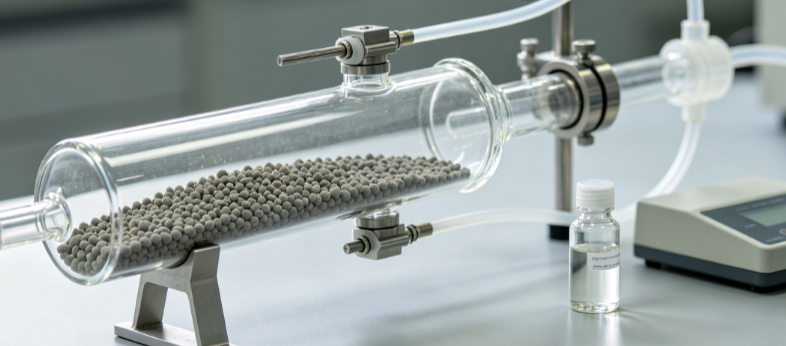
Who Requires Acrolein Catalyst Testing and What Are the Critical Challenges?
Customers seeking acrolein catalyst evaluation include petrochemical catalyst manufacturers optimising propylene oxidation formulations, glycerol valorisation companies developing bio‑based acrolein routes, acrylic acid producers qualifying catalysts for integrated plants, and academic research groups investigating novel active phases. Common bottlenecks include: rapid deactivation by coke deposition, poor selectivity to acrolein due to over‑oxidation, inconsistent performance with varying feed ratios (propylene/O₂/steam), or difficulties in scaling up from lab to pilot plant. Our service addresses these by offering custom‑designed test protocols that replicate industrial conditions – including high temperatures (300–500 °C), variable steam partial pressures, and realistic space velocities – while providing detailed kinetic and mechanistic data that enable predictive modelling and process optimisation.
Our Multi‑Tier Testing Framework – From Activity Screening to Mechanistic Elucidation
We adopt a modular, hierarchical approach that systematically probes acrolein catalysts across four critical dimensions: intrinsic activity, selectivity, stability, and structural evolution. Each tier integrates state‑of‑the‑art instrumentation to deliver a comprehensive performance map.
1. Catalytic Activity and Selectivity Profiling Under Industrially Relevant Conditions
Using our high‑throughput fixed‑bed reactor system (16 parallel channels) and fully automated single‑bed microreactors, we screen acrolein formation under a wide range of operating parameters: temperatures (250–550 °C), pressures (1–20 bar), feed ratios (propylene/O₂/H₂O/N₂), and gas hourly space velocities (GHSV 500–20,000 h⁻¹). Product effluents are analysed by on‑line GC‑FID/MS and FTIR for real‑time quantification of acrolein, propylene, acrylic acid, CO, CO₂, and minor oxygenates. We report propylene conversion, acrolein selectivity, yield, and formation rates (mol/gcat/h), and we calculate turnover frequencies (TOF) based on active site densities determined by O₂‑chemisorption or NO‑titration. For glycerol dehydration, we apply HPLC‑DAD and GC‑MS to analyse liquid products and heavy oligomers, providing a full carbon balance.
2. Detailed Kinetic Modelling and Rate‑Determining Step Identification
We conduct transient kinetic experiments – including step‑change of feed composition, temperature ramping, and pulse reactions – to extract intrinsic rate constants, adsorption coefficients, and apparent activation energies. Using Langmuir‑Hinshelwood and Mars‑van Krevelen mechanisms, we determine which step governs overall conversion (e.g., propylene activation, oxygen insertion, or acrolein desorption). For glycerol dehydration, we differentiate between homogeneous and heterogeneous pathways and quantify the acid site requirement for selective dehydration versus dehydration‑dehydrogenation. This kinetic rigor is essential for reliable scale‑up and reactor design.
3. Operando Spectroscopic and Structural Characterisation
To correlate catalyst structure with performance, we integrate operando XRD and X‑ray absorption spectroscopy (XAS) (at synchrotron facilities via our collaborative network) to track phase transitions, metal oxidation states (e.g., Bi³⁺/Bi⁰, Mo⁶⁺/Mo⁵⁺), and particle sintering during reaction. In‑house, we perform in‑situ DRIFTS with propylene/acrolein feeds to identify adsorbed intermediates (e.g., allyl species, acrylate, or acetate) and their evolution under steam‑rich conditions. For acidic catalysts, we use in‑situ pyridine‑FTIR to monitor Brønsted/Lewis acid site changes during reaction. These data allow us to construct structure‑activity‑selectivity relationships and to diagnose deactivation mechanisms.
4. Stability and Deactivation Assessment – Coking, Poisoning, and Phase Segregation
Industrial acrolein catalysts must survive thousands of hours. We perform accelerated aging tests with deliberate introduction of feed impurities (e.g., propylene containing sulfur, or glycerol with chloride/alkali contaminants) and under high‑steam/high‑temperature conditions. We monitor time‑on‑stream (TOS) deactivation profiles and quantify coke formation using TGA‑DSC coupled with MS for evolved gas analysis, distinguishing between reversible (soft) and irreversible (hard) coke. We also evaluate phase stability by post‑reaction XRD and TEM, detecting any segregation of active components (e.g., Bi₂O₃ or MoO₃). For glycerol dehydration, we assess leaching of acidic sites by analysing the liquid effluent for dissolved species (ICP‑MS).
5. Regeneration Protocol Development and Cycle Testing
We design and optimise regeneration strategies – oxidative decoking (air/O₂ diluted with N₂) at controlled temperatures, with careful monitoring to avoid exothermic runaway. We evaluate activity and selectivity recovery after multiple regeneration cycles, and we provide recommended regeneration conditions (temperature ramp, gas composition, duration) to maximise catalyst lifetime. Our reports include cost‑benefit analysis of regeneration vs. replacement.
6. Advanced Selectivity Mapping – By‑Product Suppression and Reaction Network
Acrolein selectivity is often limited by consecutive oxidation to acrylic acid and total oxidation to COx. Using our product‑specific online MS and GC‑xGC‑MS for trace by‑products, we quantify the full product spectrum and construct a detailed reaction network with rate constants for each parallel and consecutive step. We also measure the apparent activation energy for acrolein formation vs. over‑oxidation to identify the temperature window that maximises selectivity. For glycerol, we distinguish between dehydration (to acrolein) and hydrogenolysis (to propanediols), providing a selectivity map that guides catalyst formulation.
7. Mass‑Transfer and Heat‑Transfer Assessment
For industrial‑scale catalysts (tablets, extrudates), internal diffusion can significantly affect observed performance. We perform effectiveness factor analysis using varying particle sizes and Weisz‑Prater criterion to determine whether the catalyst operates in the kinetic or diffusion‑limited regime. We also measure bed temperature profiles under reaction to detect hot spots that could accelerate deactivation. These data are essential for designing optimal catalyst bed geometry and reactor configuration.
8. Computational Support – Microkinetic Modelling and DFT Validation
Our computational team builds microkinetic models based on our experimental data, validated by periodic DFT calculations for key elementary steps (e.g., C‑H activation, O‑insertion, acrolein desorption). We can predict the effect of dopants (e.g., K, Cs, or Co) or supports (e.g., TiO₂, ZrO₂) before synthesis, significantly accelerating the catalyst development cycle.
Our Distinctive Advantages – Why Choose Us for Acrolein Catalyst Testing?
Our laboratory is uniquely equipped with a suite of hyphenated instruments including a TGA‑FTIR‑MS system for evolved‑gas analysis, a high‑pressure microreactor with automated sampling up to 100 bar, and a fully integrated operando XRD‑MS system (in‑house developed) that allows simultaneous structural and catalytic measurements. We also operate a dedicated glovebox for handling air‑sensitive catalysts (e.g., reduced MoO₃ or doped bismuth molybdates).
Our team comprises catalyst scientists and chemical engineers with decades of experience in selective oxidation and dehydration processes. We do not merely provide data; we offer interpretative modelling – for example, correlating acid site density (from NH₃‑TPD) with glycerol conversion, or relating oxygen mobility (from ¹⁸O isotope exchange) to acrolein selectivity. We also provide comparative benchmarking against commercial reference catalysts (e.g., standard Bi‑Mo‑Fe or commercial dehydration catalysts) under identical conditions, giving you a clear competitive positioning.
All testing follows ISO 17025‑aligned quality management, and our reports include measurement uncertainty budgets and statistical significance based on replicate runs. We can tailor test plans to meet specific regulatory or patent‑support requirements.
Deliverables – A Comprehensive Catalyst Performance Report
Your final report will be structured as a complete technical dossier:
Section 1 – Activity and selectivity: Conversion, selectivity, yield, TOF, and by‑product distribution under all tested conditions, with parity plots comparing experimental vs. model‑predicted values.
Section 2 – Kinetic parameters: Rate constants, adsorption coefficients, activation energies, reaction orders, and confidence intervals.
Section 3 – Stability and deactivation: TOS profiles, coke deposition rates, phase stability (XRD/TEM), and poison effects.
Section 4 – Regeneration performance: Optimised regeneration protocol, recovery rate, and projected lifetime.
Section 5 – Mechanistic insights: In‑situ DRIFTS and operando XRD/XAS data, proposed reaction network, and DFT‑derived energy barriers.
Section 6 – Mass‑transfer analysis: Effectiveness factors, Weisz‑Prater criteria, and temperature gradient data.
Section 7 – Recommendations: Optimal operating conditions, catalyst formulation tips, and scale‑up guidelines.
All raw data (chromatograms, spectra, thermograms, diffractograms) are supplied in open formats for your own analysis.
Industries and Applications We Support
Our acrolein catalyst testing serves propylene oxidation plant operators, glycerol‑to‑acrolein technology developers, catalyst manufacturing companies, and engineering firms involved in process design. We also assist research institutions in publishing high‑impact mechanistic studies.
How to Initiate a Testing Project
Our engagement workflow is straightforward and collaborative:
1. Consultation: We discuss your catalyst type, intended reaction (propylene oxidation or glycerol dehydration), operating conditions, and specific performance targets (e.g., minimum acrolein selectivity, maximum pressure drop).
2. Customised proposal: We design a test matrix with optional add‑ons (synchrotron XAS, computational modelling, etc.) and provide a fixed price and timeline – typically 4–6 weeks for a full suite.
3. Sample submission: We supply instructions for safe shipping (catalyst should be stabilised and inert‑blanketed if air‑sensitive).
4. Testing and iterative updates: We run the experiments and share preliminary data mid‑way, allowing you to request additional conditions.
5. Final report and review: You receive the comprehensive report, and we schedule a one‑hour technical session to interpret results, answer questions, and propose next steps.
Confidentiality is guaranteed under our standard NDA, and we never use your catalyst data for any other project.
Conclusion – Accelerate Your Acrolein Catalyst Development with Rigorous, Integrated Testing
Acrolein catalysis remains a challenging field where selectivity, stability, and economics are tightly interwoven. Our acrolein catalyst testing service provides the scientific depth and engineering relevance needed to make informed decisions – from catalyst screening to industrial implementation. With a unique combination of advanced reactor systems, operando characterisation, and computational integration, we empower you to optimise your catalyst formulation, troubleshoot production issues, and demonstrate performance with confidence.
Contact our catalyst testing specialists today to discuss your project and receive a tailored proposal. We are ready to help you achieve superior acrolein yields and process reliability.