Reasons for choosing our testing services
ZHONGXI Testing has obtained inspection qualification certifications from multiple countries and regions worldwide. We possess a senior testing team and advanced testing methods, providing independent, impartial, and professional third-party verification services for global carbon projects.

Internationally recognized authority
Certified by multiple international standards such as CNAS, VCS, and GS, with reports universally applicable worldwide.

Global service capability
Covering 140+ countries and regions, it supports on-site detection and remote verification in multiple languages.

Professional experimental methods
Adopt standard experimental methods to ensure accurate and reliable data.
Comprehensive Diesel SCR DeNOx Catalyst Testing – Advanced Performance, Durability, and Regulatory Compliance Evaluation
Selective Catalytic Reduction (SCR) is the state‑of‑the‑art technology for reducing nitrogen oxide (NOx) emissions from diesel engines, particularly in heavy‑duty vehicles, off‑road machinery, and marine applications. SCR catalysts – primarily based on vanadium‑based, zeolite (Cu‑ or Fe‑ZSM‑5, Fe‑beta), or mixed‑oxide formulations – must deliver high NOx conversion across a wide temperature window, exhibit excellent hydrothermal stability, resist poisoning by sulfur, phosphorus, and alkali metals, and maintain performance over thousands of hours of operation. Customers seeking diesel SCR catalyst testing are typically catalyst manufacturers, system integrators, engine OEMs, and emissions compliance laboratories who need to validate new formulations, troubleshoot field failures, or certify products for Euro VI, EPA, or China VI standards. Routine screening tests (light‑off temperature, steady‑state conversion) are insufficient to capture the complexity of real‑world transient operation, ageing mechanisms, or NH₃ slip behaviour. Our diesel SCR catalyst testing service delivers a comprehensive, multi‑scale evaluation that combines advanced kinetic characterisation, hydrothermal and chemical ageing, transient cycle simulation, and detailed post‑test forensics – all under conditions that directly correlate with on‑road or off‑road performance. We provide the data and insights needed to optimise catalyst formulation, predict lifetime, and ensure compliance with the most stringent emission regulations.
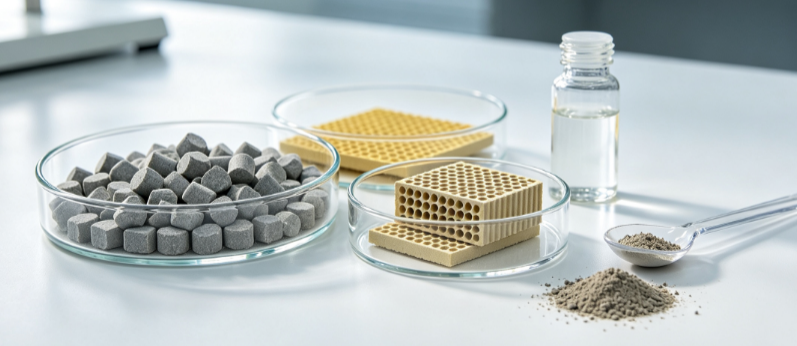
Who Needs Diesel SCR Catalyst Testing and What Are the Critical Challenges?
Our clients include global automotive catalyst suppliers developing next‑generation SCR formulations, diesel engine manufacturers integrating SCR systems, fleet operators diagnosing performance degradation, and regulatory testing bodies requiring independent verification. Common challenges include: insufficient NOx conversion at low temperature (especially during cold‑start), rapid deactivation due to thermal ageing or poisoning, unpredictable NH₃ storage dynamics leading to slip, and poor performance after on‑board diagnostic (OBD) regeneration events. Our service addresses these by providing temperature‑programmed reaction profiles, transient response to NH₃ pulses, realistic ageing protocols (hydrothermal, sulfur exposure, and hydrocarbon poisoning), and detailed characterisation of deactivated zones – enabling you to separate formulation weaknesses from operating conditions.
Our Multi‑Tier Testing Framework – From Kinetics to Full‑Scale Simulation
We employ a modular, application‑oriented approach that systematically probes SCR catalyst behaviour from fundamental kinetics to simulated real‑world drive cycles. All tests are performed using dedicated synthetic gas rigs or engine test beds, with full analytics for NO, NO₂, NH₃, N₂O, and other species.
1. Steady‑State Activity and Selectivity Mapping
Using our fully automated micro‑reactor system with mass‑flow controllers and a heated quartz reactor, we measure NOx conversion efficiency, NH₃ conversion, and N₂O formation as functions of temperature (150–600 °C), space velocity (GHSV 10,000–100,000 h⁻¹), and NH₃/NOx ratio (0.8–1.2). We construct light‑off curves and conversion maps under both standard and fast‑SCR conditions (NO₂/NOx = 0.5). We also assess the selectivity window – the temperature range where N₂ selectivity exceeds 95% – to identify optimal operation. All data are fitted to global kinetic models (e.g., Eley‑Rideal, Langmuir‑Hinshelwood) to derive intrinsic rate constants and activation energies.
2. Transient Response and NH₃ Storage Dynamics
SCR performance under real driving depends on the catalyst’s ability to store and release NH₃. We perform step‑change experiments (NH₃ feed on/off) and temperature‑programmed desorption (TPD) of NH₃ to quantify NH₃ storage capacity (mol/m³) and its temperature dependence. We also conduct standard and modified SCR transient tests with alternating NO/NO₂ and NH₃ pulses to measure the storage‑release hysteresis and the response time to lambda changes. These data are essential for calibrating on‑board control strategies to minimise NH₃ slip while maximising conversion.
3. Accelerated Ageing – Hydrothermal, Sulfur, and Poisoning
Durability is the key to commercial viability. We offer customised accelerated ageing protocols that mimic thousands of hours of real operation. Hydrothermal ageing is performed at temperatures up to 850 °C with 10% steam in air, simulating DPF regeneration events. Sulphur ageing involves exposure to SO₂ (up to 500 ppm) under oxidising conditions, followed by desulphation cycles. We also expose catalysts to phosphorus and alkali metals (from engine oil additives) via wet‑impregnation or gas‑phase delivery. After each ageing step, we re‑measure activity, NH₃ storage, and structural properties to quantify deactivation kinetics and to identify the dominant degradation mechanism.
4. Full‑scale Engine Test Bed and Cycle Simulation
For final validation, we offer engine test bed services with a modern diesel engine (up to 500 kW) equipped with SCR aftertreatment. We run legislated transient cycles (WHTC, WHSC, NRTC, and custom cycles) with continuous emissions monitoring (FTIR, CLD, NDIR) for NOx, NH₃, N₂O, and CO₂. We measure cumulative NOx conversion over the cycle and NH₃ slip peaks, providing a direct assessment of compliance. We also evaluate the impact of urea injection strategies and mixing performance.
5. Spatially Resolved and Post‑Test Forensics
Understanding degradation patterns within the monolith is critical. After testing, we perform spatially resolved activity measurements by cutting the substrate into axial segments and testing each segment individually. We use SEM‑EDS, XPS, and XRD to map elemental distribution (vanadium, zeolite, poisoning elements) and phase changes. BET and mercury porosimetry quantify pore blockage, while NH₃‑TPD on segments reveals loss of acid sites. This forensic approach pinpoints whether deactivation is uniform or front‑end dominated, guiding improvements in formulation or zoning.
6. Kinetic Modelling and Simulation Support
We develop mechanistic and empirical kinetic models calibrated with our experimental data. Using our in‑house 1D+1D reactor model, we simulate full‑scale catalysts under transient conditions, predicting conversion, slip, and temperature profiles. This service helps you optimise catalyst volume, cell density, and washcoat loading before expensive prototype testing.
7. Analysis of Reaction By‑Products and Emissions
We quantify N₂O (a potent greenhouse gas) formation under various conditions, as well as NH₃ oxidation products (NO, N₂). We also screen for SO₂ oxidation to SO₃, which can lead to downstream corrosion or particulate formation. All emissions are measured using FTIR and chemiluminescence with real‑time logging.
Our Distinctive Advantages – Why Choose Us for SCR Testing?
Our laboratory is among the few fully‑equipped facilities that combine synthetic gas bench testing (up to 10 gas lines, humidification, and rapid switching) with engine dynamometer and transient test capability, enabling seamless scaling from catalyst powder to full‑size substrates. We operate a high‑precision ageing oven with programmable temperature‑steam‑gas profiles, allowing realistic, reproducible ageing that correlates with field data.
Our team comprises catalysis scientists, chemical engineers, and engine calibration experts with over 20 years of collective experience in SCR technology. We do not simply provide raw data; we deliver diagnostic conclusions – for example, distinguishing hydrothermal dealumination from sulfur poisoning, or identifying a sub‑optimal washcoat distribution. We also offer benchmarking against commercial reference catalysts (e.g., baseline Cu‑zeolite or V₂O₅‑WO₃/TiO₂) under identical conditions, giving you a clear competitive position.
All testing follows ISO 17025 principles and is aligned with relevant regulatory cycles (Euro VI, EPA, China VI). Our reports include full measurement uncertainty and statistical significance, enabling confident decision‑making. We also provide confidentiality agreements to protect your intellectual property.
Deliverables – A Complete SCR Catalyst Performance Report
Your final report will be a comprehensive dossier, including:
Section 1 – Baseline activity: NOx conversion vs. temperature, NH₃/NOx ratio effects, and N₂O selectivity – with comparison to specified targets.
Section 2 – NH₃ storage characteristics: Storage capacity, desorption profiles, and transient response times.
Section 3 – Ageing study: Activity retention after hydrothermal, sulfur, and poison exposure, with deactivation rate constants and mechanistic interpretation.
Section 4 – Cycle performance: Cumulative conversion and NH₃ slip on WHTC, WHSC, or your custom cycle, with real‑time emissions traces.
Section 5 – Forensics: SEM‑EDS, XPS, XRD, BET, and segment‑wise activity data, identifying degradation patterns.
Section 6 – Kinetic model: Rate expressions and parameters, with validation against experimental data.
Section 7 – Recommendations: Optimised operating window, ageing mitigation strategies, and design suggestions for improved durability.
All raw data – chromatograms, FTIR spectra, engine logs – are provided in standard formats (CSV, MAT, etc.).
Industries and Applications We Support
Our service serves heavy‑duty diesel OEMs, aftertreatment system suppliers, mining and construction equipment manufacturers, marine diesel operators, and stationary power generation. We also support regulatory compliance for type‑approval and in‑service conformity testing.
How to Initiate Your SCR Catalyst Testing Project
We follow a straightforward workflow:
1. Consultation: We discuss your catalyst formulation, target application, operating conditions, and critical performance targets.
2. Test plan: We design a custom matrix of tests and ageing protocols, with clear pricing and timeline – typically 4–8 weeks for a comprehensive programme.
3. Sample submission: We provide instructions for sample dimensions (cores, full‑size monoliths, or powder) and shipping.
4. Testing and interim reporting: We conduct the tests and share progress at key milestones, allowing you to adapt if needed.
5. Final report and technical review: We deliver the report and schedule a meeting to discuss findings, answer questions, and plan next steps.
We handle all logistics, including engine test cell scheduling and safety protocols. Confidentiality is assured under a standard NDA.
Conclusion – Achieve Superior Diesel SCR Performance with Rigorous, Integrated Testing
Diesel SCR catalyst development and validation require more than simple conversion measurements – they demand a deep understanding of transient behaviour, ageing mechanisms, and system integration. Our diesel SCR DeNOx catalyst testing service provides the scientific rigor, engineering relevance, and expert interpretation needed to optimise your catalyst, demonstrate regulatory compliance, and ensure long‑term reliability. With advanced test platforms, experienced professionals, and a commitment to actionable insights, we are your trusted partner for emissions control innovation.
Contact our SCR catalyst testing experts today to discuss your project and receive a tailored proposal. Let us help you achieve cleaner diesel emissions with confidence.