Reasons for choosing our testing services
ZHONGXI Testing has obtained inspection qualification certifications from multiple countries and regions worldwide. We possess a senior testing team and advanced testing methods, providing independent, impartial, and professional third-party verification services for global carbon projects.

Internationally recognized authority
Certified by multiple international standards such as CNAS, VCS, and GS, with reports universally applicable worldwide.

Global service capability
Covering 140+ countries and regions, it supports on-site detection and remote verification in multiple languages.

Professional experimental methods
Adopt standard experimental methods to ensure accurate and reliable data.
Comprehensive Testing for Diesel Denitrification Activated Carbon – Advanced Performance and Durability Evaluation for Fuel Purification
Nitrogen compounds in diesel fuel, particularly basic nitrogen species such as quinolines, acridines, and anilines, pose significant challenges to fuel stability and environmental compliance. They contribute to deposit formation, colour degradation, and, most critically, act as precursors to NOx emissions during combustion. Activated carbon adsorbents, owing to their tailored pore architecture and surface chemistry, are increasingly employed for adsorptive denitrification – a non‑hydrogenative method that removes these nitrogenous species without altering the fuel’s hydrocarbon skeleton. However, the efficacy of activated carbon for this application hinges on a delicate balance of micro‑ vs. meso‑porosity, surface oxygen functionality (carboxylic, phenolic, lactonic groups), and the presence of basic or acidic sites that dictate selectivity. Routine quality indicators such as iodine number or methylene blue adsorption are insufficient to predict denitrification performance in real diesel matrices, where competitive adsorption from aromatics and sulfur compounds prevails. Our diesel denitrification activated carbon testing service provides a comprehensive, multi‑dimensional assessment that combines detailed physico‑chemical characterisation, static and dynamic adsorption evaluations, selectivity profiling, and accelerated regeneration studies – all performed under realistic fuel compositions and operating conditions. We deliver the critical data needed to select, qualify, and optimise activated carbon adsorbents for robust diesel denitrification.
Who Needs Denitrification Activated Carbon Testing and What Are the Critical Challenges?
Our clients include refinery process engineers integrating adsorptive polishing steps, activated carbon manufacturers developing new formulations, fuel additive and filter producers seeking to incorporate adsorbents into aftermarket devices, and environmental compliance laboratories verifying performance. Key challenges often encountered are: insufficient removal of refractory basic nitrogen species, rapid capacity loss due to fouling by polar aromatics, poor regeneration efficiency leading to high operational costs, and unacceptable pressure drop or fines generation in packed beds. Our service directly addresses these by providing quantified dynamic capacities, selectivity coefficients against sulfur and aromatic compounds, particle attrition indices, and detailed surface chemical evolution after multiple adsorption‑desorption cycles.
Our Advanced Testing Framework – From Surface Chemistry to Fuel‑Bed Simulation
We adopt a systematic, application‑oriented approach that evaluates denitrification activated carbon across four interconnected domains: intrinsic material properties, equilibrium binding performance, dynamic column behaviour, and long‑term durability.
1. Comprehensive Physico‑Chemical Characterisation
We begin with a rigorous characterisation of the activated carbon’s textural and chemical properties. Nitrogen physisorption (BET and BJH/NLDFT) provides specific surface area, total pore volume, and a detailed micropore/mesopore size distribution, revealing the accessibility of pores to bulky nitrogen‑containing molecules (e.g., quinoline, carbazole). Surface chemistry is probed by X‑ray photoelectron spectroscopy (XPS) for elemental and functional group analysis (C‑O, C=O, O‑C=O), and by Boehm titration to quantify acidic and basic surface oxide groups. Temperature‑programmed desorption (TPD) coupled with mass spectrometry identifies the types of surface oxygen species and their thermal stability. Additionally, scanning electron microscopy (SEM‑EDS) assesses particle morphology and any inorganic ash content that may affect activity.
2. Equilibrium Adsorption Isotherms and Thermodynamic Studies
Using a temperature‑controlled batch equilibration system, we measure adsorption isotherms for representative nitrogen‑containing compounds (e.g., quinoline, indole, acridine) dissolved in a standardised diesel surrogate (e.g., n‑hexadecane with varying aromatic content). Tests are performed at multiple temperatures (20–80 °C) and concentrations (5–500 ppm N) to derive maximum adsorption capacity (qmax), Langmuir/Freundlich parameters, and thermodynamic constants (ΔG, ΔH, ΔS). We also evaluate the adsorption of total basic nitrogen using potentiometric titration (ASTM D2896) before and after treatment, providing a direct measure of the denitrification efficiency in real fuel blends.
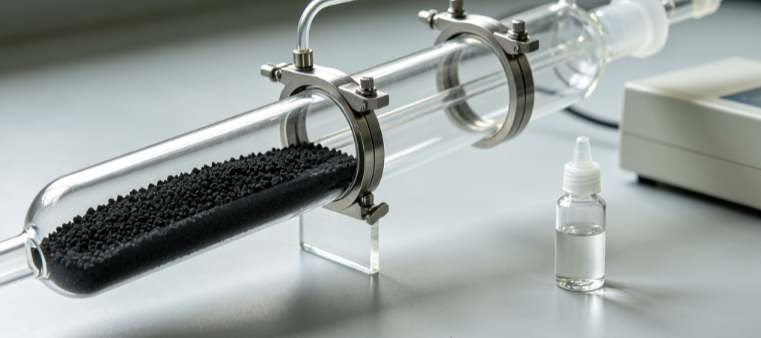
3. Dynamic Breakthrough and Fixed‑Bed Performance
Static equilibrium tests do not predict column performance. Our programmable fixed‑bed rig allows breakthrough experiments under realistic flow rates (0.5–10 BV/h) and bed heights. The feed diesel (or surrogate) is spiked with nitrogen compounds and pumped through the packed carbon bed, with on‑line UV‑vis and total nitrogen (TN) detection for real‑time breakthrough monitoring. We quantify the breakthrough capacity (C10%), exhaustion capacity (C90%), and the length of mass‑transfer zone (MTZ). Crucially, we perform competitive breakthrough experiments with added sulfur compounds (thiophene, dibenzothiophene) and aromatics (toluene, naphthalene) to determine the selectivity factor for nitrogen species over interferents, which is vital for real‑world diesel applications.
4. Surface Chemical Stability and Regeneration Assessment
Regenerability is key for economic viability. We perform thermal regeneration (inert and oxidative atmospheres, 200–500 °C) and solvent washing (toluene, ethanol, or caustic solutions) on spent carbons, followed by re‑measurement of BET, surface chemistry (XPS/TPD), and adsorption capacity over multiple cycles. We monitor the loss of surface oxygen groups and the accumulation of irreversibly adsorbed species using FT‑IR and Thermogravimetric Analysis (TGA). Our reports include a recommended regeneration protocol that balances recovery efficiency with minimal structural degradation, along with a projected lifetime cost analysis.
5. Mechanical Integrity and Particle Attrition
Attrition and fines generation can cause operational issues, including pressure drop increase and downstream contamination. We measure particle friability using a rotating drum attrition tester (ASTM D4058) and quantify the fines fraction (< 40 mesh) after vibration and flow‑induced shear. We also determine bulk crush strength to ensure the carbon withstands bed compaction during cycling. These mechanical data are essential for designing robust commercial adsorbers.
6. Advanced Speciation of Adsorbed Nitrogen Species
To understand the adsorption mechanism and identify which nitrogen compounds are selectively removed, we perform GC‑xGC‑MS (comprehensive two‑dimensional gas chromatography) on the fuel before and after treatment, and we extract the adsorbed species from the spent carbon using a pressurized solvent extraction system. This detailed speciation reveals whether the carbon preferentially removes basic N‑heterocycles versus neutral species, guiding modifications to the carbon’s surface acidity.
7. Compatibility with Diesel Additives and Base Fuel Stability
We evaluate the impact of the activated carbon on key diesel quality parameters, including oxidation stability (Rancimat method EN 15751), colour stability, and the retention of antioxidant additives. We also test for metal leaching (ICP‑MS) from the carbon into the treated fuel, ensuring that the adsorbent does not introduce new contaminants.
Our Distinctive Advantages – Why Choose Us for Activated Carbon Denitrification Testing?
Our laboratory is uniquely equipped with an integrated analytical platform that combines advanced surface characterisation (XPS, TPD, and high‑resolution porosimetry) with specialised fuel‑handling rigs that operate under oxygen‑free atmospheres to prevent auto‑oxidation of diesel samples. We have developed proprietary sampling protocols that preserve the delicate equilibrium between nitrogen species and the adsorbent, ensuring that our laboratory results accurately reflect field performance.
Our team is composed of surface chemists and fuel technologists with deep expertise in carbon‑based adsorbents and hydrocarbon matrices. We do not merely deliver numeric results; we provide mechanistic interpretation – for instance, linking a loss in denitrification capacity to the depletion of specific basic oxygen functional groups (as seen by XPS), or advising on pore‑size optimisation to exclude bulky sterically‑hindered nitrogen compounds. We also offer comparative benchmarking against commercial reference carbons, enabling you to position your product effectively.
All testing adheres to ISO 17025 quality standards and relevant ASTM and CEN fuel testing methods. Our reports include full measurement uncertainty and statistical analysis, supporting both internal R&D and regulatory submissions.
Deliverables – A Complete Denitrification Performance Dossier
Your final report will include:
Section 1 – Material properties: BET surface area, pore size distribution, XPS surface functional group quantification, Boehm titration results, and ash content.
Section 2 – Equilibrium data: Isotherm plots, Langmuir/Freundlich parameters, thermodynamic constants, and predicted maximum capacity.
Section 3 – Column dynamics: Breakthrough curves for pure and competitive feeds, calculated capacities, MTZ lengths, and selectivity coefficients against sulfur/aromatics.
Section 4 – Regeneration studies: Capacity retention after multiple cycles, recommended regeneration conditions, and TGA/DSC profiles showing deposit decomposition.
Section 5 – Mechanical integrity: Attrition index, crush strength, and fines generation data.
Section 6 – Fuel compatibility: Effect on oxidation stability, additive retention, and metal leaching analysis.
Section 7 – Executive summary and recommendations: Overall performance rating, optimal operating parameters, and guidance for process scale‑up.
All raw data (chromatograms, spectra, breakthrough logs) are provided in digital format.
Industries and Applications We Support
Our testing serves oil refineries implementing polishing beds for ultra‑low‑sulphur diesel, activated carbon producers validating new products, automotive and marine fuel system manufacturers, and environmental research institutions investigating sustainable fuel purification.
How to Engage Our Denitrification Activated Carbon Testing Service
Engaging our service is straightforward:
1. Consultation: We discuss your carbon type, fuel composition, target nitrogen concentration, and specific performance goals.
2. Custom proposal: We design a test matrix with modular options and provide a fixed price and timeline – typically 3–4 weeks for a comprehensive suite.
3. Sample submission: We provide detailed instructions for shipping activated carbon (sealed, desiccated) and fuel samples (amber glass, inert headspace).
4. Analysis and review: We conduct the tests, sharing interim data for feedback, and deliver the final comprehensive report.
5. Technical debrief: We schedule a virtual meeting to interpret findings, answer queries, and advise on subsequent optimisation steps.
Confidentiality is guaranteed under a standard NDA, and we are flexible in adapting our reporting for internal quality systems or regulatory filings.
Conclusion – Unlock the Full Denitrification Potential of Your Activated Carbon with Expert, In‑Depth Evaluation
Effective diesel denitrification demands an activated carbon that is not merely high‑surface‑area, but precisely tailored in pore size, surface chemistry, and mechanical robustness to withstand competitive adsorption and repeated regeneration. Our diesel denitrification activated carbon testing service provides the scientific rigour, engineering relevance, and interpretive expertise needed to move beyond basic quality checks and achieve reliable, cost‑effective nitrogen removal. With advanced instrumentation, fuel‑specific protocols, and a team of dedicated specialists, we equip you with the data and confidence to optimise your product or process.
Contact our activated carbon testing specialists today to discuss your project and receive a customised proposal. Let us help you deliver cleaner diesel with proven adsorbent performance.