Reasons for choosing our testing services
ZHONGXI Testing has obtained inspection qualification certifications from multiple countries and regions worldwide. We possess a senior testing team and advanced testing methods, providing independent, impartial, and professional third-party verification services for global carbon projects.

Internationally recognized authority
Certified by multiple international standards such as CNAS, VCS, and GS, with reports universally applicable worldwide.

Global service capability
Covering 140+ countries and regions, it supports on-site detection and remote verification in multiple languages.

Professional experimental methods
Adopt standard experimental methods to ensure accurate and reliable data.
Comprehensive In‑Vehicle Air Purifier Testing – Advanced Performance, Safety, and Real‑World Efficacy Evaluation
In‑vehicle air purifiers, employing technologies such as HEPA filtration, activated carbon adsorption, photocatalytic oxidation (PCO), plasma generation, or electrostatic precipitation, are increasingly deployed to mitigate cabin air pollution – including particulate matter (PM2.5, PM10), volatile organic compounds (VOCs), nitrogen dioxide, and airborne microorganisms. However, the actual performance of these devices under dynamic driving conditions is often poorly predicted by standard bench‑scale tests that ignore temperature fluctuations, humidity, ventilation rates, and the complex mixture of real‑cabin contaminants. Customers seeking vehicle air purifier testing typically need to validate product efficacy claims, comply with emerging automotive health standards, optimise filter media selection, or differentiate their product in a competitive market. Our in‑vehicle air purifier testing service delivers a comprehensive, multi‑parameter evaluation that combines controlled chamber tests, real‑vehicle cabin simulations, and advanced aerosol and gas‑phase analytical methods. We provide quantitative metrics on clean air delivery rate (CADR), single‑pass removal efficiency, VOC abatement kinetics, ozone and by‑product emissions, and long‑term filter loading performance – all under conditions that replicate actual use, including recirculation vs. fresh‑air modes, varying fan speeds, and thermal stress. Our testing bridges the gap between laboratory claims and on‑road reality, equipping you with robust data for marketing, regulatory submission, and continuous product improvement.
Who Needs In‑Vehicle Air Purifier Testing and What Are the Critical Challenges?
Our clients include automotive OEMs and Tier‑1 suppliers integrating purifiers into HVAC systems, aftermarket device manufacturers developing plug‑in units, filter media producers evaluating novel materials, and regulatory and certification bodies requiring independent verification. Common challenges include: poor correlation between filter efficiency and actual cabin clean‑up, generation of harmful by‑products (e.g., ozone, formaldehyde, or secondary organic aerosols), rapid performance degradation under dusty conditions, and lack of standardised test protocols that reflect real driving profiles (door openings, A/C cycling, passenger breathing). Our service addresses these by providing dynamic test sequences that simulate urban, highway, and idling conditions, coupled with high‑time‑resolution monitoring of particle counters, gas analyzers, and microbial samplers.
Our Multi‑Tier Testing Framework – From Material Characterisation to Full Cabin Simulation
We adopt a modular, three‑stage approach that progressively increases in realism: (1) material/component level, (2) controlled environmental chamber with vehicle cabin mock‑up, and (3) actual vehicle on‑road or on‑chassis dynamometer testing. This ensures that we can diagnose root‑cause performance issues and provide actionable recommendations.
1. Filter Media and Component Characterisation
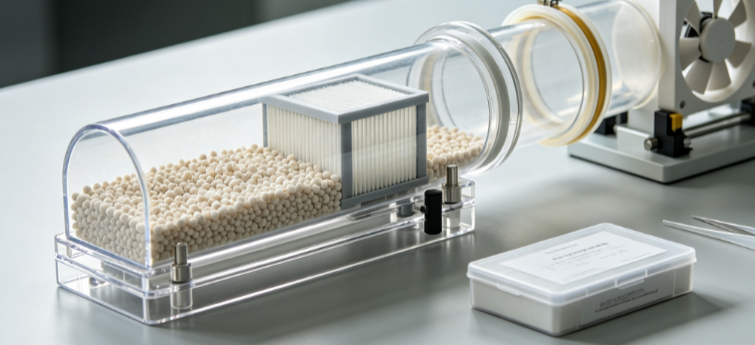
We begin with a thorough assessment of the individual filter materials or purification modules. For particulate filters, we measure filtration efficiency and pressure drop for particle sizes ranging from 0.3 to 10 µm (using monodisperse and polydisperse aerosol challenge) per ISO 11155‑1 and SAE J1669. We also determine the dust holding capacity (DHC) and the loading profile using synthetic road dust (ISO 12103‑1). For activated carbon and chemisorbent layers, we measure static adsorption capacities for key VOCs (toluene, formaldehyde, acetaldehyde) and breakthrough curves under realistic gas concentrations (0.1–10 ppm). For PCO or plasma units, we assess UV irradiance, catalyst activity, and ozone generation (using electrochemical and UV‑photometric detectors). Our GC‑MS and HPLC systems identify and quantify any reaction by‑products (e.g., formic acid, acrolein) that may be emitted.
2. Controlled Cabin Simulation Chamber Testing
We use a temperature‑ and humidity‑controlled test chamber (volume: 3–5 m³) equipped with a representative cabin mock‑up including seats, dashboard, and ventilation ducts. We inject standardised contaminants: particulate (NaCl or KCl aerosol) and gas‑phase (VOCs) to simulate urban pollution. The air purifier is operated at multiple fan speeds and air‑intake modes (recirculation vs. outside air). We monitor the decay of particle number and mass concentrations using optical particle counters (0.3–10 µm) and condensation particle counters (for sub‑0.1 µm). For VOCs, we perform real‑time PTR‑MS or FTIR to capture removal kinetics. From these data, we calculate CADR (m³/h) for particles and VOCs, removal efficiency at steady‑state, and clean‑up time to achieve 90% reduction. We also assess the effect of temperature (‑10 to 40 °C) and relative humidity (20‑90%) on performance, which is critical for real‑world automotive operation.
3. Real‑Vehicle On‑Road and Dynamometer Testing
For the most realistic evaluation, we offer on‑road testing using a dedicated test vehicle equipped with an array of portable analytical instruments: aerosol spectrometers for real‑time particle size distribution, photoacoustic gas analysers for NO₂ and O₃, and proton‑transfer‑reaction (PTR‑TOF‑MS) for rapid VOC tracking. We conduct standardised drive cycles (e.g., WLTP, urban/highway) with the purifier in both recirculation and fresh‑air modes. We also carry out door‑opening events to simulate passenger entry, measuring the recovery time of the interior air quality. In addition, we assess acoustic emissions (noise level) and energy consumption (current draw) to evaluate user acceptance and vehicle range impact for EVs.
4. Long‑Term Durability and Filter Ageing
To understand performance over the purifier’s lifetime, we perform accelerated filter loading tests using continuous dust injection and gas‑phase contaminants for periods equivalent to 6 months to 2 years of average driving. We periodically measure the remaining CADR, pressure drop increase, and capacity for gas removal. We also analyse the spent filter media via SEM‑EDS and FTIR to identify captured species and any chemical degradation of the adsorbent or catalyst. This data enables you to recommend realistic filter replacement intervals and demonstrate product reliability.
5. Safety and By‑Product Assessment
Beyond cleaning performance, we rigorously screen for ozone emissions from electrostatic or plasma devices (per UL 867) and for secondary organic aerosol (SOA) formation from PCO or ozonolysis reactions. We measure formaldehyde, acrolein, and ultrafine particles (sub‑0.1 µm) as potential by‑products, using DNPH‑HPLC and SMPS (scanning mobility particle sizer). We also evaluate microbial removal efficiency (bacteria and fungi) using aerosolised bio‑indicators (e.g., Bacillus subtilis spores) and subsequent agar plate counting. Our safety reports include compliance with IATF 16949 and relevant ECE regulations.
6. Consumer‑Relevant Performance Metrics
We translate technical data into consumer‑friendly metrics: clean air delivery rate per watt (efficiency), noise‑adjusted CADR, and reduction time for key pollutants (PM2.5, formaldehyde, toluene). We also provide comparative benchmarking against leading market devices, enabling you to position your product and develop targeted marketing claims.
Our Distinctive Advantages – Why Choose Us for Vehicle Air Purifier Testing?
Our laboratory is one of the few facilities globally that combines ISO 17025‑accredited filter testing with full‑scale vehicle cabin environmental simulation and real‑road portable monitoring. We operate a temperature‑programmable chamber with automated aerosol generation and gas‑mixing systems, and we have developed proprietary data acquisition software that synchronises particle, gas, and airflow measurements to provide high‑precision CADR values. Our team includes aerosol scientists, HVAC engineers, and automotive ventilation specialists with over 15 years of combined experience in cabin air quality assessment.
We distinguish ourselves by our ability to diagnose root causes of performance failures – for example, differentiating between media saturation, catalyst poisoning, or airflow bypass – and to recommend targeted improvements. We also provide modelling support using CFD and lumped‑parameter cabin models to extrapolate test results to different vehicle sizes and ventilation strategies. All tests follow internationally recognised protocols, including ISO 11155‑2, SAE J2762, and GB/T 18801 adapted for vehicles.
Our reports include full measurement uncertainty budgets and statistical analysis, and we offer confidentiality agreements to protect your intellectual property. We provide rapid turnaround – typically 2–4 weeks for a full characterisation programme.
Deliverables – A Complete In‑Vehicle Air Purifier Performance Report
Your final report will include:
Section 1 – Material/component characterisation: Particle filtration efficiency, pressure drop, dust holding capacity, VOC breakthrough curves, and ozone generation.
Section 2 – Chamber test results: CADR for particles and VOCs, removal efficiency, clean‑up time, and temperature/humidity effects.
Section 3 – Real‑vehicle testing: On‑road and dynamometer performance, including drive‑cycle profiles, door‑opening recovery, and energy consumption.
Section 4 – Durability assessment: Degradation of CADR and pressure drop over accelerated ageing, with filter examination (SEM/FTIR).
Section 5 – Safety and by‑product analysis: Ozone, formaldehyde, SOA, and microbial removal efficiency, with compliance statements.
Section 6 – Benchmarking: Comparison with competitor devices, highlighting strengths and improvement areas.
Section 7 – Summary and recommendations: Overall performance rating, suggested filter replacement intervals, and optimisation tips for product development.
All raw data – particle counts, gas concentrations, thermocouple logs – are provided in open‑format files for further analysis.
Industries and Applications We Support
Our testing is essential for automotive OEMs (passenger cars, buses, trucks), aftermarket purifier brands, filter media suppliers, HVAC system integrators, and regulatory agencies developing cabin air quality standards. We also serve fleet operators and ride‑sharing companies interested in health‑related differentiation.
How to Initiate Your In‑Vehicle Air Purifier Testing Project
Our engagement process is straightforward:
1. Consultation: We discuss your purifier technology, target vehicle(s), performance goals (e.g., achieving a certain CADR or meeting a specific standard), and any known challenges (e.g., noise, ozone, filter lifetime).
2. Custom proposal: We design a test matrix with selected modules (material, chamber, vehicle) and provide a fixed price and timeline – typically 3–5 weeks for a comprehensive programme.
3. Sample submission: We provide instructions for shipping devices (complete purifier units or filter media) and technical specifications (airflow rates, voltage, dimensions).
4. Testing and interim reporting: We conduct the tests and share preliminary data at agreed milestones, allowing iterative feedback.
5. Final report and technical review: We deliver the complete dossier and schedule a virtual meeting to interpret findings, answer questions, and recommend next steps for product refinement or marketing claims.
Confidentiality is guaranteed under a standard NDA, and we can customise reporting for specific regulatory submissions (e.g., for CARB, EPA, or EU eco‑design).
Conclusion – Elevate Your Vehicle Air Purifier with Rigorous, Real‑World Performance Evidence
In‑vehicle air purifiers are no longer a luxury but a health necessity, yet their performance in the dynamic cabin environment is complex and often misrepresented by oversimplified tests. Our in‑vehicle air purifier testing service provides the scientific depth, engineering relevance, and transparency needed to substantiate your claims, optimise your product, and gain consumer trust. With state‑of‑the‑art facilities, automotive‑specific protocols, and expert interpretation, we empower you to deliver cleaner, safer cabin air.
Contact our vehicle air quality testing experts today to discuss your project and receive a tailored proposal. Let us help you drive the future of healthy mobility.