Reasons for choosing our testing services
ZHONGXI Testing has obtained inspection qualification certifications from multiple countries and regions worldwide. We possess a senior testing team and advanced testing methods, providing independent, impartial, and professional third-party verification services for global carbon projects.

Internationally recognized authority
Certified by multiple international standards such as CNAS, VCS, and GS, with reports universally applicable worldwide.

Global service capability
Covering 140+ countries and regions, it supports on-site detection and remote verification in multiple languages.

Professional experimental methods
Adopt standard experimental methods to ensure accurate and reliable data.
Comprehensive Quality Assessment of Potassium Sulfate Granules: Advanced Testing Services
Potassium sulfate (K₂SO₄) granules are a premium fertiliser and industrial chemical, valued for their high nutrient content, low chloride index, and essential sulfur supply. Their physical and chemical integrity directly influences downstream performance—whether in bulk blending, direct field application, or production of specialty compounds. However, variability in granulation processes, raw material sources, and storage conditions can lead to inconsistent particle size, suboptimal crushing strength, excessive dust, or contamination with heavy metals and chloride. These parameters are not merely quality indicators; they affect flowability, caking tendency, dissolution rate, and ultimately crop yield or process efficiency. Our laboratory offers a fully integrated, multi‑parameter testing programme for potassium sulfate granules, designed to meet both international fertiliser standards (e.g., ISO 8157, EN 14888) and specific customer specifications. We deliver quantitative, reproducible, and interpretable data that empowers producers, traders, and regulatory bodies to ensure consistent product quality and regulatory compliance.
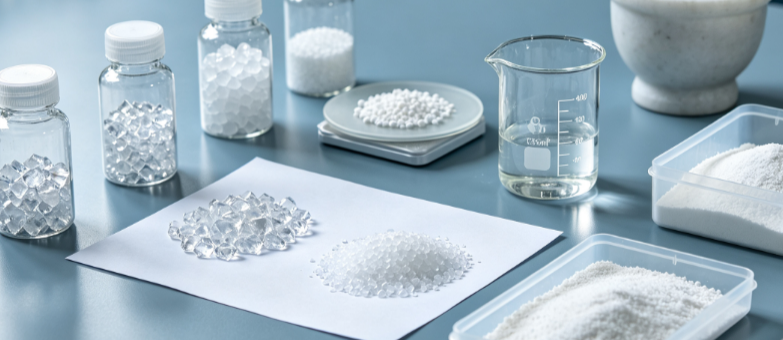
Why Rigorous Testing of Potassium Sulfate Granules Is Critical for Agricultural and Industrial Applications
Clients seeking potassium sulfate granule testing typically encounter one or more of the following challenges: variation in granule size distribution affecting blending uniformity, poor mechanical strength leading to excessive fines during transport, high moisture content causing caking in storage, or unexpected chloride levels that can damage salt‑sensitive crops. Additionally, trace elements such as arsenic, cadmium, lead, and mercury are subject to strict regulatory limits in many jurisdictions (e.g., EU Fertilising Products Regulation, US AAPFCO). Without comprehensive testing, these hidden factors can result in rejected shipments, reduced shelf life, and compromised agricultural outcomes. Our service provides a systematic characterisation that identifies deviations from specification, pinpoints root causes (e.g., granulator settings, drying conditions), and offers actionable recommendations for process optimisation. By detecting issues early, we help our clients avoid costly recalls, maintain brand reputation, and meet sustainability goals.
Our Analytical Capabilities: From Basic Parameters to Advanced Characterization
Our testing regime for potassium sulfate granules is organised into three complementary modules, each addressing a critical aspect of product quality:
Physical and mechanical profiling—We determine particle size distribution using both automated sieve analysis (vibratory and air‑jet sieving) and laser diffraction (wet and dry dispersion), covering ranges from 0.1 µm to several millimetres with high resolution. Mean particle diameter (D₅₀), uniformity coefficient, and fines content are reported with statistical confidence intervals. For mechanical robustness, we perform single‑granule crushing strength using a precision load cell (0.1 N resolution) and bulk crush strength on a bed of granules, following ISO 8398 or equivalent. Abrasion resistance is quantified using a rotating drum method (similar to ASTM D4058) to simulate handling wear, while angle of repose and bulk density (loose and tapped) are measured to predict flow and storage behaviour.
Chemical composition and purity analysis—We employ inductively coupled plasma optical emission spectrometry (ICP‑OES) and ICP‑mass spectrometry (ICP‑MS) for major, minor, and trace elemental quantification. Potassium (as K₂O) and sulfur (as SO₃) are determined with accuracy better than ±0.5 % relative, using matrix‑matched calibration and internal standardisation. Chloride content is measured by potentiometric titration and ion chromatography (IC), with a detection limit of 10 ppm. Moisture is determined by loss on drying (LOD) at 105 °C and also by Karl Fischer titration for low‑level water content. pH of a 1:5 suspension is measured in accordance with ISO 6598. Heavy metals (As, Cd, Pb, Hg, Cr, Ni) are analysed by ICP‑MS with sub‑ppb detection limits, meeting the most stringent regulatory requirements.
Advanced structural and morphological assessment—For deeper insight, we offer X‑ray diffraction (XRD) to confirm the crystalline phase (orthorhombic K₂SO₄) and detect any polymorphic or amorphous contaminants. Scanning electron microscopy (SEM) with energy‑dispersive X‑ray spectroscopy (EDS) provides high‑resolution images of granule surface morphology, porosity, and elemental distribution, revealing coating uniformity, crystal habits, or the presence of foreign particles. We also perform Thermogravimetric Analysis (TGA) coupled with evolved gas analysis (EGA) to detect organic additives, water of hydration, or decomposition behaviour up to 1000 °C—particularly useful for verifying anti‑caking agents or coating materials.
High‑Level Physical and Mechanical Testing
Recognising that granule performance is often governed by mechanical properties, we go beyond standard crush tests to include impact resistance using a custom drop‑weight tester, and friability by the Roche method adapted for granular solids. Our dynamic flowability measurement uses a powder rheometer to quantify shear stress, compressibility, and aeration behaviour, providing a comprehensive fingerprint for handling and metering. For caking tendency, we subject granules to controlled temperature‑humidity cycling and measure the force required to break the cake—a simulation that directly correlates with storage stability. These advanced tests are rarely available from routine service labs, yet they deliver critical data for quality assurance and process troubleshooting.
Chemical Purity and Trace Element Profiling
Our chemical analysis is performed using fully validated methods with rigorous quality control: each batch includes certified reference materials (CRMs), spike recoveries, and duplicate runs to ensure accuracy and precision. For chloride, we employ both turbidimetric and ion‑selective electrode methods as cross‑checks. We also quantify water‑insoluble residue to assess the purity of the starting material and the efficiency of the granulation process. Where required, we offer speciation analysis for elements like arsenic (As³⁺ vs As⁵⁺) using HPLC‑ICP‑MS, adding an extra layer of safety evaluation for end‑use applications.
Regulatory Compliance and Method Validation
All test methods are aligned with ISO 8157 (Fertilizers – Sampling), ISO 6598 (Determination of pH), ISO 5310 (Determination of potassium content), and AOAC official methods. Our laboratory maintains ISO/IEC 17025:2017 accreditation for a wide scope of fertiliser tests, and we regularly participate in proficiency testing schemes (e.g., WEPAL, Fertilizer Institute). We provide full method validation reports upon request, including linearity, limits of detection/quantification, repeatability, reproducibility, and measurement uncertainty. This documentation supports regulatory submissions, customer audits, and product registration in global markets.
Our Competitive Advantages in Potassium Sulfate Granule Testing
Decades of fertiliser material expertise: Our team comprises analytical chemists and materials engineers with specific experience in potash and sulfate‑based products. We understand the effect of granulation parameters (roller pressure, binder addition, drying temperature) on final properties, enabling us to correlate test results with production variables and offer practical process advice—not just a data sheet.
One‑stop integrated service: We handle all physical, chemical, and advanced characterisation under one roof, eliminating the need to split samples and coordinate multiple vendors. This ensures consistent sample preparation, rapid turnaround (typically 5‑7 working days), and a single, harmonised report that cross‑references all measured parameters. Our proprietary Quality Index Score aggregates key metrics into a single performance rating, simplifying comparison between batches or suppliers.
Flexible sample throughput: Whether you need a single batch release or a high‑frequency production control programme, we adapt our capacity accordingly. We offer discounted pricing for regular submissions and provide online dashboard access to track ongoing results and historical trends.
Interpretive reporting: We do not merely deliver numbers; our reports include graphical summaries (histograms, scatter plots, trend lines) and a compliance summary that clearly highlights any out‑of‑specification parameters. For non‑conforming results, we append hypotheses for root causes and suggested corrective actions, leveraging our deep understanding of granulation technology.
Seamless Workflow from Sample Submission to Actionable Insights
Our process begins with a complimentary consultation to define your specific requirements—whether you need full characterisation, selective screening, or customised test development. We guide you on sampling protocols (representative sampling, particle size segregation) to ensure that the submitted sample accurately reflects your product lot. Upon sample receipt, we log and photograph the material, then distribute it across our instrument suite according to a pre‑agreed test plan. Data acquisition is followed by triple‑layer quality review—instrument operator, project scientist, and a second senior reviewer—before final compilation.
The final report is delivered in secure PDF format, with raw data files (e.g., .csv, .spc, .xrdml) available on request. We also provide a post‑report video conference to walk through the results, answer queries, and discuss any follow‑up actions. For clients requiring rapid decisions, we offer preliminary verbal results within 48 hours for critical parameters, followed by the full certified report.
Partner with Us for Uncompromised Quality Assurance
In the competitive fertiliser market, product consistency and safety are paramount. Our potassium sulfate granule testing service is designed to deliver scientific rigour, operational efficiency, and commercial value. We have supported leading fertiliser producers, global traders, and agricultural co‑operatives in verifying their products against international standards, resolving customer complaints, and optimising granulation processes to reduce waste and increase yield.
We invite you to contact our technical team to discuss your specific testing needs—whether for routine quality control, supplier qualification, or market entry compliance. With our state‑of‑the‑art instrumentation, accredited methodologies, and unwavering commitment to accuracy, we provide the clarity and confidence you need to ensure your potassium sulfate granules meet the highest expectations. Request a detailed quotation or schedule a technical consultation today and take the next step towards superior product quality and regulatory peace of mind.