Reasons for choosing our testing services
ZHONGXI Testing has obtained inspection qualification certifications from multiple countries and regions worldwide. We possess a senior testing team and advanced testing methods, providing independent, impartial, and professional third-party verification services for global carbon projects.

Internationally recognized authority
Certified by multiple international standards such as CNAS, VCS, and GS, with reports universally applicable worldwide.

Global service capability
Covering 140+ countries and regions, it supports on-site detection and remote verification in multiple languages.

Professional experimental methods
Adopt standard experimental methods to ensure accurate and reliable data.
Advanced Analytical Testing of Industrial Beryllium Oxide: Precision, Safety, and Material Performance
Industrial beryllium oxide (BeO) is a high‑performance ceramic material prized for its exceptional thermal conductivity, high electrical resistivity, low dielectric loss, and remarkable mechanical strength at elevated temperatures. These properties make it indispensable in electronics packaging, microwave devices, laser components, nuclear fuel rods, and specialised refractories. However, the inherent toxicity of beryllium compounds imposes stringent safety and quality requirements at every stage—from raw powder synthesis and sintering to final component fabrication. Any variation in phase purity, trace impurities, densification, grain size, or surface chemistry can drastically affect device reliability, thermal management, and worker safety. Our laboratory offers a comprehensive, multi‑technique testing platform for industrial BeO, combining ultra‑trace elemental analysis, precise phase quantification, microstructural characterisation, and thermal‑mechanical property evaluation. We operate under rigorous safety protocols (including HEPA‑filtered gloveboxes and dedicated containment zones) to handle beryllium‑containing samples securely. Our services are designed to meet ASTM C708, ISO 6474, and nuclear‑grade specifications, delivering data that supports process optimisation, quality release, failure analysis, and regulatory compliance for manufacturers and end‑users worldwide.
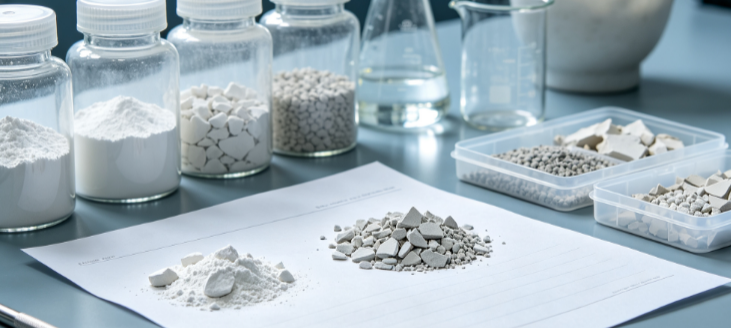
Why Industrial Beryllium Oxide Demands Specialised Testing
Clients seeking BeO testing often face critical challenges: unexpected thermal conductivity drops, dielectric breakdown under high‑voltage, or dimensional instability during thermal cycling. These issues typically trace back to second‑phase inclusions (e.g., Al₂O₃, SiO₂, or unreacted BeO precursors), excessive grain growth during sintering, or contamination from grinding media. Moreover, beryllium oxide is a Class A1 carcinogen; therefore, surface contamination, leachability, and airborne particle release are not only quality concerns but also occupational health imperatives. Our testing programme is built to detect sub‑percent impurities, nanoscale porosity, and residual stress that are invisible to routine inspections. By quantifying these subtle factors, we enable clients to improve sintering protocols, select appropriate dopants, and certify products for aerospace, defence, or medical electronics—applications where failure is not an option.
Analytical Capabilities: From Bulk Composition to Atomic‑Scale Structure
Our BeO testing portfolio is structured into four interconnected modules, each providing a distinct layer of information:
Elemental and isotopic analysis—We employ high‑resolution inductively coupled plasma mass spectrometry (HR‑ICP‑MS) and glow discharge mass spectrometry (GD‑MS) to determine major, minor, and trace elements (including Li, B, Na, Mg, Al, Si, Fe, Ca, Ti, Cr, Mn, Cu, Zn, and U/Th) with detection limits in the sub‑ppb to low‑ppb range. For beryllium itself, we use ICP‑OES and titrimetry to confirm stoichiometric purity (BeO ≥ 99.5 %). Carbon and sulfur are measured by combustion infrared detection, while oxygen/nitrogen are determined by inert‑gas fusion. Our isotope dilution methods, when required, provide absolute quantification for nuclear‑grade accountability.
Phase identification and crystallinity—We perform powder X‑ray diffraction (PXRD) using a high‑brilliance rotating anode (Cu Kα₁) with a hyphenated micro‑diffractometer for small samples. Rietveld refinement quantifies crystalline BeO (wurtzite structure) versus amorphous content, and detects impurity phases down to 0.1 % w/w. For thin films or coatings, we apply grazing‑incidence XRD (GIXRD) and high‑resolution reciprocal space mapping to assess epitaxy and strain.
Microstructural and morphological characterisation—We utilise field‑emission scanning electron microscopy (FE‑SEM) with backscattered electron (BSE) and secondary electron (SE) detectors, coupled with energy‑dispersive X‑ray spectroscopy (EDS) and electron backscatter diffraction (EBSD) to map grain orientation, size distribution, and phase distribution. Transmission electron microscopy (TEM) at 200–300 kV, with selected‑area electron diffraction (SAED) and high‑angle annular dark‑field (HAADF) imaging, reveals grain‑boundary films, dislocations, and nanoprecipitates. For porosity and crack characterisation, we offer X‑ray micro‑computed tomography (µ‑CT) at resolutions down to 1 µm, providing 3D defect visualisation.
Thermal, mechanical, and electrical properties—We measure thermal diffusivity by the laser flash method (25–1000 °C) to derive thermal conductivity with an accuracy of ±3 %. Coefficient of thermal expansion (CTE) is determined via push‑rod dilatometry up to 1200 °C. For mechanical strength, we perform flexural strength (three‑point and four‑point bending) and fracture toughness (indentation or single‑edge notch) per ASTM C1161. Electrical properties include volume and surface resistivity (up to 10¹⁶ Ω·cm) and dielectric constant and loss tangent at frequencies from 1 kHz to 1 MHz.
High‑End Chemical Speciation and Surface Analysis
For applications where surface chemistry governs bonding or coating adhesion, we provide X‑ray photoelectron spectroscopy (XPS) with monochromatic Al Kα, including depth profiling by argon ion sputtering, to quantify surface oxide thickness, carbon contamination, and chemical states of Be, O, and adventitious elements. Time‑of‑flight secondary ion mass spectrometry (ToF‑SIMS) adds molecular specificity for organic residues or binder remnants. We also perform leachability testing (e.g., EPA 1311) to assess potential release of beryllium under simulated environmental or physiological conditions—critical for waste classification and worker safety assessments.
Regulatory Compliance and Safety‑Integrated Workflow
All BeO handling is conducted in isolated negative‑pressure laboratories equipped with continuous air monitoring (particle counters and beryllium‑specific detectors). Operators wear full PPE and follow OSHA, ACGIH, and local regulatory guidelines. Our analytical methods are validated per ISO/IEC 17025:2017 and ASTM E1361 for beryllium analysis. We issue certified reports that include measurement uncertainties, methodological references, and a health‑safety annex summarising any detected surface contamination above action levels. For clients submitting samples from different facilities, we maintain a strict chain‑of‑custody and decontamination procedure to avoid cross‑contamination.
Our Distinctive Advantages in Beryllium Oxide Testing
Unrivalled safety and containment infrastructure: Unlike general‑purpose labs that handle BeO only occasionally, we have designed dedicated workspaces with class‑100 cleanrooms, glovebox‑based sample preparation, and real‑time beryllium monitoring. This allows us to perform even the most sensitive analyses (e.g., TEM, XPS) without risk to personnel or instrument contamination—a capability that many facilities cannot guarantee.
Integrated multi‑technique approach: We correlate elemental, structural, and property data to create a complete material fingerprint. For example, we can directly link a trace increase in aluminium (from ICP‑MS) to the formation of secondary aluminate phases (by XRD) and consequent reduction in thermal conductivity (laser flash). This holistic view provides root‑cause diagnosis rather than isolated numbers.
Fast turnaround and expert interpretation: Our standard package (elemental + XRD + SEM + thermal) is delivered within 8–10 working days. For urgent failure investigations, we offer 72‑hour expedited service with preliminary results within 24 hours. Our reports include annotated micrographs, quantitative phase tables, and concise technical commentary—written by senior materials scientists who have published in the field of beryllium ceramics.
Support for advanced materials development: Beyond routine QC, we collaborate with clients on dopant optimisation, grain‑size control, and thermal ageing studies. We can design customised testing regimes—such as thermal shock cycling combined with in‑situ ultrasonic monitoring—to evaluate reliability under extreme service conditions.
End‑to‑End Service Workflow
Our engagement begins with a confidential technical consultation to define your testing objectives, sample forms (powder, bulk, thin film, or component), and relevant specifications. We advise on sampling, packaging, and shipping in compliance with transport regulations for hazardous materials. Upon arrival, samples are logged, photographed, and prepared under inert atmosphere. Analyses are scheduled in parallel to minimise total time, and each data set undergoes independent peer review before integration. The final report—delivered as a secure PDF—includes all raw data, processed results, and graphical summaries, along with a clear conformity statement against your specified limits. We offer a 30‑day free follow‑up support for any interpretive questions.
Partner with Us for Unmatched Quality and Safety in Beryllium Oxide Testing
Industrial beryllium oxide is a material that demands the highest level of analytical scrutiny—not only to guarantee performance but also to protect human health and the environment. Our testing service is built on decades of experience in refractory and nuclear ceramics, combined with state‑of‑the‑art instrumentation and a relentless focus on data integrity. We have served leading manufacturers of electronic substrates, aerospace components, and nuclear fuels, earning a reputation for accuracy, reliability, and insightful reporting.
We invite you to contact our technical specialists to discuss your specific BeO testing needs—whether for incoming material inspection, process control, failure analysis, or regulatory certification. With our dedicated safety infrastructure, comprehensive analytical arsenal, and expert scientific staff, we are your trusted partner in unlocking the full potential of beryllium oxide while ensuring the highest standards of safety and compliance. Request a detailed proposal or schedule a private consultation today and experience the confidence that comes from truly understanding your advanced ceramic materials.