Reasons for choosing our testing services
ZHONGXI Testing has obtained inspection qualification certifications from multiple countries and regions worldwide. We possess a senior testing team and advanced testing methods, providing independent, impartial, and professional third-party verification services for global carbon projects.

Internationally recognized authority
Certified by multiple international standards such as CNAS, VCS, and GS, with reports universally applicable worldwide.

Global service capability
Covering 140+ countries and regions, it supports on-site detection and remote verification in multiple languages.

Professional experimental methods
Adopt standard experimental methods to ensure accurate and reliable data.
Comprehensive Testing of Desiccants: Advanced Characterisation for Moisture Control Performance and Reliability
Desiccants—including silica gel, molecular sieves, activated alumina, clay minerals (e.g., bentonite), and calcium‑based drying agents—are indispensable in a wide range of industrial and consumer applications, from pharmaceutical packaging and electronic device protection to compressed air drying and gas dehydration. Their primary function is to adsorb or absorb moisture to maintain a critically low relative humidity environment. However, the efficiency and longevity of a desiccant are governed by a complex set of parameters: water vapour adsorption capacity, adsorption kinetics, regeneration behaviour, mechanical integrity, and chemical stability. Variations in production processes, storage conditions, or contamination can lead to reduced drying efficiency, premature saturation, or even the release of particulates and volatile impurities—compromising product quality and equipment safety. Our laboratory provides a fully integrated, multi‑method testing programme for all types of desiccants, combining Thermogravimetric Analysis, breakthrough curve measurements, porosimetry, and surface chemistry evaluation. We deliver quantitative, reproducible, and application‑oriented data that supports material selection, quality assurance, supplier qualification, and failure diagnosis across the pharmaceutical, electronics, automotive, and chemical processing sectors.
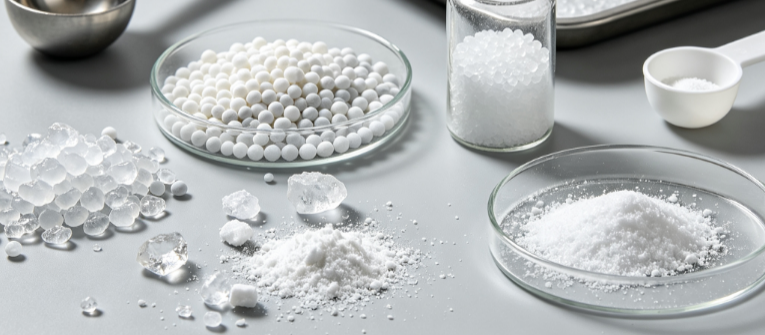
Why Rigorous Desiccant Testing Is Essential for Product Integrity and Process Efficiency
Clients seeking desiccant testing typically face challenges such as unexpected humidity excursions in sealed packages, reduced drying capacity in regenerative systems, or inconsistent performance between batches. These issues often stem from sub‑optimal pore structure, insufficient activation, surface contamination, or binder‑induced blockage. Moreover, in regulated industries like pharmaceuticals (ICH guidelines) and food packaging (FDA/EFSA), desiccants must meet extractable and leachable limits, as well as particulate cleanliness standards. Our service provides a comprehensive diagnostic that not only evaluates baseline performance but also identifies underlying material weaknesses—such as poor thermal stability, irreversible moisture uptake, or susceptibility to oil/acid vapour poisoning. This enables clients to specify the right desiccant for their environment, optimise replacement intervals, and maintain stringent quality control throughout their supply chain.
Our Analytical Capabilities: From Fundamental Properties to Dynamic Performance Modelling
Our testing framework is organised into four complementary modules, ensuring a complete material fingerprint:
Physical and textural characterisation—We determine BET specific surface area and pore size distribution (micropore and mesopore) via low‑temperature nitrogen adsorption (77 K) using advanced density functional theory (DFT) and Barrett–Joyner–Halenda (BJH) models. Skeletal density is measured by helium pycnometry, and particle size distribution by laser diffraction and sieve analysis. Bulk density (loose and tapped) and angle of repose are assessed for handling and packing behaviour. For formed desiccants (e.g., beads, pellets), we measure crush strength and abrasion resistance to ensure mechanical durability during transport and use.
Water vapour adsorption performance—We generate static adsorption isotherms (gravimetric or volumetric) over a wide relative humidity (RH) range (0–95 %) at controlled temperatures (20–60 °C), using both water vapour and organic solvent vapours (if required). Models including Langmuir, Freundlich, BET, and GAB are fitted to extract capacity parameters. Adsorption kinetics are measured by dynamic vapour sorption (DVS) to quantify rates of moisture uptake and diffusivity. For regenerative desiccants, we perform multiple adsorption‑desorption cycles to evaluate working capacity and degradation over repeated use.
Dynamic breakthrough and column performance—Using a custom‑built gas‑ or liquid‑phase test rig, we measure breakthrough curves under fixed flow rates, temperatures, and influent humidity levels. This provides mass transfer zone (MTZ) length, utilisation fraction, and pressure drop data essential for designing packed beds or canisters. We also simulate competitive adsorption with volatile organic compounds (VOCs) or acid gases, which can impair desiccant efficiency in real‑world conditions.
Chemical and thermal stability assessment—We conduct Thermogravimetric Analysis (TGA) coupled with differential scanning calorimetry (DSC) to determine dehydration profiles, phase transitions, and maximum operating temperature. X‑ray diffraction (XRD) identifies crystalline phases and detects contaminant phases. Fourier‑transform infrared spectroscopy (FTIR) and X‑ray photoelectron spectroscopy (XPS) probe surface functional groups and potential surface poisoning. Inductively coupled plasma mass spectrometry (ICP‑MS) quantifies trace metal impurities and leachable elements—critical for food/drug contact applications.
High‑Level Predictive and Diagnostic Capabilities
We go beyond standard characterisation by integrating our measured parameters into computational modelling that predicts desiccant performance under your specific operational conditions. Using finite‑element simulations of heat and mass transfer, we can estimate temperature rise during adsorption (exotherm), regeneration energy requirements, and lifetime under cyclic use. For quality troubleshooting, we perform root‑cause analysis by correlating performance loss with specific microstructural or chemical changes—e.g., pore collapse from sintering, salt poisoning from oil mist, or binder degradation. This diagnostic depth is rarely offered by routine testing laboratories.
Regulatory Compliance and Quality Assurance
All test methods are aligned with ASTM D3460 (Silica Gel), D4882 (Bentonite), D5757 (Desiccant Performance), ISO 10927, and USP <671> (Packaging for Desiccants) where applicable. Our laboratory holds ISO/IEC 17025:2017 accreditation for a broad scope of desiccant and sorbent tests. We provide certified reports with comprehensive measurement uncertainty budgets, calibration traceability, and quality control data (reference standards, blanks, and duplicates). For pharmaceutical applications, we support ICH Q3D elemental impurity compliance through validated ICP‑MS methods.
Our Distinctive Advantages in Desiccant Testing
Unmatched versatility of sample types: We handle powders, granules, beads, extrudates, composites, and packaging‑integrated desiccants (e.g., canisters, sachets, sheets). Our test rigs accommodate small (grams) to large (kilograms) sample quantities, covering both R&D and production‑scale needs.
Integrated multi‑scale approach: We correlate micro‑scale pore structure (from physisorption) with macro‑scale bed performance (from breakthrough) to explain deviations—e.g., why a material with high BET area fails in dynamic service. This systems‑level perspective provides actionable engineering feedback.
Realistic simulation of application conditions: We customise the test atmosphere (humidity, temperature, flow, pressure, and gas matrix) to replicate your actual usage—whether it is a nitrogen‑dry cabinet, a compressed‑air dryer, or a pharmaceutical blister pack. We also offer altitude simulation (reduced pressure) for aviation or high‑altitude packaging.
Expert interpretive reporting: Our reports include graphical summaries (isotherms, breakthrough curves, TGA traces), statistical analysis, and a clear compliance statement against your specifications. We provide recommendations for media selection, regeneration protocols, and storage conditions—backed by decades of industrial experience.
Fast turnaround and flexibility: Typical turnaround for a full characterisation package is 7–10 working days. We offer emergency 48‑hour service for critical parameters (e.g., water capacity and loss on ignition). Our capacity scales to handle high‑volume quality control with discounted rates for regular submissions.
End‑to‑End Service Workflow
We start with a complimentary consultation to define your testing objectives, relevant standards, and environmental conditions. We advise on sampling, packaging, and shipping to preserve the desiccant’s integrity. Upon sample receipt, we perform visual inspection and conditioning (if required). Analyses are scheduled in parallel to minimise lead time, with internal checkpoints at each stage. After data collection, a senior scientist reviews all results, then compiles a comprehensive certified report with raw data files (e.g., .isotherm, .xrdml, .xps) upon request. We also offer a post‑report webinar to walk through the findings and discuss follow‑up actions.
Partner with Us for Uncompromising Moisture Control Confidence
Whether you are developing a new desiccant formulation, qualifying a new supplier, or investigating a field‑failure, our testing service delivers the technical depth, practical relevance, and regulatory support you need. We have worked with leading pharmaceutical companies, electronics manufacturers, industrial gas processors, and packaging suppliers to ensure their desiccants perform reliably in the most demanding environments.
We invite you to contact our technical experts to discuss your specific desiccant testing requirements. With our advanced instrumentation, accredited protocols, and material science expertise, we provide the clarity and confidence to optimise your moisture control strategy. Request a detailed proposal or schedule a technical consultation today and take the next step towards assured product integrity and process efficiency.