Reasons for choosing our testing services
ZHONGXI Testing has obtained inspection qualification certifications from multiple countries and regions worldwide. We possess a senior testing team and advanced testing methods, providing independent, impartial, and professional third-party verification services for global carbon projects.

Internationally recognized authority
Certified by multiple international standards such as CNAS, VCS, and GS, with reports universally applicable worldwide.

Global service capability
Covering 140+ countries and regions, it supports on-site detection and remote verification in multiple languages.

Professional experimental methods
Adopt standard experimental methods to ensure accurate and reliable data.
Advanced Performance Evaluation of Porous Solid Ammonia Storage Blocks: Comprehensive Testing and Diagnostic Solutions
Porous solid ammonia storage blocks—typically based on metal halide ammines (e.g., MgCl₂·6NH₃, CaCl₂·4NH₃, SrCl₂·8NH₃), activated carbons, zeolites, or metal‑organic frameworks (MOFs)—are emerging as key materials for safe, compact, and reversible ammonia storage in applications ranging from selective catalytic reduction (SCR) systems for diesel vehicles to hydrogen‑carrier technologies and refrigeration. The performance of these materials is governed by a intricate interplay of ammonia uptake capacity, sorption/desorption kinetics, thermal conductivity, mechanical integrity, and chemical stability under cycling conditions. Subtle variations in synthesis, compaction, or operation can lead to capacity fade, pulverisation, pressure drop escalation, or unwanted side reactions—compromising system efficiency and safety. Our laboratory offers a fully integrated, multi‑scale testing platform specifically designed for porous solid ammonia storage blocks, combining volumetric/gravimetric sorption analysis, thermophysical characterisation, mechanical testing, and accelerated cycling ageing under realistic pressure and temperature profiles. We deliver quantitative, predictive, and diagnostically rich data that supports material development, quality control, system design, and failure investigation for automotive, energy, and chemical engineering sectors.
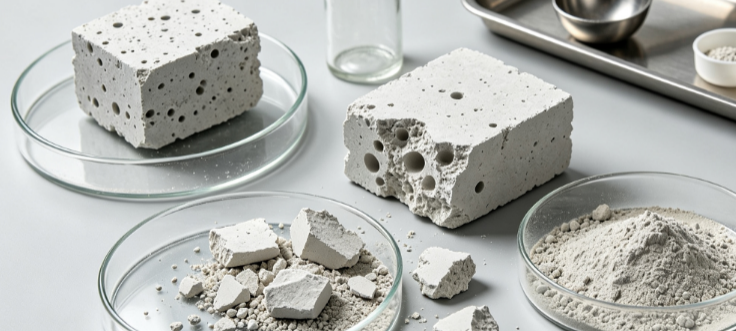
Why Dedicated Testing of Ammonia Storage Blocks Is Critical for Reliable and Safe Operation
Clients seeking testing of these materials often face pressing challenges: inconsistent ammonia delivery pressure in SCR systems, loss of storage capacity after repeated refuelling, or structural crumbling of the block during thermal cycling. These issues typically originate from non‑uniform salt impregnation, pore blocking by reaction by‑products, thermal expansion mismatches, or ineffective compaction. Moreover, ammonia is a toxic and flammable gas; thus, leakage integrity, outgassing behaviour, and pressure‑bearing capability are not only performance parameters but also safety-critical. Our service provides a systematic characterisation that quantifies maximum storage density, sorption hysteresis, effective thermal conductivity, and resistance to attrition, and identifies degradation mechanisms such as salt migration, particle sintering, or binder decomposition. By pinpointing performance boundaries, we enable clients to optimise block formulation, design robust containment vessels, and establish safe operational envelopes.
Our Analytical Capabilities: From Microscopic Structure to Full‑Scale Block Performance
Our testing programme is organised into four interconnected modules, each addressing a critical dimension of material behaviour:
Physicochemical and microstructural characterisation—We determine specific surface area and pore size distribution by N₂ physisorption (BET and DFT), mercury intrusion porosimetry for macroporosity, and helium pycnometry for skeletal density. X‑ray diffraction (XRD) and FTIR/Raman spectroscopy identify crystalline phases and functional groups, while scanning electron microscopy (SEM‑EDS) reveals salt distribution, grain morphology, and potential fissures. Thermogravimetric Analysis (TGA) coupled with mass spectrometry (MS) quantifies the ammonia content and decomposition temperature, providing the theoretical maximum capacity.
Sorption equilibrium and kinetics—We measure ammonia adsorption/desorption isotherms using a Sieverts‑type volumetric apparatus and a high‑pressure microbalance (gravimetric) at temperatures from ‑20 °C to +200 °C and pressures up to 20 bar. From these, we derive storage capacity (wt% NH₃), isosteric heat of sorption, and hysteresis loops. Kinetic parameters are extracted from pressure‑step relaxation experiments and fitted to diffusion models (Fickian, LDF, or shrinking‑core) to identify rate‑limiting steps—critical for predicting refuelling and release times.
Thermal and mechanical integrity—We measure effective thermal conductivity using the transient hot‑wire and laser flash methods over a range of ammonia loadings and temperatures. compressive strength of the entire block (up to 20 kN) and crush strength of individual granules are tested, along with friction/abrasion resistance (ASTM D4058). We assess thermal expansion by dilatometry under controlled ammonia atmosphere. For safety, we perform leak‑tightness tests under pressurised helium and burst pressure evaluations of sealed blocks.
Cyclic ageing and durability simulation—Using a custom‑built multi‑channel test rig, we subject blocks to repeated absorption‑desorption cycles with realistic pressure ramps and holding times, monitoring capacity retention, pressure drop, and temperature evolution (thermal gradient). After ageing, we re‑characterise the material by XRD, SEM, and TGA to identify phase segregation, particle sintering, or binder degradation. We also perform accelerated thermal stress (rapid heating/cooling) and vibration testing to mimic vehicular environments.
High‑Level Predictive Modelling and Diagnostic Interpretation
We integrate our experimental data with finite‑element heat and mass transfer models to simulate the transient behaviour of a storage block during dynamic operation—predicting temperature excursions, pressure gradients, and utilisation efficiency. For degradation, we apply phenomenological models to forecast capacity fade over thousands of cycles, enabling lifetime assessment. Our diagnostics go beyond numbers: we correlate specific performance losses with microstructural changes (e.g., salt agglomeration, pore collapse) and provide targeted recommendations—such as adjusting compaction pressure, adding conductive fillers, or modifying salt composition—to enhance durability.
Regulatory Compliance and Quality Assurance
All test methods are aligned with ISO 15901 (porosity), ASTM C20 (compressive strength), and relevant automotive standards (e.g., SAE J2990 for ammonia storage). Our laboratory holds ISO/IEC 17025:2017 accreditation for a wide scope of materials and sorption testing. We issue certified reports that include full measurement uncertainty, calibration traceability, and detailed method descriptions. For safety‑critical applications, we comply with ATEX directives and provide risk assessment data for handling ammonia‑loaded blocks.
Our Distinctive Advantages in Ammonia Storage Block Testing
Combined high‑pressure and high‑temperature capability: Our sorption rigs are rated for pressures up to 30 bar and temperatures up to 300 °C, allowing us to test a wide range of ammine complexes and advanced materials—including those with high desorption temperatures, which many commercial labs cannot accommodate.
Integrated thermal‑mechanical‑sorption correlation: We uniquely link thermal conductivity changes with ammonia loading and block compaction state, providing a complete picture for system designers—for example, how heat removal capability evolves as the block discharges, influencing refuelling time.
Realistic cycling with dynamic gas composition: Our rig allows introduction of impurities (H₂O, CO₂, O₂) that may be present in the ammonia source, simulating actual field conditions. We quantify their impact on capacity and kinetics, helping you set realistic purity specifications.
Expert root‑cause failure analysis: We have extensive experience with post‑mortem analysis of aged blocks from field returns, combining X‑ray computed tomography (µ‑CT) with destructive sectioning and chemical mapping to pinpoint failure origins—whether mechanical, chemical, or thermal.
Fast and flexible service: Our standard characterisation package (isotherms + kinetics + basic mechanical) is delivered within 10‑14 working days. For urgent development cycles, we provide expedited 5‑day screening for key parameters. We accommodate both small research samples and full‑scale industrial blocks.
End‑to‑End Service Workflow
We initiate each project with a free technical consultation to define your block composition, intended operating conditions, and critical performance indicators. We design a custom test plan, advising on sample size, handling (including inert atmosphere protection for air‑sensitive materials), and shipping protocols. Upon sample receipt, we conduct visual and dimensional inspection, then proceed with parallel testing streams. All data undergo independent review by a second senior scientist. Our final report integrates all findings into a comprehensive document with annotated graphs, statistical summaries, and a clear executive summary and recommendations for formulation or process optimisation. A post‑report meeting is offered to discuss the results and plan next steps.
Partner with Us for Reliable and High‑Performance Ammonia Storage Solutions
Ammonia storage blocks represent a frontier in clean energy and emission control, but their success hinges on precise characterisation and continuous quality oversight. Our testing service is built on scientific rigour, engineering relevance, and safety consciousness. We have supported leading automotive suppliers, energy research institutes, and chemical companies in developing robust and durable storage systems.
We invite you to contact our technical specialists to discuss your specific testing needs—whether for material screening, batch release, or field failure investigation. With our advanced analytical arsenal, accredited quality systems, and deep domain expertise, we provide the insights you need to advance your ammonia storage technology with confidence. Request a detailed proposal or schedule a technical consultation today and take the decisive step toward superior storage performance and operational safety.