Reasons for choosing our testing services
ZHONGXI Testing has obtained inspection qualification certifications from multiple countries and regions worldwide. We possess a senior testing team and advanced testing methods, providing independent, impartial, and professional third-party verification services for global carbon projects.

Internationally recognized authority
Certified by multiple international standards such as CNAS, VCS, and GS, with reports universally applicable worldwide.

Global service capability
Covering 140+ countries and regions, it supports on-site detection and remote verification in multiple languages.

Professional experimental methods
Adopt standard experimental methods to ensure accurate and reliable data.
Advanced Testing of Dehydrating Agents for Alcohol‑Based Preservation Liquids: Comprehensive Analytical Solutions
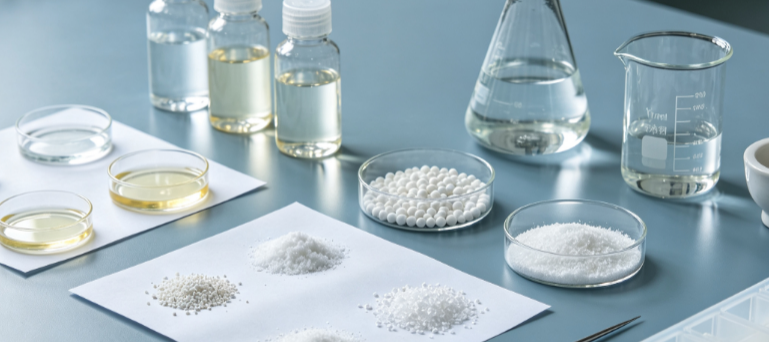
Dehydrating agents used in alcohol‑based preservation liquids—including molecular sieves (3A, 4A), activated alumina, calcium oxide, and polymeric desiccants—play a critical role in maintaining low water activity to prevent microbial growth, hydrolysis, and degradation of sensitive biological, pharmaceutical, or food samples. These agents must efficiently remove residual water without leaching contaminants, altering the alcohol concentration, or introducing particulate matter. However, variations in adsorption capacity, kinetics, particle integrity, and compatibility with the organic matrix can lead to ineffective drying, pH shifts, or contamination of the preserved specimen. Our laboratory provides a fully integrated testing programme for dehydrating agents used in alcohol‑based preservation media, combining moisture sorption isotherms, leachables analysis, particle characterisation, and chemical compatibility studies. We deliver quantitative, predictive, and safety‑oriented data that supports product qualification, quality control, supplier verification, and process optimisation for the pharmaceutical, biobanking, food, and histology industries.
Why Specialised Testing of Dehydrating Agents Is Essential for Preservation Integrity
Clients seeking testing of these materials typically encounter issues such as unexpected water activity drift in stored samples, visible precipitates or turbidity after treatment, or batch‑to‑batch variation in drying efficiency. These problems often arise from incomplete activation of the agent, fine particle generation causing haze, or the release of ionic impurities (e.g., Na⁺, Ca²⁺, Al³⁺) that may interact with the preservation liquid. Moreover, in regulated environments (e.g., GMP, ISO 13485), the extractable and leachable profile of the dehydrant must be well characterised to ensure compatibility with the preserved specimen. Our service provides a systematic evaluation that quantifies water uptake capacity at relevant ethanol/water mixtures, desorption hysteresis, and impurity release, enabling you to select the optimum agent and define safe usage conditions.
Our Analytical Capabilities: From Moisture Sorption to Chemical Compatibility
Our testing framework is structured into four interconnected modules, each providing critical performance and safety data:
Physical and textural characterisation—We determine specific surface area (BET), pore volume and size distribution (DFT/BJH) by N₂ physisorption, and macroporosity by mercury intrusion. Particle size distribution (laser diffraction), bulk density, and attrition resistance (rotating drum) are measured to assess handling and mechanical stability. Scanning electron microscopy (SEM) examines surface morphology, while X‑ray diffraction (XRD) confirms the crystalline phase and potential impurities.
Moisture sorption performance in alcohol‑water mixtures—We perform gravimetric water sorption isotherms using a dynamic vapour sorption (DVS) system equipped with both water and ethanol vapour generators, covering a range of alcohol concentrations (70–100 % v/v) and temperatures (4–40 °C). This provides equilibrium capacity (g water/g adsorbent), adsorption kinetics, and selectivity for water over ethanol. We also simulate multiple dehydration cycles to assess regeneration efficiency and capacity decay.
Leachables and extractables analysis—We incubate the dehydrating agent in representative alcohol‑based preservation liquids under accelerated conditions (elevated temperature, prolonged contact) and analyse the supernatant by ICP‑MS for trace metals (Na, K, Ca, Al, Si, Fe, etc.), ion chromatography (IC) for anions (Cl⁻, SO₄²⁻), and LC‑MS/GC‑MS for organic leachables (e.g., binders, surfactants, polymer fragments). This ensures that no interfering substances are introduced into the preservation medium.
Compatibility and stability testing—We assess pH change of the preservation liquid after contact with the dehydrant, and monitor for turbidity, colour change, or precipitate formation by visual and spectrophotometric methods. We also evaluate the impact on the stability of typical biological markers (e.g., enzymes, nucleic acids, or proteins) using standard activity assays, providing a direct measure of biological compatibility.
High‑Level Predictive and Diagnostic Capabilities
We integrate sorption data with mass transfer models to predict the drying time and final water activity for your specific container geometry and liquid volume. For complex formulations, we apply thermodynamic models (e.g., Wilson‑NRTL) to describe water‑alcohol adsorption competition. In addition, our failure diagnostic service can identify the cause of unexpected performance—for instance, distinguishing between surface poisoning, pore blockage, or binder degradation—using post‑test characterisation (XRD, BET, SEM) and correlating with process history.
Regulatory Compliance and Quality Assurance
All test methods are aligned with USP <671> (packaging), ASTM D3460, and ISO 10927 where applicable. Our laboratory holds ISO/IEC 17025:2017 accreditation for sorption and chemical analysis. We provide certified test reports with full measurement uncertainty, control data, and method references. For pharmaceutical or medical device applications, we can support ICH Q3D elemental impurity compliance and provide extractable data for regulatory submissions (e.g., FDA Master File).
Our Distinctive Advantages in Dehydrating Agent Testing
Realistic alcohol‑water mixture simulation: Unlike standard water‑only tests, we perform sorption measurements in vapour mixtures that closely match your actual preservation liquid composition, ensuring that our capacity and selectivity data are directly applicable.
Comprehensive leachables profiling: We offer a full screening of both inorganic and organic extractables using state‑of‑the‑art mass spectrometry, with identification of unknown peaks via library matching and high‑resolution accurate mass data—a level of detail rarely available from routine testing labs.
Biological compatibility endpoint: We go beyond chemical analysis to directly evaluate the impact of the dehydrant on the preserved biological material, providing peace of mind for critical sample integrity.
Fast turnaround and customisation: Our standard package (sorption + leachables + compatibility) is delivered within 10–14 working days. We offer expedited screening for key parameters (water capacity and pH shift) within 48 hours. We also adapt test matrices to your specific formulation and storage conditions.
End‑to‑End Service Workflow
We start with a complimentary consultation to define your preservation liquid composition, expected water content, and any regulatory or quality constraints. We design a tailored test plan, advise on sample quantity and handling, and provide shipping guidelines. Upon sample receipt, we perform inspection and preconditioning (if required). All tests are executed with strict QA/QC, including blanks, spikes, and duplicates. Data is reviewed by our senior material scientist and compiled into a comprehensive report with isotherm curves, leachable tables, compatibility summaries, and a clear recommendation for optimal agent selection and usage. A post‑report meeting is offered to discuss results and next steps.
Partner with Us for Reliable and Safe Dehydration of Alcohol‑Based Preservation Systems
The integrity of your preservation medium depends on the performance and purity of the dehydrating agent. Our testing service is built on scientific excellence, regulatory awareness, and a deep understanding of biochemical preservation. We have supported biobanks, pharmaceutical companies, and histology laboratories in ensuring their dehydration processes are both effective and non‑interfering.
We invite you to contact our technical experts to discuss your specific testing needs—whether for material qualification, batch release, or troubleshooting. With our advanced analytical arsenal, accredited methods, and application‑specific expertise, we provide the clarity and confidence you need to safeguard your valuable preserved samples. Request a detailed proposal or schedule a technical consultation today and take the next step towards optimised, risk‑free preservation.