Reasons for choosing our testing services
ZHONGXI Testing has obtained inspection qualification certifications from multiple countries and regions worldwide. We possess a senior testing team and advanced testing methods, providing independent, impartial, and professional third-party verification services for global carbon projects.

Internationally recognized authority
Certified by multiple international standards such as CNAS, VCS, and GS, with reports universally applicable worldwide.

Global service capability
Covering 140+ countries and regions, it supports on-site detection and remote verification in multiple languages.

Professional experimental methods
Adopt standard experimental methods to ensure accurate and reliable data.
Comprehensive Performance Testing of Nano‑Formulated Formaldehyde‐Removal Liquids for Ceramic Tiles: Advanced Analytical and Efficacy Solutions
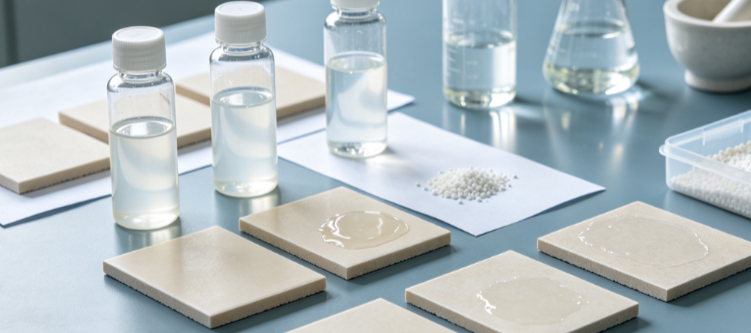
Nano‑formulated formaldehyde‐removal liquids for ceramic tiles—typically comprising nano‑TiO₂, noble metal‐modified photocatalysts, amine‐functionalised silanes, or polymeric scavengers—are increasingly applied as surface coatings to decompose or adsorb gaseous formaldehyde emitted from interior materials. The efficacy of these products depends on a complex interplay of photocatalytic activity (under visible/UV light), adhesion durability, film uniformity, and resistance to cleaning abrasion. However, variations in nanoparticle dispersion, binder formulation, and curing conditions can lead to inconsistent formaldehyde degradation, poor long‐term stability, or even secondary emission of volatile by‐products. Our laboratory offers a fully integrated, multi‐parameter testing platform specifically designed for such nano‐liquids, combining photocatalytic efficiency measurements, film characterisation, durability simulation, and safety/emission screening. We deliver quantitative, reproducible, and application‐oriented data that supports product development, quality control, certification (e.g., GB/T, ISO, and EU eco‑labels), and competitive benchmarking for manufacturers and formulators.
Why Rigorous Testing of Nano‐Formaldehyde‐Removal Coatings Is Indispensable for Indoor Air Quality Assurance
Clients seeking testing of these liquids often encounter challenges such as inconsistent formaldehyde reduction in field tests, rapid performance decay after cleaning, or yellowish discolouration of the tiles after application. These issues often originate from non‐optimal particle size, poor film adhesion, insufficient photocatalytic activation under indoor lighting, or photo‑induced degradation of the binder. Moreover, regulatory frameworks (e.g., China GB 50325, EU REACH, and US EPA) require validated performance data and emission safety before marketing. Our service provides a systematic evaluation that quantifies formaldehyde removal rate (initial and sustained), quantum efficiency, and film durability, while also identifying volatile organic compound (VOC) by‑products that may undermine the health benefits. By characterising performance under realistic indoor conditions (light intensity, humidity, temperature), we enable clients to optimise product formulations, justify marketing claims, and satisfy regulatory requirements with confidence.
Our Analytical Capabilities: From Photocatalytic Activity to Film Integrity and Safety
Our testing programme is organised into five interconnected modules, each addressing a critical aspect of product performance and safety:
Physicochemical characterisation of the nano‑liquid—We determine particle size distribution (DLS and TEM), zeta potential, and solid content (gravimetry). X‑ray diffraction (XRD) identifies the crystalline phase of nano‑TiO₂ or other photocatalysts, while UV‑Vis spectroscopy assesses the bandgap and photo‑responsive wavelength range. Inductively coupled plasma mass spectrometry (ICP‑MS) quantifies elemental composition (Ti, Ag, Pt, etc.), and FTIR characterises organic binders and functional groups.
Formaldehyde removal efficacy—We perform static chamber tests (ISO 16000‑23) and dynamic flow‐through tests to measure the formaldehyde degradation rate under controlled conditions: temperature (20–30 °C), relative humidity (40–80 %), and light intensity (UV, visible, or dark). We use acetylacetone spectrophotometry (AHMT) and high‑performance liquid chromatography (HPLC) for formaldehyde quantification. We also determine the apparent quantum yield (AQY) and the Langmuir–Hinshelwood kinetic parameters for photocatalysis. For scavenger‐type products, we measure the adsorption capacity and chemisorption kinetics using a custom gas adsorption rig.
Film characterisation on ceramic tile substrates—We apply the nano‑liquid onto standardised ceramic tiles under controlled conditions (spraying, rolling, or dipping) and evaluate film thickness (profilometry), surface wetting (contact angle), and uniformity (optical microscopy, SEM). Adhesion strength is measured by cross‑cut tape test (ASTM D3359), and abrasion resistance by wet scrubbing cycles (ISO 11998). Transparency/gloss change is monitored to ensure aesthetic compatibility.
Durability and ageing simulation—We subject coated tiles to accelerated weathering (UV irradiation, temperature cycling, humidity condensation) and simulated cleaning with neutral detergents. The residual formaldehyde removal performance is re‑assessed after each ageing step to determine the service life and performance half‑life. We also evaluate thermal stability by Thermogravimetric Analysis (TGA).
Emissions and safety assessment—We use environmental chambers (ISO 16000‑9) to collect and quantify volatile organic compounds (VOCs) and carbonyl compounds emitted from coated tiles over 28 days, using TD‑GC‑MS and DNPH‑HPLC. We identify any secondary by‑products (e.g., formic acid, acetaldehyde) that may arise from incomplete degradation. Metal leaching into water (simulating wet cleaning) is quantified by ICP‑MS to ensure safety for contact with skin or food surfaces.
High‑Level Predictive Modelling and Diagnostic Interpretation
We integrate experimental data with reactor modelling (e.g., plug‐flow or perfectly mixed) to predict the actual performance in a real room environment, considering air exchange rates and source strengths. For optimisation, we apply design of experiments (DoE) to identify the most influential formulation variables (particle loading, binder type, curing temperature). Our diagnostic service can pinpoint failure causes—for instance, distinguishing between photocatalyst deactivation (surface poisoning) and film delamination using post‑ageing SEM/EDS and XPS analysis.
Regulatory Compliance and Quality Assurance
All test methods are aligned with ISO 22197‑1 (photocatalytic activity), ISO 16000‑23, ASTM D5116, and China GB/T 18801 standards. Our laboratory holds ISO/IEC 17025:2017 accreditation for a wide scope of indoor air quality and materials testing. We issue certified test reports with full raw data, statistical analysis, and measurement uncertainty, suitable for product certifications and regulatory submissions.
Our Distinctive Advantages in Nano‑Formaldehyde‐Removal Liquid Testing
Realistic indoor simulation: We use both commercial LED lighting (various colour temperatures) and filtered UV sources to mimic actual home or office environments, ensuring that our efficacy data is directly translatable to field performance—unlike standard high‑intensity UV tests that overestimate capability.
Comprehensive film durability assessment: We combine chemical, mechanical, and optical stability tests in a single workflow, providing a holistic view of the coating’s long‑term behaviour. This includes simulated cleaning with real household detergents, which is often neglected but critical for practical utility.
Advanced by‑product identification: Our high‑resolution GC‑MS and LC‑HRMS capabilities allow us to detect and identify trace organic intermediates, enabling you to refine the formulation to minimise any unintended emissions—a key differentiator for health‑conscious brands.
Expert interpretation and formulation guidance: Our team includes photo‐ and environmental chemists who can translate test outcomes into specific formulation adjustments, e.g., increasing doping levels to enhance visible‐light response or adjusting binder crosslink density to improve adhesion.
Fast turnaround and flexible throughput: Our standard full package (efficacy + film + ageing + emissions) is delivered in 12‑15 working days. For rapid screening, we offer expedited 5‑day testing for initial photocatalytic rate and basic film properties. We accommodate both liquid samples and pre‑coated tile panels.
End‑to‑End Service Workflow
We initiate with a complimentary technical consultation to understand your product composition, intended application method, target performance claims, and regulatory needs. We design a tailored test plan, advising on sample quantity, substrate specifications, and handling. Upon sample receipt, we perform receipt inspection and prepare test substrates under standardised conditions. All tests are executed with internal QA/QC (reference photocatalyst, blanks, duplicates). Data is compiled and reviewed by our lead scientist, then integrated into a comprehensive report with graphical summaries, tables, and clear conclusions. We also provide a post‑report interpretation meeting to discuss optimisations and next steps.
Partner with Us for Credible, High‑Performance Formaldehyde Removal Solutions
With growing public awareness of indoor air quality, the demand for reliable formaldehyde‐removal coatings is rising—but so is the need for scientific validation. Our testing service provides the scientific rigour, practical relevance, and regulatory support necessary to substantiate your product claims and build customer trust. We have assisted numerous coating manufacturers and raw material suppliers in bringing effective, safe, and durable products to market.
We invite you to contact our technical team to discuss your specific testing needs—whether for product development, quality assurance, or certification. With our advanced analytical instruments, accredited protocols, and specialised expertise in photocatalytic and sorptive materials, we provide the clarity and confidence you need to lead in the indoor air quality market. Request a detailed proposal or schedule a technical consultation today and take the decisive step towards superior, science‑based formaldehyde removal solutions.