Reasons for choosing our testing services
ZHONGXI Testing has obtained inspection qualification certifications from multiple countries and regions worldwide. We possess a senior testing team and advanced testing methods, providing independent, impartial, and professional third-party verification services for global carbon projects.

Internationally recognized authority
Certified by multiple international standards such as CNAS, VCS, and GS, with reports universally applicable worldwide.

Global service capability
Covering 140+ countries and regions, it supports on-site detection and remote verification in multiple languages.

Professional experimental methods
Adopt standard experimental methods to ensure accurate and reliable data.
Advanced Analytical Testing of Magnetic Chelating Compounds: Comprehensive Performance and Safety Evaluation
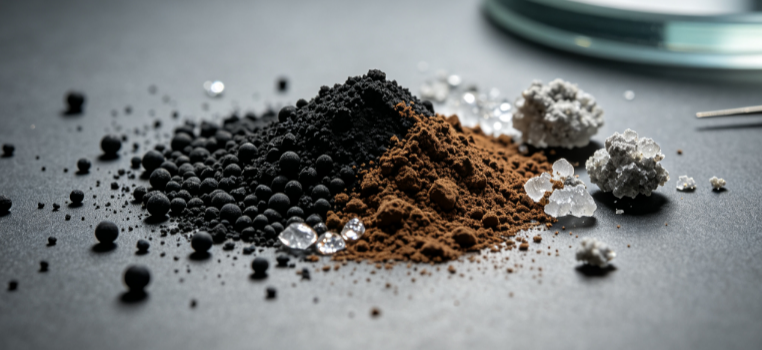
Magnetic chelating compounds—typically comprising superparamagnetic iron oxide nanoparticles (SPIONs) or ferrite cores functionalised with chelating ligands such as EDTA, DTPA, iminodiacetic acid, or macrocyclic polyamines—are increasingly deployed in metal ion separation, water remediation, biomedical detoxification, and diagnostic imaging. Their unique ability to selectively bind and magnetically recover target metal ions (e.g., heavy metals, radiometals, or lanthanides) offers unparalleled efficiency. However, the performance of these hybrid materials hinges on a critical balance of ligand density, chelation affinity, magnetic responsiveness, colloidal stability, and resistance to competitive ions. Subtle variations in synthesis—such as uneven surface grafting, partial oxidation of the magnetic core, or ligand hydrolysis—can lead to reduced metal uptake, poor selectivity, leaching of toxic components, or compromised magnetic recoverability. Our laboratory offers a fully integrated, multi‑parameter testing platform specifically designed for magnetic chelating compounds, combining physicochemical characterisation, magnetic property analysis, chelation capacity and kinetics, stability assessments, and application‑oriented performance simulation. We deliver quantitative, diagnostic, and predictive data that supports material development, quality assurance, regulatory compliance, and process optimisation for environmental, biomedical, and industrial clients.
Why Specialised Testing of Magnetic Chelating Compounds Is Essential for Reliable Performance
Clients seeking testing of these materials often encounter critical challenges: inconsistent metal removal efficiency in field applications, unexpected leaching of iron or ligand into treated media, or poor reproducibility between synthesis batches. These issues typically originate from non‑uniform ligand coverage, surface oxidation affecting magnetic properties, or inadequate cross‑linking that weakens chelate stability. Furthermore, in biomedical or environmental applications, Cytotoxicity, genotoxicity, and metal leakage must be stringently evaluated to ensure safety and regulatory compliance. Our service provides a systematic characterisation that quantifies maximum chelation capacity (Qₘ), binding affinity (Kd), selectivity coefficients, magnetic saturation (Mₛ), and colloidal stability under relevant conditions. By identifying the root causes of sub‑optimal performance—such as ligand crowding, pore blocking, or core degradation—we enable clients to refine synthesis protocols, optimise ligand grafting, and validate product consistency for their targeted applications.
Our Analytical Capabilities: From Core Composition to Chelation Dynamics and Safety
Our testing programme is structured into five interconnected modules, each addressing a critical dimension of material behaviour and application fitness:
Physicochemical and morphological characterisation—We determine particle size distribution (DLS and TEM), specific surface area (BET) and pore structure by nitrogen physisorption. X‑ray diffraction (XRD) confirms the magnetic phase (Fe₃O₄, γ‑Fe₂O₃, or spinel ferrites) and detects impurities. Thermogravimetric Analysis (TGA) quantifies the organic ligand loading (%) and thermal stability. Scanning electron microscopy (SEM‑EDS) and high‑resolution TEM visualise core‑shell morphology, coating uniformity, and any agglomeration.
Magnetic property measurement—Using vibrating sample magnetometry (VSM) and SQUID magnetometry, we measure saturation magnetisation (Mₛ), remanence, coercivity, and blocking temperature. We also perform magnetic separation kinetics under fixed magnetic field gradients to quantify the time to 95 % recovery—essential for evaluating process feasibility.
Chelation capacity and selectivity assessment—We conduct batch equilibrium experiments with a range of representative metal ions (Cu²⁺, Pb²⁺, Cd²⁺, Hg²⁺, Ni²⁺, etc.) at varied pH (2–9), temperature (10–60 °C), and ionic strength. From isotherms (Langmuir, Freundlich) we derive maximum adsorption capacity (Qₘ) and affinity constants. Competitive ion studies quantify selectivity coefficients for target metals over common coexisting ions (Ca²⁺, Mg²⁺, Na⁺). Kinetic profiles (pseudo‑first‑order, pseudo‑second‑order, intra‑particle diffusion) reveal rate‑limiting steps—critical for designing contact times in real processes.
Stability and leachables analysis—We evaluate colloidal stability via zeta potential and DLS over time (1–14 days) under storage and application conditions (pH, salinity, presence of proteins). Metal leaching from the magnetic core (Fe, Co, Ni) and ligand degradation products are quantified by ICP‑MS and LC‑HRMS under simulated use (acidic/alkaline elution, biological fluids). Thermal stability is assessed by TGA‑DSC and accelerated ageing (40–80 °C).
Application‑oriented performance simulation—We test the material in dynamic flow‑through columns to measure breakthrough curves and exhaustion capacity under continuous operation. For biomedical applications, we perform Cytotoxicity assays (MTT, LDH) and hemocompatibility tests (ISO 10993) on eluates. For environmental use, we assess reusability over multiple adsorption‑desorption cycles, monitoring capacity retention and magnetic recoverability.
High‑Level Diagnostic and Predictive Modelling
We integrate experimental data with surface complexation models (e.g., diffuse‑layer or triple‑layer models) to describe pH‑dependent metal binding and predict performance under variable water chemistry. For kinetic analysis, we apply chemical reaction engineering models to simulate continuous stirred‐tank and plug‐flow reactors. We also perform multivariate statistical analysis (PCA, PLS) to identify critical synthesis parameters that govern chelation capacity and magnetic response—enabling quality‑by‑design (QbD) optimisation. Our failure mode analysis combines post‑test characterisation (XRD, XPS, FTIR) with performance data to distinguish between ligand hydrolysis, core oxidation, and physical agglomeration as degradation mechanisms.
Regulatory Compliance and Quality Assurance
All test methods are aligned with ISO 17025, ASTM D7380, USP <661>, and ICH Q3D guidelines. Our laboratory holds ISO/IEC 17025:2017 accreditation for a broad scope of materials characterisation and trace elemental analysis. We provide certified test reports with full measurement uncertainty, raw data archives, and method validation summaries, supporting regulatory submissions, patent applications, and quality agreements.
Our Distinctive Advantages in Magnetic Chelating Compound Testing
Correlative multi‑technique platform: We seamlessly link magnetic performance (VSM) with chelation capacity and surface chemistry (XPS, FTIR) on the same batch, providing a coherent performance‑structure relationship that guides formulation improvement—a holistic view rarely achieved by specialised labs.
Real‑matrix simulation under relevant conditions: Our chelation tests use synthetic groundwaters, seawater, serum, or biorelevant fluids with controlled background electrolytes and natural organic matter, ensuring that our capacity and selectivity data are directly transferable to your application.
Advanced leachables and degradation product identification: With HRMS and ICP‑MS/MS, we detect trace leachables (sub‑ppb) and identify unexpected degradation products, which is critical for biomedical and environmental safety compliance.
Expert interpretation and actionable recommendations: Our team includes inorganic chemists and colloid scientists with deep understanding of chelation chemistry. We provide clear, evidence‑based suggestions—for instance, adjusting the grafting pH to maximise ligand accessibility, or introducing a protective silica layer to enhance core stability.
Fast turnaround and flexible sample volumes: Our standard full characterisation package is delivered within 10‑14 working days, with expedited 72‑hour service for critical parameters (chelation capacity, Mₛ, and particle size). We handle powder, slurry, and dry samples with minimal mass requirements.
End‑to‑End Service Workflow
We begin with a complimentary technical consultation to define your compound composition, target metals, application environment, and regulatory needs. We then design a customised test plan, advising on sample handling and shipping. Upon receipt, we perform receipt inspection and preconditioning. All tests are executed with strict QA/QC (reference materials, blanks, duplicates). Data is integrated and reviewed by our lead scientist, then compiled into a comprehensive report containing isotherms, kinetic plots, magnetic curves, and a clear executive summary with optimisation recommendations. A post‑report meeting is offered to discuss findings and plan next steps.
Partner with Us for Reliable and High‑Performance Magnetic Chelation Solutions
Magnetic chelating compounds offer transformative potential in metal management, but their complexity demands rigorous, multifaceted testing. Our service is built on scientific excellence, practical relevance, and collaborative partnership. We have supported leading environmental technology companies, biomedical device manufacturers, and research institutions in developing robust, safe, and efficient magnetic chelators.
We invite you to contact our technical experts to discuss your specific testing requirements—whether for product development, quality control, or regulatory submission. With our advanced analytical arsenal, accredited protocols, and specialised expertise, we provide the insights you need to perfect your magnetic chelating materials and achieve your performance goals with confidence. Request a detailed proposal or schedule a technical consultation today and take the next step towards superior magnetic chelation technology.