Reasons for choosing our testing services
ZHONGXI Testing has obtained inspection qualification certifications from multiple countries and regions worldwide. We possess a senior testing team and advanced testing methods, providing independent, impartial, and professional third-party verification services for global carbon projects.

Internationally recognized authority
Certified by multiple international standards such as CNAS, VCS, and GS, with reports universally applicable worldwide.

Global service capability
Covering 140+ countries and regions, it supports on-site detection and remote verification in multiple languages.

Professional experimental methods
Adopt standard experimental methods to ensure accurate and reliable data.
Comprehensive Analytical Testing of Magnetic Kaolin Composites: Advanced Characterisation and Performance Validation
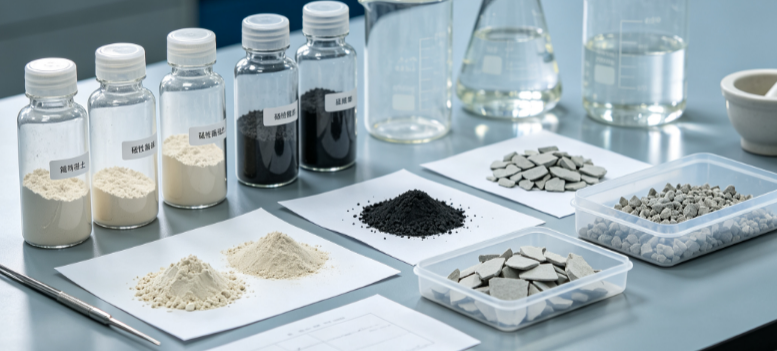
Magnetic kaolin composites—typically produced by incorporating superparamagnetic iron oxide nanoparticles (Fe₃O₄ or γ‑Fe₂O₃) onto or into kaolinite layered silicates—have emerged as versatile materials for wastewater treatment, heavy metal removal, dye adsorption, catalysis, and magnetic separation processes. The unique combination of kaolin’s high specific surface area, layered structure, and cation exchange capacity with the rapid magnetic recoverability of iron oxides enables efficient solid‑liquid separation and reusable performance. However, the functional efficacy of these composites depends critically on the dispersion of magnetic nanoparticles, preservation of kaolinite’s layered morphology, magnetic saturation, and chemical stability under operational conditions. Subtle variations in synthesis—such as non‑uniform coating, phase segregation, or pore blocking—can lead to reduced adsorption capacity, slow magnetic separation, or iron leaching. Our laboratory offers a fully integrated, multi‑scale testing platform specifically designed for magnetic kaolin materials, combining mineralogical, textural, magnetic, and surface chemical analyses with application‑oriented adsorption and stability assessments. We deliver quantitative, diagnostic, and predictive data that supports material development, quality control, process optimisation, and regulatory compliance for environmental, construction, and chemical engineering clients.
Why Rigorous Testing of Magnetic Kaolin Is Essential for Reliable Performance in Environmental and Industrial Applications
Clients seeking testing of magnetic kaolin often encounter challenges such as inconsistent pollutant removal efficiency, incomplete magnetic recovery leading to material loss, or unexpected release of iron species into treated water. These issues commonly originate from inadequate magnetic nanoparticle loading, poor adhesion to the kaolin surface, or aggregation that reduces the accessible surface area. Furthermore, the chemical stability of the composite under acidic or alkaline conditions is critical to prevent dissolution of both kaolin and iron phases. Our service provides a systematic characterisation that quantifies specific surface area (BET), pore structure, saturation magnetisation (Mₛ), surface functional groups, and adsorption capacity for representative contaminants (heavy metals, dyes, phosphate). By identifying the root causes of performance deviations—such as pore blockage, surface oxidation, or phase transformation—we enable clients to optimise synthesis parameters (Fe loading, calcination temperature, coating protocol) and validate product consistency for their specific applications.
Our Analytical Capabilities: From Crystal Structure to Magnetic Behaviour and Adsorption Dynamics
Our testing programme is structured into five interconnected modules, each addressing a critical dimension of material composition, structure, and functional performance:
Mineralogical and structural characterisation—We employ powder X‑ray diffraction (PXRD) with Rietveld refinement to identify kaolinite phases (Al₂Si₂O₅(OH)₄), detect magnetic phases (Fe₃O₄, γ‑Fe₂O₃, or hematite), and quantify crystallinity changes upon modification. Fourier‑transform infrared spectroscopy (FTIR‑ATR) and Raman microscopy probe the functional groups and any chemical bonding between kaolin and iron oxide. High‑resolution transmission electron microscopy (HR‑TEM) with selected‑area electron diffraction (SAED) and scanning TEM‑EDS mapping visualise the spatial distribution and size of magnetic nanoparticles on the kaolin layers.
Textural and surface analysis—We determine specific surface area (BET), total pore volume, and pore size distribution (DFT/BJH) using N₂ physisorption at 77 K. Mercury intrusion porosimetry assesses macroporosity and particle packing. Field‑emission scanning electron microscopy (FE‑SEM) reveals particle morphology, layer exfoliation, and surface roughness. X‑ray photoelectron spectroscopy (XPS) provides surface elemental composition and oxidation states of iron (Fe²⁺/Fe³⁺), as well as the chemical environment of Al, Si, and O.
Magnetic property measurement—Using vibrating sample magnetometry (VSM) and SQUID magnetometry (2–400 K, up to 7 T), we measure magnetisation hysteresis loops (M‑H), extracting saturation magnetisation (Mₛ), remanence, coercivity (H꜀), and blocking temperature. We also conduct magnetic separation kinetics under a defined magnetic field to quantify the time to recover 95 % of the material—a critical parameter for process design. For anisotropic composites, we assess orientation‑dependent magnetic behaviour.
Adsorption performance evaluation—We perform batch equilibrium experiments using representative model pollutants, including heavy metals (Pb²⁺, Cd²⁺, Cu²⁺), anionic dyes (methyl orange, Congo red), and phosphate, at environmentally relevant concentrations (ppm–ppb). We obtain adsorption isotherms (Langmuir, Freundlich, Temkin) and kinetic profiles (pseudo‑first‑order, pseudo‑second‑order, intraparticle diffusion) under controlled pH (3–10), temperature (10–50 °C), and background ionic strength. We determine maximum adsorption capacity (Qₘ), distribution coefficient (Kd), and selectivity in the presence of coexisting anions/cations. We also evaluate desorption and reusability over multiple cycles.
Stability, durability, and leachability assessment—We subject the composite to acid/alkaline resistance (pH 2–12), thermal ageing (up to 400 °C), and mechanical attrition (rotating drum). After stress, we re‑measure BET, XRD, Mₛ, and adsorption capacity to quantify degradation. Leaching of Fe, Al, and Si into aqueous media (deionised water, simulated acid rain, PBS buffer) is quantified by ICP‑MS and ICP‑OES over contact periods up to 14 days, ensuring compliance with environmental and drinking water standards.
High‑Level Predictive Modelling and Diagnostic Interpretation
We integrate experimental adsorption data with surface complexation models (e.g., diffuse‑layer model) to describe pH‑dependent binding and predict performance under variable water chemistry. For column applications, we apply advection‑dispersion‑reaction (ADR) simulations to generate breakthrough curves and design treatment units. We also use multivariate statistical tools (PCA, PLS) to correlate synthesis variables (e.g., Fe/kaolin ratio, calcination temperature) with final performance metrics, enabling quality‑by‑design (QbD) optimisation. For failure analysis, we combine post‑use characterisation (XRD, SEM, XPS) with performance history to distinguish between surface poisoning, pore clogging, and phase transformation as degradation mechanisms.
Regulatory Compliance and Quality Assurance
All test methods are aligned with ASTM D4646 (cation exchange capacity), D5757 (adsorbent performance), ISO 9277 (BET), and relevant US EPA methods for water quality. Our laboratory holds ISO/IEC 17025:2017 accreditation for a wide scope of materials characterisation and environmental analysis. We provide certified test reports with full traceability, measurement uncertainty, and quality control data (reference materials, blanks, duplicates). For product certification, we prepare comprehensive data packages suitable for NSF/ANSI or regulatory submissions.
Our Distinctive Advantages in Magnetic Kaolin Testing
Integrated multi‑technique correlation: We perform all analyses on the same sample batch, ensuring that relationships between mineralogy, texture, magnetic properties, and adsorption capacity are directly interpretable—a capability that eliminates inter‑batch variability and provides a truly holistic material fingerprint.
Realistic environmental simulation: Our adsorption tests use synthetic groundwaters and industrial effluents with controlled background electrolytes and natural organic matter, ensuring that our capacity and selectivity data are directly applicable to field conditions, rather than idealised lab water.
Advanced iron speciation and leachate profiling: With Mössbauer spectroscopy (available on request) and XPS, we precisely determine iron oxidation states and magnetic phase composition, and correlate with leaching risks. Our HRMS capability detects trace organic leachables that may arise from synthesis residues or surfactants.
Expert interpretation and actionable guidance: Our team includes clay mineralogists, magnetic materials specialists, and environmental engineers who provide specific, evidence‑based recommendations—for example, optimising the Fe loading to balance magnetic responsiveness and surface availability, or suggesting protective coatings to prevent acid‑induced dissolution.
Fast turnaround and flexible sample requirements: Our standard full characterisation package is delivered within 10–14 working days, with expedited 72‑hour service for key parameters (BET, Mₛ, and initial adsorption screening). We handle powders, pellets, and slurries with sample masses as low as 5 g.
End‑to‑End Service Workflow
We begin with a complimentary technical consultation to define your composite composition, target application, and critical performance indicators. We design a tailored test plan, advising on sample handling and shipping (including inert atmosphere for oxidation‑sensitive materials). Upon receipt, we perform visual inspection and preconditioning (drying, degassing). All tests are executed with strict QA/QC—reference standards, blanks, and replicates. Data are integrated and reviewed by our lead scientist, then compiled into a comprehensive report containing XRD patterns, BET tables, magnetic hysteresis loops, adsorption isotherms, and a clear executive summary with optimisation recommendations. A post‑report meeting is offered to discuss the findings and plan further development steps.
Partner with Us for Reliable, High‑Performance Magnetic Kaolin Solutions
Magnetic kaolin composites represent a cost‑effective and sustainable platform for adsorption and separation, but their performance hinges on thorough characterisation and quality control. Our testing service provides the scientific depth, practical relevance, and regulatory support necessary to ensure your material meets the demands of environmental remediation, water treatment, or catalytic applications. We have assisted mining companies, water treatment equipment manufacturers, and research institutes in developing and qualifying magnetic clay‑based products.
We invite you to contact our technical experts to discuss your specific magnetic kaolin testing requirements—whether for product development, batch release, or troubleshooting. With our advanced analytical instruments, accredited protocols, and deep domain expertise, we provide the insights you need to perfect your magnetic clay technology and achieve your performance goals with confidence. Request a detailed proposal or schedule a technical consultation today and take the next step towards superior, data‑driven magnetic kaolin solutions.