Reasons for choosing our testing services
ZHONGXI Testing has obtained inspection qualification certifications from multiple countries and regions worldwide. We possess a senior testing team and advanced testing methods, providing independent, impartial, and professional third-party verification services for global carbon projects.

Internationally recognized authority
Certified by multiple international standards such as CNAS, VCS, and GS, with reports universally applicable worldwide.

Global service capability
Covering 140+ countries and regions, it supports on-site detection and remote verification in multiple languages.

Professional experimental methods
Adopt standard experimental methods to ensure accurate and reliable data.
Advanced Analytical Testing of Magnetic Pitch‑Resin‑Based Activated Carbon: Comprehensive Characterisation and Performance Validation
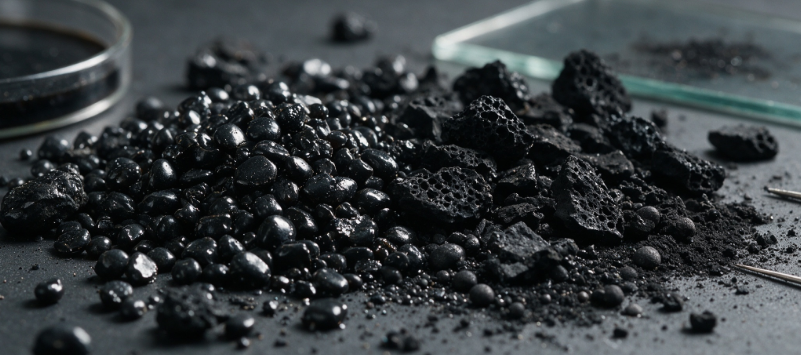
Magnetic pitch‑resin‑based activated carbon (MPR‑AC) represents a sophisticated class of hybrid adsorbents derived from coal tar pitch or petroleum pitch co‑polymerised with synthetic resins, followed by activation and in‑situ or ex‑situ incorporation of superparamagnetic iron oxide nanoparticles (Fe₃O₄ or γ‑Fe₂O₃). This combination leverages the highly developed micro‑/mesoporosity, exceptional mechanical strength, and tailored surface chemistry of pitch‑resin carbons with the rapid magnetic separability of magnetite, making them ideal for advanced water treatment, high‑purity gas purification, pharmaceutical intermediate recovery, and catalytic support. However, the performance of MPR‑AC is critically influenced by the homogeneity of magnetic dispersion, pore accessibility, surface functionalisation, magnetic saturation, and structural integrity under repeated use. Non‑uniform iron deposition, pore blockage, incomplete activation, or phase oxidation can lead to diminished adsorption capacity, sluggish magnetic recovery, and metal leaching. Our laboratory provides a fully integrated, multi‑scale testing platform specifically designed for MPR‑AC, combining textural, magnetic, surface chemical, thermal stability, and application‑oriented adsorption assessments. We deliver quantitative, diagnostic, and predictive data that supports material formulation, process optimisation, quality assurance, and regulatory compliance for the chemical, pharmaceutical, and environmental sectors.
Why Specialised Testing of Magnetic Pitch‑Resin Activated Carbon Is Critical for High‑End Applications
Clients seeking MPR‑AC testing often face challenges such as sub‑par removal of target contaminants in fixed‑bed systems, slow magnetic separation leading to increased cycle times, or unexpected iron release in pharmaceutical applications. These issues typically stem from uneven nanoparticle distribution, insufficient activation creating inaccessible pores, or oxidative degradation of the resin‑derived carbon matrix. Moreover, the thermo‑mechanical stability of pitch‑resin carbons is intrinsically high, but magnetic incorporation must not compromise this advantage. Our service provides a systematic characterisation that quantifies specific surface area (BET), micropore/mesopore ratio, saturation magnetisation (Mₛ), surface oxygen functionalities, and adsorption capacity for model pollutants (e.g., phenolics, heavy metals, dyes). By identifying the root causes of performance deviations—such as pore constriction, magnetite agglomeration, or surface oxidation—we enable clients to optimise precursor ratios, activation protocols, and iron loading strategies to achieve superior, consistent product quality.
Our Analytical Capabilities: From Precursor Chemistry to Functional Performance
Our testing programme is structured into five interconnected modules, each addressing a critical facet of MPR‑AC composition, structure, and application fitness:
Textural and structural characterisation—We determine specific surface area (BET), total pore volume, and pore size distribution (DFT/BJH for micro‑ and mesopores) via N₂ physisorption at 77 K. Mercury intrusion porosimetry assesses macroporosity. X‑ray diffraction (XRD) identifies the crystalline phases of iron oxides and any graphitic ordering of the carbon. Raman spectroscopy evaluates the degree of structural order (D/G ratio). High‑resolution transmission electron microscopy (HR‑TEM) and scanning electron microscopy (SEM) with EDS mapping visualise the distribution and size of magnetic nanoparticles within the carbon matrix.
Magnetic property measurement—We perform vibrating sample magnetometry (VSM) and SQUID magnetometry (5–400 K) to obtain magnetisation hysteresis loops (M‑H), extracting saturation magnetisation (Mₛ), coercivity (H꜀), remanence, and blocking temperature. We also quantify magnetic separation kinetics using a standardised magnetic field (0.5‑1.5 T) to determine the time to 95 % recovery—a key metric for process design.
Surface chemistry and functional group quantification—We characterise oxygen‑containing groups (carboxylic, phenolic, lactonic, carbonyl) by Boehm titration and temperature‑programmed desorption (TPD). X‑ray photoelectron spectroscopy (XPS) with depth profiling provides the surface elemental composition, oxidation states of Fe (Fe²⁺/Fe³⁺), and carbon bonding environment (sp², sp³, C‑O, C=O). Fourier‑transform infrared spectroscopy (FTIR‑ATR) identifies chemical bonds between carbon and iron. Zeta potential as a function of pH (2‑12) determines the isoelectric point and surface charge.
Thermal and mechanical stability—We evaluate thermal stability by Thermogravimetric Analysis (TGA) under inert and oxidative atmospheres (up to 1000 °C), quantifying carbon oxidation temperature and magnetite reduction/oxidation behaviour. Mechanical strength is assessed by attrition resistance (rotating drum, ASTM D4058) and crush strength (single‑particle compression). We also perform accelerated thermal cycling (25‑300 °C) to simulate regeneration conditions, followed by re‑measurement of BET and Mₛ.
Adsorption performance and leachability assessment—We conduct batch equilibrium experiments using model contaminants: organic pollutants (phenol, methylene blue, ibuprofen), heavy metals (Pb²⁺, Cd²⁺, As³⁺), and volatile organic compounds under controlled pH (3‑10), temperature, and ionic strength. We generate adsorption isotherms (Langmuir, Freundlich, Sips) and kinetic profiles (pseudo‑first‑order, pseudo‑second‑order, intraparticle diffusion) to obtain maximum adsorption capacity (Qₘ), affinity constants, and rate‑limiting steps. We evaluate competitive adsorption in mixed‑solute systems and reusability over multiple cycles. Leaching of iron and trace metals into water and acidic/alkaline solutions is quantified by ICP‑MS and ICP‑OES over 7‑day contact periods to ensure compliance with purity standards (e.g., USP, EPA).
High‑Level Predictive Modelling and Diagnostic Interpretation
We integrate experimental adsorption data with surface complexation and transport‑reaction models to predict performance in fixed‑bed and continuous stirred‑tank reactors. Using multivariate analysis (PCA, PLS), we correlate synthesis parameters (pitch/resin ratio, activation temperature, iron precursor concentration) with final properties (BET, Mₛ, Qₘ) to enable quality‑by‑design (QbD) optimisation. For root‑cause analysis, we combine post‑use characterisation (XRD, XPS, BET, TEM) with performance history to distinguish between pore blockage, magnetite oxidation, surface deactivation, and carbon attrition as mechanisms of capacity loss.
Regulatory Compliance and Quality Assurance
All test methods align with ASTM D2866 (ash), D5742 (activation), D5757 (adsorbent performance), ISO 9277 (BET), and US EPA methods for water and air. Our laboratory holds ISO/IEC 17025:2017 accreditation for a broad scope of materials characterisation and environmental analysis. We issue certified test reports with full measurement uncertainty, traceability to NIST standards, and quality control data (reference materials, blanks, duplicates). For pharmaceutical and food‑contact applications, we support ICH Q3D and USP <661> compliance through validated leachables testing.
Our Distinctive Advantages in Magnetic Pitch‑Resin Activated Carbon Testing
Tailored precursor‑specific expertise: We have deep knowledge of pitch‑ and resin‑based carbons, including their unique activation behaviour, mesophase development, and compatibility with iron oxide incorporation. This enables us to interpret test results with precision and suggest targeted modifications—for example, adjusting resin type to improve magnetic nanoparticle adhesion.
Correlated structural‑magnetic‑adsorption workflow: We perform all critical analyses on identical sample aliquots, ensuring direct correlation between pore architecture (BET), magnetic properties (VSM), and adsorption capacity (Qₘ). This integrated approach eliminates cross‑batch variability and provides robust structure‑property‑performance relationships.
Realistic multi‑component simulation: Our adsorption tests use natural water, industrial effluents, and mixed‑contaminant systems with controlled background organic matter and competing ions, ensuring that capacity and selectivity data accurately reflect field conditions.
Advanced iron speciation and oxidation profiling: With Mössbauer spectroscopy (available on request) and high‑resolution XPS, we precisely determine iron oxidation states and the degree of magnetite‑maghemite transformation, correlating with magnetic performance and leaching risks.
Comprehensive thermal‑mechanical assessment: We evaluate not only static properties but also dynamic behaviour under simulated regeneration (thermal cycling) and mechanical stress, providing data essential for industrial durability and lifetime estimation.
Fast turnaround and flexible sample requirements: Our standard full characterisation package is delivered within 10‑14 working days, with expedited 72‑hour service for key parameters (BET, Mₛ, and phenol number). We handle powders, pellets, and monoliths with sample masses as low as 2 g.
End‑to‑End Service Workflow
We begin with a complimentary technical consultation to define your MPR‑AC synthesis route, target application (e.g., drinking water treatment, pharmaceutical polishing, gas adsorption), and critical quality attributes. We design a customised test plan, advising on sample handling (including inert atmosphere if required). Upon sample receipt, we perform inspection and preconditioning (degassing at appropriate temperature). All tests are executed with strict QA/QC—reference standards, blanks, and replicates. Data are integrated and reviewed by our lead carbon materials scientist, then compiled into a comprehensive report containing BET isotherms, Raman spectra, magnetic hysteresis loops, TGA curves, adsorption isotherms, leachate profiles, and a clear executive summary with optimisation recommendations. A post‑report meeting is offered to discuss findings and plan further development or scale‑up.
Partner with Us for Reliable, High‑Performance Magnetic Pitch‑Resin Activated Carbon Solutions
Magnetic pitch‑resin‑based activated carbon combines the best of carbonaceous and magnetic materials, but unlocking its full potential demands rigorous, multi‑dimensional testing. Our service provides the scientific depth, practical realism, and regulatory support necessary to ensure your MPR‑AC performs reliably, safely, and economically in demanding applications. We have supported specialty chemical manufacturers, water treatment system integrators, and pharmaceutical purification companies in qualifying and optimising their magnetic carbon products.
We invite you to contact our technical experts to discuss your specific MPR‑AC testing requirements—whether for research and development, batch release, or process troubleshooting. With our advanced analytical instruments, accredited protocols, and deep domain expertise, we provide the insights you need to perfect your magnetic pitch‑resin activated carbon technology and achieve your performance goals with confidence. Request a detailed proposal or schedule a technical consultation today and take the next step towards superior, data‑driven magnetic carbon solutions.