Reasons for choosing our testing services
ZHONGXI Testing has obtained inspection qualification certifications from multiple countries and regions worldwide. We possess a senior testing team and advanced testing methods, providing independent, impartial, and professional third-party verification services for global carbon projects.

Internationally recognized authority
Certified by multiple international standards such as CNAS, VCS, and GS, with reports universally applicable worldwide.

Global service capability
Covering 140+ countries and regions, it supports on-site detection and remote verification in multiple languages.

Professional experimental methods
Adopt standard experimental methods to ensure accurate and reliable data.
Comprehensive Analytical Testing of Sludge‑Based Activated Carbon: Advanced Characterisation for Environmental and Industrial Applications
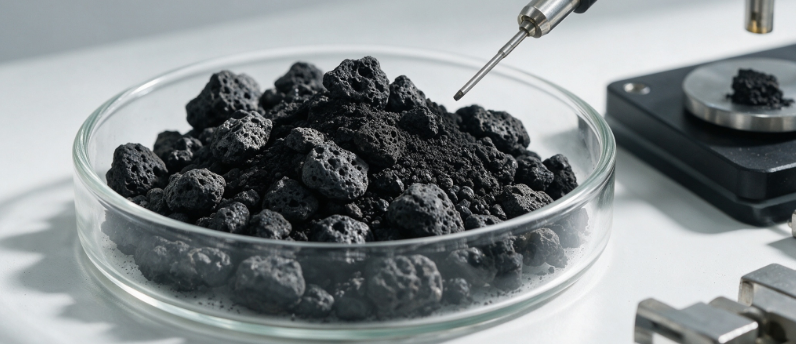
Sludge‑based activated carbon (SBAC)—derived from municipal, industrial, or biological wastewater sludge via pyrolysis and chemical or physical activation—has gained significant attention as a cost‑effective and sustainable adsorbent for wastewater treatment, flue gas purification, heavy metal removal, and organic pollutant control. Its performance is governed by a complex interplay of specific surface area, pore structure, surface functional groups, elemental composition, and the presence of inorganic ash components. However, the heterogeneity of sludge precursors and the variability in activation conditions can lead to inconsistent adsorption capacity, undesirable heavy metal leaching, or poor mechanical strength, limiting its practical application. Our laboratory provides a fully integrated, multi‑parameter testing platform specifically designed for sludge‑based activated carbon, combining textural, chemical, thermal, and application‑oriented assessments. We deliver quantitative, diagnostic, and predictive data that supports material development, quality control, process optimisation, and regulatory compliance for environmental engineers, waste management companies, and water treatment facilities.
Why Rigorous Testing of Sludge‑Based Activated Carbon Is Essential for Reliable Performance and Safety
Clients seeking SBAC testing often face challenges such as unexpectedly low pollutant removal efficiency, excessive release of trace metals (e.g., Pb, Cd, Cr, Cu) into treated water, or structural disintegration during use. These issues frequently originate from incomplete activation, non‑optimal carbonisation temperature, high ash content that blocks pores, or the presence of unstable mineral phases. Moreover, the environmental safety of SBAC—particularly concerning the leaching of heavy metals and organic contaminants—must be rigorously verified to comply with international standards (e.g., US EPA, EU directives). Our service provides a systematic characterisation that quantifies BET specific surface area, micropore/mesopore distribution, elemental composition (including heavy metals), surface functional groups (Boehm titration), thermal stability, and adsorption capacity for model pollutants (methylene blue, iodine, phenol, and heavy metals). By identifying the root causes of sub‑standard performance—such as insufficient activation, residual organic matter, or ash‑induced pore occlusion—we enable clients to optimise pyrolysis temperature, activation agent concentration, and pre‑treatment steps to ensure consistent, high‑quality product output.
Our Analytical Capabilities: From Bulk Composition to Surface Reactivity
Our testing programme is structured into five interconnected modules, each addressing a critical dimension of SBAC material properties and application fitness:
Textural and physical characterisation—We determine specific surface area (BET), total pore volume, and pore size distribution (DFT/BJH) via N₂ physisorption at 77 K, covering micropores (<2 nm) and mesopores (2‑50 nm). Mercury intrusion porosimetry evaluates macroporosity and bulk density. Particle size distribution is measured by laser diffraction, while mechanical strength (attrition resistance) is assessed using a rotating drum (ASTM D4058) to evaluate durability under handling and flow conditions.
Chemical composition and elemental analysis—We quantify major elements (C, H, N, S) by combustion‑gas chromatography (CHNS), and ash content by gravimetric analysis (ASTM D2866). X‑ray fluorescence (XRF) and inductively coupled plasma optical emission spectrometry (ICP‑OES) provide quantitative elemental profiles, including Si, Al, Fe, Ca, Mg, Na, K, P, and trace heavy metals (Pb, Cd, Cr, Cu, Zn, Ni, As, Hg). X‑ray diffraction (XRD) identifies mineral phases in the ash (e.g., quartz, calcite, clay minerals). For organic contaminants, we perform GC‑MS analysis of polycyclic aromatic hydrocarbons (PAHs) and volatile organic compounds (VOCs) to ensure safety for environmental applications.
Surface chemistry and functional group characterisation—We use Boehm titration to quantify acidic (carboxyl, lactonic, phenolic) and basic surface oxygen groups. X‑ray photoelectron spectroscopy (XPS) provides detailed information on carbon bonding (sp², sp³, C‑O, C=O, O‑C=O) and the chemical states of heteroatoms (N, S, O). Fourier‑transform infrared spectroscopy (FTIR‑ATR) identifies surface functional groups and confirms the presence of active sites. Temperature‑programmed desorption (TPD) coupled with mass spectrometry (MS) quantifies the evolution of CO and CO₂, providing a semi‑quantitative profile of surface oxygen complexes.
Adsorption performance testing—We conduct batch equilibrium experiments using standard adsorbates: iodine number (ASTM D4607), methylene blue number, and phenol adsorption capacity to evaluate micropore and mesopore accessibility. For heavy metal removal, we perform isotherm studies (Langmuir, Freundlich) and kinetic profiling (pseudo‑first‑order, pseudo‑second‑order) with representative metals (Pb²⁺, Cd²⁺, Cu²⁺) under controlled pH, temperature, and ionic strength. We also evaluate competitive adsorption in mixed‑solute systems and regenerability over multiple adsorption‑desorption cycles.
Stability, leaching, and environmental safety assessment—We perform leaching tests in accordance with EPA Method 1311 (TCLP) and EN 12457 to quantify the release of heavy metals and organic contaminants under simulated landfill or use‑phase conditions. Thermogravimetric Analysis (TGA) in air and inert atmospheres (up to 1000 °C) determines thermal stability, reactivity, and ash fusion behaviour. Hydrothermal stability is assessed by immersing the material in water at elevated temperature (e.g., 60‑90 °C for 24‑72 h) and re‑measuring BET, pore volume, and leaching profiles.
High‑Level Predictive Modelling and Diagnostic Interpretation
We integrate adsorption equilibrium data with isotherm and kinetic modelling to predict performance in fixed‑bed or continuous stirred‑tank reactors. Surface complexation models are used to describe metal binding behaviour as a function of pH. Using multivariate statistical analysis (PCA, PLS), we correlate pyrolysis conditions (temperature, heating rate, activation agent) with final textural and chemical properties, enabling quality‑by‑design (QbD) optimisation. For failure diagnosis, we combine post‑use characterisation (XRD, XPS, TGA) with performance history to distinguish between pore blockage, surface oxidation, active site poisoning, or mineral phase sintering as degradation mechanisms.
Regulatory Compliance and Quality Assurance
All test methods align with ASTM, ISO, EPA, and EN standards for activated carbon and waste material characterisation. Our laboratory holds ISO/IEC 17025:2017 accreditation for a broad scope of physical, chemical, and environmental testing. We issue certified test reports with full measurement uncertainty, traceability to NIST standards, and comprehensive quality control data (reference materials, blanks, duplicates). For product certification and regulatory submission, we provide complete documentation packages that meet the requirements of NSF/ANSI 61, EU REACH, and UK Environment Agency guidelines.
Our Distinctive Advantages in Sludge‑Based Activated Carbon Testing
In‑depth heavy metal and leaching expertise: We specialise in the analysis of sludge‑derived materials, with a focus on trace metal speciation, leachable fractions, and environmental risk. Our ICP‑MS and TCLP protocols are tailored to capture the specific challenges of waste‑derived carbons, ensuring that our clients receive reliable safety data.
Integrated ash and mineralogical analysis: We do not treat ash as a “background” component; we quantify it mineralogically (XRD) and chemically (XRF), and correlate with performance (e.g., pore blockage, attrition). This provides actionable insights for pre‑treatment (e.g., acid washing) or activation optimisation.
Realistic matrix simulation: Our adsorption tests use natural water matrices (with background ions, organic matter) and industrially relevant concentrations to ensure that our capacity data accurately predicts field performance.
Interpretive reporting with process guidance: Our team includes environmental chemists and engineers who provide specific, actionable recommendations—for example, advising on the optimal pyrolysis temperature to maximise surface area while minimising heavy metal mobilisation, or suggesting acid pre‑treatment to reduce ash content.
Fast turnaround and flexible sample volumes: Our standard full characterisation package is delivered within 10‑14 working days, with expedited 72‑hour service for key parameters (BET, iodine number, and leachable metals). We handle sample masses from 10 g to several kilograms.
End‑to‑End Service Workflow
We initiate each project with a complimentary technical consultation to define your sludge source, activation method, target application, and regulatory requirements. We then design a customised test plan, specifying sampling and shipping guidelines. Upon sample receipt, we perform inspection and preconditioning (drying, grinding, homogenisation). All tests are executed with strict QA/QC—reference materials, blanks, and replicate runs. Data are integrated and reviewed by our lead environmental scientist, then compiled into a comprehensive report containing BET isotherms, elemental composition tables, leaching profiles, adsorption curves, and a clear executive summary with optimisation recommendations. A post‑report meeting is offered to discuss findings and plan further development or deployment.
Partner with Us for Sustainable and Safe Sludge‑Based Carbon Solutions
Sludge‑based activated carbon offers a promising pathway to waste valorisation and circular economy, but its success depends on rigorous, science‑based characterisation. Our testing service provides the scientific depth, practical relevance, and regulatory support necessary to ensure your material performs effectively and safely. We have assisted municipalities, wastewater treatment plants, and environmental technology companies in developing and qualifying sludge‑derived carbons for commercial applications.
We invite you to contact our technical experts to discuss your specific SBAC testing needs—whether for product development, quality assurance, or regulatory compliance. With our advanced analytical capabilities, accredited protocols, and deep domain expertise, we provide the insights you need to perfect your sludge‑based activated carbon technology and achieve your sustainability and performance goals. Request a detailed proposal or schedule a technical consultation today and take the next step towards superior, data‑driven adsorbent solutions.