Reasons for choosing our testing services
ZHONGXI Testing has obtained inspection qualification certifications from multiple countries and regions worldwide. We possess a senior testing team and advanced testing methods, providing independent, impartial, and professional third-party verification services for global carbon projects.

Internationally recognized authority
Certified by multiple international standards such as CNAS, VCS, and GS, with reports universally applicable worldwide.

Global service capability
Covering 140+ countries and regions, it supports on-site detection and remote verification in multiple languages.

Professional experimental methods
Adopt standard experimental methods to ensure accurate and reliable data.
Advanced Performance Testing of Catalysts for sec‑Butyl Acetate Synthesis: Comprehensive Characterisation and Optimisation
Catalysts for sec‑butyl acetate production—primarily acidic ion‑exchange resins, zeolites, heteropolyacids, and supported sulphonic acid catalysts—play a pivotal role in the esterification of sec‑butanol with acetic acid, as well as in transesterification and reactive distillation processes. The efficiency, selectivity, and longevity of these catalysts directly influence reaction kinetics, product purity, and process economics. Even subtle variations in acid site density, pore architecture, thermal stability, and resistance to poisoning can lead to reduced conversion, unwanted side reactions (e.g., dehydration to butenes), or rapid deactivation. Our laboratory offers a fully integrated, multi‑parameter testing platform specifically designed for the rigorous evaluation of catalysts used in sec‑butyl acetate synthesis, combining physicochemical characterisation, activity and selectivity testing under realistic conditions, and accelerated deactivation/regeneration studies. We deliver quantitative, diagnostic, and predictive data that supports catalyst screening, process optimisation, quality assurance, and troubleshooting for chemical manufacturers and catalyst developers.
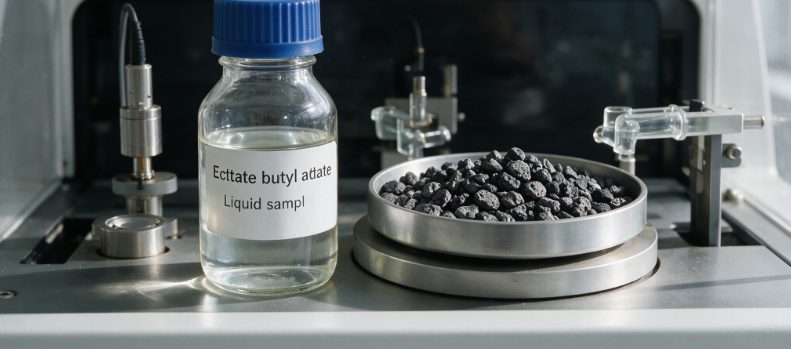
Why Dedicated Testing of sec‑Butyl Acetate Catalysts Is Essential for Process Efficiency and Product Quality
Clients seeking catalyst testing often face challenges such as unexpected decline in conversion, increased formation of by‑products (e.g., sec‑butyl ether, butenes), or shortened catalyst lifetime. These issues frequently stem from loss of acid sites due to leaching or fouling, pore blockage by heavy by‑products, or thermal degradation of the active phase. Furthermore, the presence of trace impurities in the feed (e.g., water, basic compounds) can irreversibly poison the active sites, reducing overall performance. Our service provides a systematic evaluation that quantifies acid site concentration (acidity), specific surface area (BET), pore structure, thermal stability, and catalytic activity (conversion, selectivity, yield) under steady‑state and transient conditions. By identifying the root causes of performance loss—such as sintering, coking, or ion exchange deactivation—we empower clients to select the most robust catalyst, optimise reaction parameters (temperature, feed ratio, space velocity), and establish effective regeneration protocols.
Our Analytical Capabilities: From Material Fingerprinting to Reactor Performance and Lifetime Prediction
Our testing framework is structured into five interconnected modules, each addressing a critical facet of catalyst behaviour:
Physicochemical characterisation—We determine specific surface area (BET), total pore volume, and pore size distribution (DFT/BJH) via N₂ physisorption at 77 K. X‑ray diffraction (XRD) identifies crystalline phases, while scanning electron microscopy (SEM‑EDS) examines particle morphology and elemental homogeneity. X‑ray photoelectron spectroscopy (XPS) probes surface chemical states, and Fourier‑transform infrared spectroscopy (FTIR) with pyridine adsorption distinguishes between Brønsted and Lewis acid sites. Temperature‑programmed desorption (TPD) of NH₃ or isopropylamine quantifies total acidity and acid strength distribution. Thermogravimetric Analysis (TGA) evaluates thermal stability and coke formation potential.
Catalytic activity and selectivity testing—We employ continuous flow fixed‑bed reactors and batch slurry reactors to simulate industrial esterification conditions. Using sec‑butanol and acetic acid (or other relevant feedstocks), we measure conversion, selectivity to sec‑butyl acetate, and by‑product formation (sec‑butyl ether, butenes, heavy esters) as functions of temperature (70‑150 °C), pressure (1‑10 bar), feed molar ratio, and space velocity (WHSV). Products are analysed by online GC‑FID with internal standard calibration, achieving detection limits below 0.1 % for all components. We also evaluate the effect of water co‑feed to mimic industrial recycle streams.
Kinetic and mass transfer studies—We derive intrinsic kinetic parameters (e.g., activation energy, reaction order) using differential reactor data and Weisz‑Prater analysis to assess intraparticle diffusion limitations. Effectiveness factors are calculated for different particle sizes, enabling optimal catalyst morphology design.
Deactivation and regeneration assessment—We perform accelerated ageing tests under aggressive conditions (e.g., elevated temperature, high water content, or feed impurities) to quantify the rate of activity decline. After deactivation, we characterise coke deposits (TGA, GC‑MS of extracted organics) and loss of acid sites (NH₃‑TPD, pyridine‑FTIR). Regeneration protocols (e.g., calcination in air, solvent washing) are evaluated, and multiple cycle tests are conducted to determine the maximum number of regenerations before unacceptable performance loss occurs.
Leaching and stability testing—For supported or resin‑based catalysts, we quantify leaching of active species (e.g., sulphonic acid groups, metal ions) into the liquid phase by ICP‑OES and ion chromatography (IC) over time, ensuring that catalyst integrity is maintained. Hydrothermal stability is assessed by exposing the catalyst to hot water/acetic acid mixtures and re‑measuring acidity and porosity.
High‑Level Predictive Modelling and Diagnostic Interpretation
We integrate experimental data with kinetic models (e.g., Langmuir‑Hinshelwood, Eley‑Rideal) to predict reactor performance under varying feed conditions. Using multivariate statistical analysis (PCA, PLS), we correlate synthesis parameters (e.g., cross‑linking degree, acid loading) with catalytic performance and stability, enabling quality‑by‑design (QbD) optimisation. For deactivation diagnosis, we combine post‑use characterisation (XRD, XPS, TGA, BET) with activity profiles to differentiate between coke deposition, acid site neutralisation, pore collapse, and active phase sintering as primary degradation mechanisms.
Regulatory Compliance and Quality Assurance
All test methods align with ASTM, ISO, and relevant industrial standards for catalyst characterisation and performance testing. Our laboratory holds ISO/IEC 17025:2017 accreditation for a broad scope of physicochemical and catalytic testing. We issue certified test reports with full measurement uncertainty, traceability to certified reference materials, and quality control data (blanks, duplicates, reference catalyst runs). For intellectual property and process scale‑up, we supply comprehensive data packages with detailed experimental protocols and raw data archives.
Our Distinctive Advantages in sec‑Butyl Acetate Catalyst Testing
Reactor flexibility and process simulation: We operate multiple reactor types (fixed‑bed, slurry, CSTR) to accommodate various catalyst forms (powder, extrudates, beads) and process conditions, enabling testing that closely mirrors industrial practice.
Real‑time product analysis and high throughput: Our automated multi‑stream GC systems allow simultaneous monitoring of up to 6 reactor outlets, accelerating kinetic and stability studies, while our high‑throughput screening rig can evaluate multiple catalyst formulations in parallel.
Integrated deactivation diagnostics: We correlate post‑run TGA, NH₃‑TPD, and FTIR with activity decline profiles to provide a mechanistic understanding of deactivation—whether due to coking, ion exchange with acetic acid, or thermal hydrolysis—offering targeted recommendations for regeneration or preventive measures.
Expert guidance for catalyst selection and process optimisation: Our team includes industrial chemists and chemical engineers with direct experience in esterification processes. We provide clear, actionable recommendations—for example, advising on the optimal acid site density to maximise selectivity while minimising butene formation, or suggesting a pre‑treatment step to remove leachable species.
Fast turnaround and flexible sample requirements: Our standard full characterisation and performance package is delivered within 12‑15 working days, with expedited 72‑hour screening for key parameters (conversion, acidity, BET). We handle sample masses from 1 g to several kilograms.
End‑to‑End Service Workflow
We begin with a complimentary technical consultation to define your catalyst type, reaction conditions, and performance targets. We design a customised test plan, including shipping and handling guidelines (e.g., drying, inert atmosphere for moisture‑sensitive materials). Upon sample receipt, we perform receipt inspection and preconditioning (e.g., drying, activation). All tests are executed with strict QA/QC—reference catalysts, blanks, and duplicate runs. Data are integrated and reviewed by our lead catalytic scientist, then compiled into a comprehensive report containing characterisation results, kinetic profiles, deactivation trends, and a clear executive summary with optimisation recommendations. A post‑report meeting is offered to discuss findings and plan further development or scale‑up.
Partner with Us for Reliable, High‑Performance Catalyst Solutions
The performance of sec‑butyl acetate catalysts is central to achieving high yields, product purity, and sustainable operation. Our testing service provides the scientific depth, practical realism, and regulatory support necessary to ensure your catalyst performs optimally under industrial conditions. We have supported catalyst manufacturers, chemical producers, and research institutions in screening, qualifying, and improving esterification catalysts.
We invite you to contact our technical experts to discuss your specific testing needs—whether for new catalyst development, quality control, or troubleshooting. With our advanced analytical instruments, accredited protocols, and specialised expertise, we provide the insights you need to perfect your catalytic process. Request a detailed proposal or schedule a technical consultation today and take the next step towards superior, data‑driven catalyst solutions for sec‑butyl acetate synthesis.