Reasons for choosing our testing services
ZHONGXI Testing has obtained inspection qualification certifications from multiple countries and regions worldwide. We possess a senior testing team and advanced testing methods, providing independent, impartial, and professional third-party verification services for global carbon projects.

Internationally recognized authority
Certified by multiple international standards such as CNAS, VCS, and GS, with reports universally applicable worldwide.

Global service capability
Covering 140+ countries and regions, it supports on-site detection and remote verification in multiple languages.

Professional experimental methods
Adopt standard experimental methods to ensure accurate and reliable data.
Advanced Analytical Characterisation of Single‑Walled Carbon Nanotubes: Comprehensive Quality, Purity, and Performance Testing
Single‑walled carbon nanotubes (SWCNTs)—cylindrical graphene sheets with exceptional electrical, thermal, and mechanical properties—are enabling breakthrough innovations in nanoelectronics, composite materials, biomedical imaging, energy storage, and sensing technologies. However, the practical exploitation of SWCNTs is critically dependent on their structural integrity, purity, diameter distribution, chirality, defect density, and surface chemistry. Even minor batch‑to‑batch variations in synthesis (arc discharge, CVD, laser ablation) or post‑processing (purification, functionalisation) can drastically alter functional performance, leading to inconsistent device yields, compromised mechanical reinforcement, or unpredictable biological behaviour. Our laboratory provides a fully integrated, multi‑technique analytical platform specifically designed for the rigorous characterisation of SWCNT materials, combining spectroscopic, microscopic, thermal, and elemental analysis with application‑oriented performance validation. We deliver quantitative, diagnostic, and predictive data that supports material development, quality control, supplier qualification, and regulatory compliance for academic, industrial, and biomedical clients worldwide.
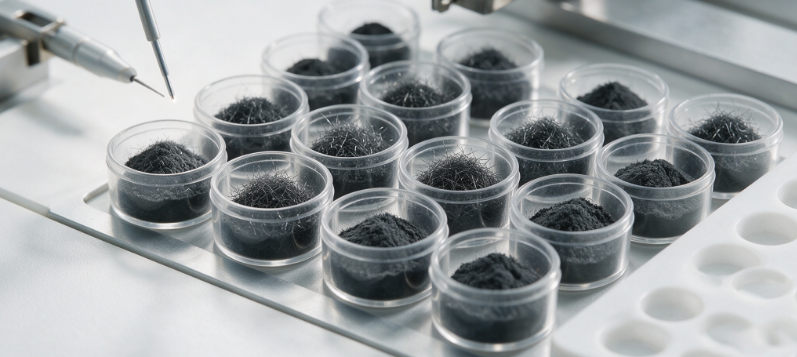
Why Comprehensive Testing of SWCNTs Is Essential for Reliable Performance and Regulatory Acceptance
Clients seeking SWCNT testing often encounter challenges such as unexpected electrical resistivity, poor dispersibility, batch‑to‑batch variability, or the presence of harmful metal catalyst residues. These issues frequently arise from incomplete removal of metal nanoparticles (Fe, Co, Ni, Mo), excessive amorphous carbon or graphitic impurities, non‑uniform diameter distribution, or damage to the sp² carbon framework during purification. Moreover, regulatory bodies (e.g., REACH, EPA, and OECD) increasingly require detailed physicochemical characterisation for risk assessment and product registration. Our service provides a systematic characterisation that quantifies purity (carbon content), metal catalyst residue (ICP‑MS), diameter and chirality distribution (UV‑Vis‑NIR and Raman), defect density (Raman D/G ratio), specific surface area (BET), and thermal stability (TGA). By identifying the root causes of performance deviations—such as oxidation, metal contamination, or aggregation—we enable clients to optimise synthesis parameters, refine purification protocols, and ensure batch‑to‑batch consistency for their target applications.
Our Analytical Capabilities: From Structural Fingerprinting to Application‑Relevant Performance Metrics
Our testing framework is organised into five interconnected modules, each addressing a critical facet of SWCNT quality and functionality:
Spectroscopic characterisation—We utilise UV‑Vis‑NIR absorption spectroscopy to probe the electronic transitions (S₁₁, S₂₂, M₁₁) and determine the diameter distribution and relative metallic/semiconducting content via integration of characteristic peaks. Photoluminescence excitation (PLE) mapping provides detailed chirality (n,m) assignment and quantitative assessment of the semiconducting fraction. Raman spectroscopy with multiple excitation wavelengths (e.g., 488, 532, 633, 785 nm) evaluates the radial breathing mode (RBM) for diameter distribution, the D/G ratio for defect density, and the G⁺/G⁻ splitting for metallic vs. semiconducting character. X‑ray photoelectron spectroscopy (XPS) quantifies surface chemical states (C‑C, C‑O, C=O, O‑C=O) and identifies any heteroatoms or metal contaminants at the surface.
Microscopic and morphological analysis—We employ high‑resolution transmission electron microscopy (HR‑TEM) with selected‑area electron diffraction (SAED) to visualise individual nanotubes, measure inner and outer diameters, assess wall integrity, and detect amorphous carbon or metal particle contamination. Scanning electron microscopy (SEM) with energy‑dispersive X‑ray spectroscopy (EDS) provides large‑area compositional mapping and impurity identification. Atomic force microscopy (AFM) in tapping mode measures height profiles (diameter) and length distribution of individual nanotubes deposited on suitable substrates.
Elemental and thermal analysis—We quantify total carbon content (combustion‑GC) and metal impurities (Fe, Co, Ni, Mo, etc.) by inductively coupled plasma mass spectrometry (ICP‑MS) after acid digestion, achieving detection limits below 1 ppm. Thermogravimetric Analysis (TGA) in air and inert atmospheres (up to 1000 °C) determines thermal stability, oxidation temperature, amorphous carbon content, and metal residue (ash). Differential scanning calorimetry (DSC) provides insight into oxidative exotherms and phase transitions. Brunauer‑Emmett‑Teller (BET) surface area and Barrett‑Joyner‑Halenda (BJH) pore volume are measured by N₂ physisorption at 77 K to assess accessible surface area and porosity.
Dispersion and functionalisation assessment—We evaluate dispersibility in common solvents (water, DMF, NMP, chlorobenzene) by UV‑Vis‑NIR absorbance after sonication and centrifugation, reporting the concentration (via Beer‑Lambert law) and suspension stability over time. Zeta potential measurements as a function of pH and ionic strength provide information on surface charge and colloidal stability. For functionalised SWCNTs, we quantify grafting density of organic groups by TGA mass loss, XPS, and elemental analysis (CHNS).
Electrical and conductive properties (on request)—For electronics applications, we can measure sheet resistance of SWCNT films using the four‑point probe method, and field‑effect transistor (FET) device testing to determine charge carrier mobility and on/off ratio. These tests are customised to your specific device geometry and measurement conditions.
High‑Level Diagnostics and Predictive Correlative Analysis
We integrate data from multiple techniques to build a comprehensive structure‑property relationship—for instance, correlating the Raman D/G ratio with TGA oxidation temperature to predict thermal stability, or linking chirality distribution (PLE) with conductivity for electronic applications. Our multivariate statistical analysis (PCA, PLS) identifies key quality attributes (CQAs) that govern performance, enabling quality‑by‑design (QbD) strategies for scaled‑up production and quality control. For research and development, we provide customised benchmarking against reference materials (e.g., NIST RM 8281) to validate measurement accuracy.
Regulatory Compliance and Quality Assurance
All test methods are aligned with ISO/TS 11251 (characterisation of SWCNTs), ISO 10808 (metals in SWCNTs), ASTM E2999 (Raman analysis), and relevant OECD guidelines for nanomaterials. Our laboratory holds ISO/IEC 17025:2017 accreditation for a broad scope of carbon nanomaterial characterisation. We provide certified test reports with full measurement uncertainty, traceability to NIST/CRM standards, and comprehensive quality control data (reference materials, blanks, duplicates). For regulatory submissions (e.g., REACH, EPA TSCA), we supply data packages in the required format, including detailed descriptions of sample handling, instrumentation, and statistical analysis.
Our Distinctive Advantages in SWCNT Testing
Unmatched spectroscopic depth and resolution: Our PLE mapping and multi‑wavelength Raman capabilities allow the definitive assignment of chiral indices and metallic/semiconducting fractions—a critical step for applications in electronics and sensing, where chirality dictates performance.
Correlative TEM‑Raman‑TGA workflow: We perform HR‑TEM, Raman spectroscopy, and TGA on the same sample batch, ensuring that morphological, structural, and purity data are directly comparable and eliminating cross‑batch variation. This holistic approach provides a complete material fingerprint.
Realistic dispersion and process simulation: Our dispersion tests and functionalisation quantification are conducted under conditions relevant to your specific application—whether it is polymer composite compounding, inkjet printing, or biological conjugation—ensuring that our data is directly actionable.
Expert interpretation and problem‑solving: Our team includes specialists in carbon nanomaterials with extensive experience in SWCNT synthesis and purification. We provide specific, actionable recommendations—for example, advising on the optimal acid‑treatment time to remove metal catalysts without introducing excessive defects, or suggesting sonication conditions that maximise dispersion without damaging the nanotubes.
Fast turnaround with flexible sample volumes: Our standard full characterisation package is delivered within 10‑15 working days, with expedited 48‑72 hour service for key parameters (purity, diameter, defect density). We handle sample quantities from 1 mg to 1 g, accommodating both early‑stage research and production‑scale quality control.
End‑to‑End Service Workflow
We initiate each project with a complimentary technical consultation to define your material synthesis route, intended application, and critical quality attributes. Based on this, we design a tailored test plan, including sampling, handling, and shipping recommendations (e.g., inert atmosphere for air‑sensitive samples). Upon sample receipt, we perform receipt inspection and document all initial observations. Analyses are carried out using validated protocols, with internal quality checks at every step. Data are compiled into a comprehensive, easy‑to‑interpret report featuring annotated spectra, micrographs, elemental tables, and a clear executive summary with actionable recommendations. A post‑report meeting is available to discuss the findings and guide your next development or quality assurance steps.
Partner with Us for Reliable, High‑Performance SWCNT Solutions
Single‑walled carbon nanotubes are among the most remarkable materials of our time, but their complexity demands a sophisticated analytical partner. Our testing service offers the technical depth, operational flexibility, and regulatory readiness to ensure that your SWCNTs consistently meet the highest standards of purity, structure, and functional performance. We have supported leading electronics manufacturers, composite material developers, biomedical researchers, and regulatory agencies in advancing their SWCNT technologies.
We invite you to contact our technical experts to discuss your specific SWCNT testing needs—whether for raw material release, process optimisation, or regulatory submission. With our state‑of‑the‑art instrumentation, accredited quality systems, and proven expertise, we provide the clarity and confidence you need to excel in your field. Request a detailed proposal or schedule a consultation today and experience the advantage of specialised, high‑end SWCNT characterisation.