Reasons for choosing our testing services
ZHONGXI Testing has obtained inspection qualification certifications from multiple countries and regions worldwide. We possess a senior testing team and advanced testing methods, providing independent, impartial, and professional third-party verification services for global carbon projects.

Internationally recognized authority
Certified by multiple international standards such as CNAS, VCS, and GS, with reports universally applicable worldwide.

Global service capability
Covering 140+ countries and regions, it supports on-site detection and remote verification in multiple languages.

Professional experimental methods
Adopt standard experimental methods to ensure accurate and reliable data.
Advanced Performance Testing of Light Olefin Catalysts: Comprehensive Characterisation and Process Optimisation
The production of light olefins (ethylene, propylene, and butenes) through processes such as methanol-to-olefins (MTO), fluid catalytic cracking (FCC), propane dehydrogenation (PDH), and ethanol dehydration relies fundamentally on the performance of specialised catalysts. These catalysts, often comprising silicoaluminophosphate (SAPO) molecular sieves, high-silica ZSM-5 zeolites, or supported metal oxides (CrOx/Al₂O₃, Pt-Sn), operate under harsh conditions of high temperature, steam partial pressure, and frequent regeneration cycles. The commercial viability of these processes is dictated by a narrow window of optimal performance, where activity (conversion), selectivity (especially propylene-to-ethylene ratio), and longevity (resistance to coking and sintering) must be precisely balanced. Our laboratory provides a fully integrated, multi-scale testing platform specifically designed for the rigorous characterisation of light olefin catalysts, combining advanced physicochemical analysis, high-throughput kinetic testing, in-situ spectroscopy, and accelerated deactivation/regeneration studies. We deliver quantitative, diagnostic, and predictive data that supports catalyst screening, quality assurance, process troubleshooting, and next-generation formulation development for the petrochemical and refining industries.
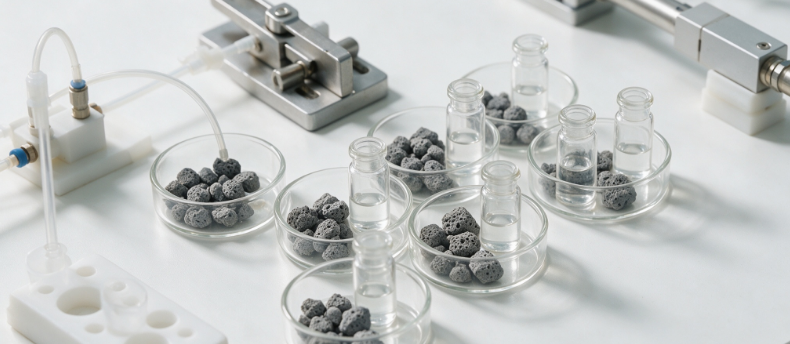
Why Dedicated Testing of Light Olefin Catalysts Is Critical for Commercial Viability
Clients seeking testing of these catalysts frequently encounter challenges such as unexpected selectivity drift during an operating cycle, rapid pressure-drop build-up due to coking, or irreversible deactivation following regeneration. These issues often stem from non-optimal acid site distribution (Bronsted/Lewis ratio), microstructural collapse under steaming, or agglomeration of active metal sites. Furthermore, the complex interplay between diffusion limitations (shape selectivity), reaction kinetics, and heat transfer in industrial reactors means that laboratory data must be generated under conditions that realistically mimic commercial practice. Our service provides a systematic evaluation that quantifies total acidity (NH₃-TPD), acid strength distribution, specific surface area (BET) and micropore volume, metal dispersion (H₂ or CO chemisorption), coke deposition kinetics (TGA), and catalytic performance (conversion, selectivity, and deactivation rate) under realistic feed compositions and space velocities. By identifying the root causes of performance degradation—such as dealumination, framework collapse, or site poisoning—we enable clients to optimise synthesis protocols, adjust regeneration conditions, and select optimal catalyst formulations for specific feedstocks.
Advanced Analytical Capabilities: From Atomic Structure to Catalytic Function
Our testing framework is organised into five interconnected modules, each addressing a critical dimension of catalyst behaviour in the context of light olefin production:
Structural and textural characterisation. We employ high-resolution powder X-ray diffraction (PXRD) with Rietveld refinement to determine phase purity, crystallite size, and unit cell parameters, detecting any amorphous impurities or phase transitions. Scanning electron microscopy (SEM) and transmission electron microscopy (TEM) with EDS mapping visualise morphology, particle size distribution, and elemental homogeneity. N₂ physisorption at 77 K provides BET specific surface area and DFT/BJH pore size distribution, covering micropores and mesopores critical for reactant accessibility. Solid-state ²⁹Si and ²⁷Al MAS-NMR probes the framework coordination and Si/Al ratio, quantifying framework defects and extra-framework aluminium species.
Acidity and active site characterisation. We quantify total acidity and acid strength distribution using temperature-programmed desorption of ammonia (NH₃-TPD), distinguishing between weak, medium, and strong acid sites. Pyridine-adsorbed FTIR differentiates Bronsted and Lewis acid sites by the characteristic bands at 1545 cm⁻¹ and 1455 cm⁻¹, respectively. For metal-based catalysts, we perform hydrogen (H₂) or carbon monoxide (CO) chemisorption to determine metal dispersion (%) and active surface area, and temperature-programmed reduction (H₂-TPR) to evaluate reducibility and metal-support interactions.
In-situ and operando spectroscopic analysis. To understand dynamic changes under reaction conditions, we offer in-situ FTIR and Raman spectroscopy combined with gas feeds to monitor the formation of reaction intermediates (e.g., methoxy species, carbenium ions) and coke precursors. UV-Vis diffuse reflectance spectroscopy (in-situ) tracks the state of transition metal ions (e.g., Cr⁶⁺/Cr³⁺) during redox cycles. These measurements provide mechanistic insight that guides rational catalyst improvement, correlating spectral fingerprints with activity/selectivity shifts.
Catalytic performance evaluation under simulated industrial conditions. We operate custom-designed fixed-bed micro-reactors and fluidised-bed units equipped with precise temperature, pressure, and flow control. Using the relevant feedstock (methanol, propane, naphtha, or ethanol), we measure conversion, product yields, and selectivity (including propylene/ethylene ratio, butenes distribution, and coke selectivity) as functions of temperature (350-650 °C), pressure (1-5 bar), weight-hourly space velocity (WHSV), and time-on-stream (TOS). Products are analysed by on-line gas chromatography (GC-FID/TCD) with backflush capability to separate C1-C6 hydrocarbons, oxygenates, and permanent gases. We also evaluate the effect of co-fed steam or hydrogen to simulate commercial regeneration or stabilisation conditions.
Deactivation, regeneration, and coking analysis. We conduct accelerated deactivation studies by increasing feed severity or extending TOS, monitoring activity decay profiles. Thermogravimetric Analysis (TGA) coupled with mass spectrometry (MS) quantifies coke deposition (total weight loss) and characterizes its nature (e.g., soft vs. hard coke, aliphatic vs. aromatic) by analysing effluent species during combustion/thermal desorption. Regeneration protocols (air, oxygen-nitrogen, or steam) are simulated in the reactor system, and multiple cycle tests are performed to determine the catalyst lifetime and the efficiency of coke burn-off. Post-regeneration characterisation (XRD, BET, NH₃-TPD) identifies irreversible changes such as sintering, phase transformation, or acid site loss.
High-Level Predictive Modelling and Diagnostic Interpretation
We integrate kinetic, physical, and spectroscopic data with lumped kinetic models (e.g., hydrocarbon pool mechanism, direct cracking pathways) to simulate reactor performance and predict yields under varying process parameters. Using multivariate analysis (PCA, PLS), we correlate synthesis variables (Si/Al ratio, template type, metal loading) with key performance indicators (activity, propylene selectivity, coking rate), enabling quality-by-design (QbD) optimisation of catalyst manufacturing. For post-mortem analysis, we combine post-use characterisation (XRD, XPS, TGA, TEM) with operational history to distinguish between carbon-induced pore plugging, thermal dealumination, and metal sintering as primary deactivation mechanisms, providing targeted recommendations for process adjustments or catalyst re-formulation.
Regulatory Compliance and Quality Assurance
All test methods are aligned with ASTM, ISO, and relevant industry standards for catalyst characterisation and hydrocarbon analysis. Our laboratory holds ISO/IEC 17025:2017 accreditation for a broad scope of physicochemical testing and catalytic evaluation. We issue certified test reports containing full measurement uncertainty, traceability to certified reference materials, and rigorous quality control data (reference catalysts, blanks, and duplicate runs). For intellectual property and process-scale licensing, we supply comprehensive data packages with detailed experimental protocols and raw data archives.
Our Distinctive Advantages in Light Olefin Catalyst Testing
Multi-scale and multi-technique integration. We correlate micro-scale acidity (NH₃-TPD) and pore architecture (BET) with macro-scale reactor performance on the same sample batch. This eliminates cross-batch variability and provides a robust structure-activity relationship that is essential for understanding the complex hydrocarbon pool mechanism in MTO and FCC processes.
Industrial realistic feed and condition simulation. Unlike standard academic tests, our setups accommodate impurity-containing feeds (e.g., methanol with water, propane with light alkanes) and replicate fast-flow fluidised conditions (where applicable), ensuring that our data translates directly to commercial operations, not just idealised lab scenarios.
Advanced coking and regeneration diagnostics. We provide detailed coke speciation (via GC-MS on extracted organics) and quantitative regeneration kinetics, helping our clients optimise their regeneration strategy (temperature ramp, air flow) to minimise irreversible catalyst damage while ensuring complete carbon removal.
Expert interpretation and actionable guidance. Our team consists of chemical engineers and catalysis scientists with deep industrial experience in olefin production. We provide specific recommendations—for instance, adjusting the SAPO-34 crystal size to improve diffusion, modifying the Cr/Al ratio to enhance stability in PDH, or suggesting a steaming pretreatment to stabilise framework aluminium in zeolites.
Fast turnaround and adaptable sample formats. Our standard full characterisation and performance package is delivered within 10-15 working days, with expedited 72-hour screening for key activity and selectivity parameters. We handle powder catalysts, spray-dried microspheres, extrudates, and even commercial shaped pellets.
End-to-End Service Workflow
We initiate each project with a complimentary technical consultation to define your catalyst type, target process (MTO, FCC, PDH, etc.), feedstock specifications, and performance targets. We design a customised test plan, including handling and shipping guidelines (e.g., inert atmosphere for air-sensitive samples). Upon sample receipt, we perform preconditioning (calcination, reduction, or drying). All tests are executed with strict quality controls. Data is integrated and reviewed by our lead catalysis scientist, then compiled into a comprehensive report containing structural characterisation, acidity profiles, reactor performance curves, deactivation trends, and a clear executive summary with actionable recommendations. A post-report meeting is offered to discuss the findings and plan further development or scale-up.
Contact our technical experts today to discuss your specific light olefin catalyst testing requirements. With our advanced analytical capabilities, accredited protocols, and specialised expertise, we provide the insights necessary to optimise your catalyst selection, enhance process efficiency, and drive innovation in olefin production. Request a detailed proposal or schedule a technical consultation to take the next step towards superior, data-driven catalytic solutions.