Reasons for choosing our testing services
ZHONGXI Testing has obtained inspection qualification certifications from multiple countries and regions worldwide. We possess a senior testing team and advanced testing methods, providing independent, impartial, and professional third-party verification services for global carbon projects.

Internationally recognized authority
Certified by multiple international standards such as CNAS, VCS, and GS, with reports universally applicable worldwide.

Global service capability
Covering 140+ countries and regions, it supports on-site detection and remote verification in multiple languages.

Professional experimental methods
Adopt standard experimental methods to ensure accurate and reliable data.
Comprehensive Analytical Testing of Antimony Tellurate Nanorod Biofiltration Media: Advanced Characterisation for Environmental and Biomedical Applications
Antimony tellurate (Sb₂Te₄O₁₁ or related stoichiometries) nanorods represent a novel class of inorganic biofiltration materials with unique physicochemical properties, including high specific surface area, tunable surface charge, exceptional chemical stability, and promising biocompatibility. These anisotropic nanostructures are increasingly explored for wastewater treatment, heavy metal scavenging, antimicrobial filtration, and controlled drug delivery systems. The performance of such nanorod‑based filters depends critically on morphological uniformity (aspect ratio, diameter distribution), crystallographic phase purity, surface functional groups, and the absence of cytotoxic leachables. Even subtle variations in synthesis—such as precursor concentration, reaction temperature, or hydrothermal ageing—can lead to batch‑to‑batch variations in nanorod dimensions, secondary phase formation (e.g., Sb₂O₃, TeO₂), or residual organic contaminants, all of which directly impact filtration efficiency and biological safety. Our laboratory provides a fully integrated, multi‑scale testing platform specifically engineered for antimony tellurate nanorod biofiltration media, combining high‑resolution structural and morphological characterisation, precise elemental and speciation analysis, surface chemical profiling, in‑vitro biocompatibility screening, and dynamic filtration performance evaluation. We deliver quantitative, diagnostic, and predictive data that supports material development, quality assurance, regulatory compliance, and application optimisation for environmental engineering, water treatment, and biomedical device industries.
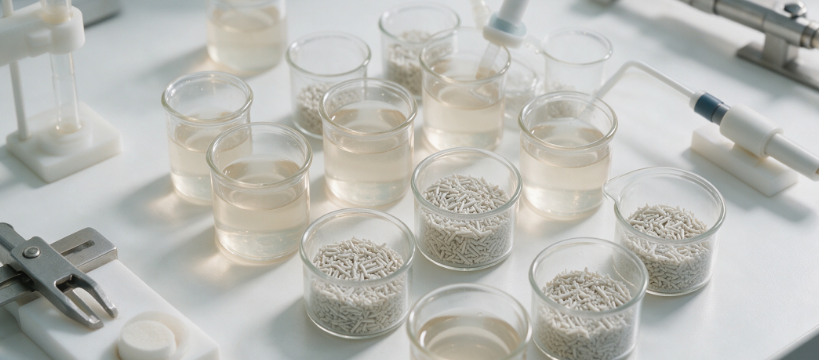
Why Dedicated Testing of Antimony Tellurate Nanorod Biofilters Is Essential for Reliable and Safe Performance
Clients seeking testing of this advanced filtration medium frequently encounter challenges such as inconsistent contaminant removal efficiency, unexpected Cytotoxicity in cell‑based assays, or poor long‑term hydraulic stability. These issues often originate from non‑uniform nanorod growth leading to broad size distribution, incomplete removal of precursor‑derived impurities, or surface oxidation that alters zeta potential and protein adsorption. Furthermore, the potential release of toxic antimony or tellurium species under operational conditions (e.g., pH shifts, microbial activity) demands rigorous leachability and ecotoxicity testing, especially for drinking water or biomedical applications. Our service provides a systematic characterisation that quantifies nanorod dimensions (length, diameter, aspect ratio) and distribution via TEM/SEM, crystalline phase composition (XRD), surface chemistry (XPS, FTIR), elemental stoichiometry (ICP‑MS), zeta potential and colloidal stability, specific surface area (BET), and simulated filtration performance (removal of model pathogens, heavy metals, or organic toxins). By identifying the root causes of sub‑optimal performance—such as poor crystallinity, surface contamination, or nanorod aggregation—we empower clients to optimise hydrothermal synthesis parameters, implement effective washing/annealing steps, and validate batch‑to‑batch reproducibility for reliable, safe biofiltration products.
Our Analytical Capabilities: From Nanoscale Architecture to Functional Performance and Biosafety
Our testing framework is structured into five interconnected modules, each addressing a critical aspect of nanorod biofilter quality and application fitness:
Structural and morphological characterisation—We employ high‑resolution transmission electron microscopy (HR‑TEM) with selected‑area electron diffraction (SAED) and scanning electron microscopy (SEM) with energy‑dispersive X‑ray spectroscopy (EDS) to visualise nanorod morphology, measure individual length, diameter, and aspect ratio, and assess size distribution across multiple fields. Powder X‑ray diffraction (PXRD) with Rietveld refinement identifies the precise crystalline phase(s), quantifies any amorphous content, and calculates crystallite size and microstrain. Atomic force microscopy (AFM) provides complementary height profiling and surface roughness data.
Elemental composition and speciation analysis—We determine bulk elemental stoichiometry (Sb, Te, O, and any dopants) by inductively coupled plasma optical emission spectrometry (ICP‑OES) and ICP‑mass spectrometry (ICP‑MS) with sub‑ppm detection limits. X‑ray photoelectron spectroscopy (XPS) with depth profiling (Ar⁺ sputtering) reveals surface oxidation states (Sb³⁺/Sb⁵⁺, Te⁴⁺/Te⁶⁺), quantifies surface adsorbates, and detects trace contamination. Raman spectroscopy and Fourier‑transform infrared spectroscopy (FTIR‑ATR) identify characteristic vibrations of tellurate and antimonate groups, as well as any organic residues from surfactants or capping agents.
Surface and colloidal characterisation—We measure specific surface area (BET) and pore size distribution (DFT/BJH) via N₂ physisorption at 77 K. Zeta potential as a function of pH (2–10) and ionic strength determines the isoelectric point and surface charge, critical for predicting electrostatic interactions with charged pollutants and microbial cells. Hydrodynamic size and polydispersity are assessed by dynamic light scattering (DLS) in relevant dispersion media (water, saline, culture medium) to evaluate aggregation propensity and colloidal stability.
Biological safety and biocompatibility testing—We perform in‑vitro Cytotoxicity assays (MTT, LDH, or Alamar Blue) using representative mammalian cell lines (e.g., HEK‑293, L929) following ISO 10993‑5 guidelines. Hemocompatibility is evaluated by haemolysis rate and platelet activation. Endotoxin testing (LAL assay) ensures compliance for medical applications. We also conduct leachability studies by incubating the nanorods in simulated physiological or environmental fluids (PBS, serum, groundwater) and quantifying released Sb and Te species by ICP‑MS over 7‑14 days.
Filtration performance simulation—We evaluate dynamic filtration efficiency using customised flow‑through columns spiked with model contaminants: bacteria (E. coli, S. aureus) and viruses (MS2 Bacteriophage) for antimicrobial assessment; heavy metal ions (Pb²⁺, Cd²⁺, As³⁺) for water purification; and organic dyes or endocrine‑disrupting chemicals for adsorption capacity. Influent and effluent are analysed by plate counting, flow cytometry, ICP‑MS, or HPLC‑UV to calculate removal efficiency (%), breakthrough capacity, and pressure drop as a function of flow rate and bed depth. We also perform multiple cycle tests to assess reusability and structural integrity after backwashing or regeneration.
High‑Level Predictive Modelling and Diagnostic Interpretation
We integrate morphological, surface, and filtration data with transport‑reaction models to predict filter performance under varying operational parameters. Using multivariate statistical analysis (PCA, PLS), we correlate synthesis conditions (temperature, pH, precursor ratio) with key quality attributes (aspect ratio, zeta potential, contaminant removal), enabling quality‑by‑design (QbD) optimisation. For root‑cause failure analysis, we combine post‑use characterisation (TEM, XPS, ICP‑MS) with performance decline profiles to distinguish between nanorod dissolution, surface fouling by organic matter, and mechanical fragmentation as degradation mechanisms.
Regulatory Compliance and Quality Assurance
All test methods are aligned with ASTM, ISO, US EPA, and OECD guidelines for nanomaterials, biocides, and water filters. Our laboratory holds ISO/IEC 17025:2017 accreditation for a broad scope of physicochemical, biological, and environmental testing. We issue certified test reports with full measurement uncertainty, traceability to NIST/CRM standards, and quality control data (reference materials, blanks, duplicates). For product registration (e.g., NSF/ANSI, CE, FDA 510(k)), we provide comprehensive data packages with detailed protocols and raw data archives.
Our Distinctive Advantages in Antimony Tellurate Nanorod Biofilter Testing
Integrated morphological‑chemical‑functional correlation: We perform HR‑TEM, XRD, XPS, BET, and filtration assays on identical sample batches, enabling direct correlation between nanorod dimensions, surface chemistry, and contaminant removal efficiency. This holistic, within‑batch approach eliminates inter‑sample variability and provides a complete material fingerprint, essential for understanding the structure‑performance relationships of these complex ternary oxides.
Advanced tellurium/antimony speciation and leachability profiling: Our combined XPS, Raman, and ICP‑MS capabilities allow unequivocal identification of oxidation states and precise quantification of metal release under dynamic conditions—critical for ensuring long‑term safety and environmental compliance, especially given the potential toxicity of soluble tellurium species.
Realistic filtration and biocompatibility simulation: We use actual microbial strains, natural water matrices, and serum‑containing media in our tests, ensuring that our performance and safety data directly reflect real‑world conditions, not simplified buffer solutions.
Expert guidance for material and process optimisation: Our team includes nanomaterial chemists, environmental engineers, and toxicologists with deep experience in ternary oxide synthesis and biofiltration. We provide specific, actionable recommendations—for example, adjusting the hydrothermal treatment to optimise nanorod aspect ratio for maximum surface area, or suggesting a coating step to reduce nonspecific protein adsorption and enhance antibacterial activity.
Fast turnaround and flexible sample formats: Our standard full characterisation and performance package is delivered within 12‑16 working days, with expedited 72‑hour screening for key parameters (size distribution, phase purity, and initial filtration efficiency). We handle powders, suspensions, and pre‑packed filter cartridges with sample masses as low as 50 mg.
End‑to‑End Service Workflow
We begin with a complimentary technical consultation to define your synthesis route, target application (e.g., drinking water treatment, antimicrobial filter, biomedical device), and critical quality attributes. We design a tailored test plan, advising on sample handling and shipping (including inert atmosphere or refrigeration if needed). Upon sample receipt, we perform receipt inspection and preconditioning (drying, sterilisation if applicable). All tests are executed with strict QA/QC—reference materials, blanks, and replicates. Data are integrated and reviewed by our lead material scientist, then compiled into a comprehensive report containing TEM images, XRD patterns, XPS spectra, filtration breakthrough curves, biocompatibility results, and a clear executive summary with optimisation recommendations. A post‑report meeting is offered to discuss findings and plan further development or scale‑up.
Partner with Us for Reliable, High‑Performance Antimony Tellurate Nanorod Biofilter Solutions
Antimony tellurate nanorods represent a frontier in advanced filtration, but their successful translation into safe and effective products demands rigorous, multi‑faceted characterisation. Our testing service provides the scientific depth, practical relevance, and regulatory support necessary to ensure your biofilter material meets the highest standards of performance, safety, and consistency. We have supported water treatment developers, biomedical device manufacturers, and research institutions in qualifying and optimising nanorod‑based filtration technologies.
We invite you to contact our technical experts to discuss your specific testing needs—whether for material screening, quality control, or regulatory submission. With our advanced analytical instruments, accredited protocols, and specialised expertise, we provide the insights you need to perfect your antimony tellurate nanorod biofilter technology. Request a detailed proposal or schedule a technical consultation today and take the next step towards superior, data‑driven filtration solutions.