Reasons for choosing our testing services
ZHONGXI Testing has obtained inspection qualification certifications from multiple countries and regions worldwide. We possess a senior testing team and advanced testing methods, providing independent, impartial, and professional third-party verification services for global carbon projects.

Internationally recognized authority
Certified by multiple international standards such as CNAS, VCS, and GS, with reports universally applicable worldwide.

Global service capability
Covering 140+ countries and regions, it supports on-site detection and remote verification in multiple languages.

Professional experimental methods
Adopt standard experimental methods to ensure accurate and reliable data.
Advanced Performance Testing of Gas‑Line Desiccants: Comprehensive Quality Assurance for Critical Drying Applications
Gas‑line desiccants—including activated alumina, molecular sieves (3A, 4A, 5A, 13X), silica gel, and clay‑based adsorbents—are essential for removing moisture from compressed air, natural gas, instrument air, process gases, and refrigerant circuits to prevent corrosion, hydrate formation, and equipment malfunction. The reliability of these drying systems hinges on the desiccant's water adsorption capacity, breakthrough performance, regeneration efficiency, mechanical integrity, and resistance to oil, acid gases, and particulate fouling. Even minor deviations in desiccant quality or ageing can lead to unacceptable dew points, accelerated pressure drop, premature saturation, or costly process downtime. Our laboratory offers a fully integrated, multi‑scale testing platform specifically designed for the rigorous evaluation of gas‑line desiccants, combining static and dynamic water adsorption measurements, thermal regeneration studies, dew‑point analysis, pressure‑drop profiling, and mechanical durability testing. We deliver quantitative, diagnostic, and predictive data that supports desiccant selection, quality control, supplier qualification, and predictive maintenance for the petrochemical, pharmaceutical, food processing, and power generation industries.
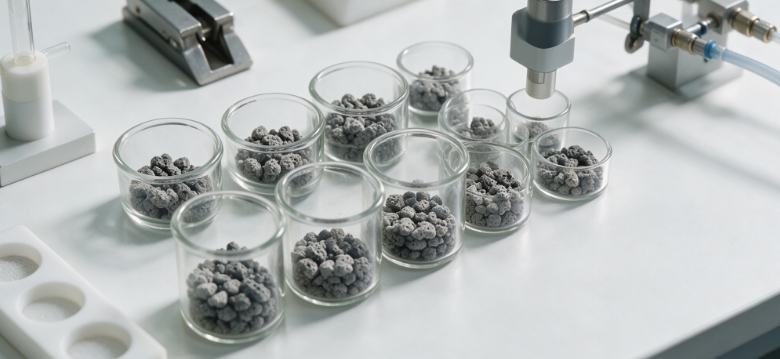
Why Rigorous Testing of Gas‑Line Desiccants Is Critical for Operational Efficiency and Safety
Plant operators and maintenance engineers seeking desiccant testing often encounter challenges such as unexpected dew‑point excursions, frequent regeneration cycles, excessive dusting causing valve wear, or bed fluidisation due to broken pellets. These issues frequently stem from sub‑optimal pore structure, inadequate activation, contamination by oil or compressor condensate, or mechanical attrition during transport/loading. Moreover, the interplay between water loading, regeneration temperature, and gas flow rate determines the economic viability of the drying system. Our service provides a systematic characterisation that quantifies equilibrium water capacity (g/100g) at relevant relative humidities, dynamic adsorption rate (breakthrough curves), regeneration energy requirements, loss on attrition, bulk density, and particle size distribution. By identifying the root causes of sub‑standard performance—such as pore blockage, adsorbent poisoning by hydrocarbon carryover, or thermal degradation—we enable clients to optimise change‑out schedules, select the most cost‑effective desiccant for their specific gas composition, and implement effective pre‑filtration measures.
Our Analytical Capabilities: From Material Fingerprinting to Simulated Service‑Life Performance
Our testing framework is structured into five interconnected modules, each addressing a critical dimension of desiccant quality and application fitness:
Physicochemical and textural characterisation—We determine specific surface area (BET), total pore volume, and pore size distribution (DFT/BJH) via N₂ physisorption at 77 K. X‑ray diffraction (XRD) confirms crystalline phases (e.g., NaA, KA, gamma‑alumina) and detects any amorphous impurities or hydration products. Scanning electron microscopy (SEM) with EDS examines particle morphology and elemental composition, while Thermogravimetric Analysis (TGA) quantifies bound water content and desorption profiles. Bulk density (loose and tapped), particle size distribution (sieve analysis and laser diffraction), and crush strength (single‑pellet and bulk) are measured to assess handling and packing behaviour.
Static and dynamic water adsorption performance—We measure equilibrium water isotherms at multiple temperatures (10‑60 °C) using a gravimetric dynamic vapour sorption (DVS) system over a relative humidity range of 0‑95 %. From these, we calculate monolayer capacity, Freundlich constants, and isosteric heat of adsorption. Dynamic breakthrough tests are conducted in packed‑bed columns using humidified gas streams (air, nitrogen, or natural gas) at controlled flow rates, pressures, and inlet dew points, with online dew‑point sensors (mirror‑type or capacitive) and mass flow controllers to generate breakthrough curves. We derive kinetic adsorption rate constants, mass transfer zone (MTZ) length, and saturation capacity under realistic operating conditions.
Regeneration and thermal stability assessment—We evaluate regeneration efficiency by subjecting loaded desiccants to temperature‑swing (100‑300 °C) and pressure‑swing protocols in the column rig, measuring residual water after regeneration, energy consumption, and the number of cycles before capacity declines. Accelerated thermal ageing is performed in a controlled oven (at temperatures up to 350 °C) followed by re‑characterisation (BET, crush strength) to determine the onset of irreversible degradation (e.g., alumina phase transformation, zeolite dealumination).
Mechanical integrity and dust generation—We quantify attrition resistance using a rotating drum (ASTM D4058) or fluidised‑bed attrition tester to measure fines generation (mass % < 20 µm) and pellet/bead breakage. Crush strength of individual particles is determined using a texture analyser with a flat probe, reporting the force at break (N). For dusting risk, we measure particle dusting propensity by air‑elutriation and collect respirable fines for gravimetric analysis.
Contaminant tolerance and chemical stability—We simulate the effect of oil carryover, compressor lubricant vapour, acidic gases (CO₂, H₂S, SO₂), and liquid water slugs by exposing the desiccant to controlled doses and then re‑measuring adsorption capacity and structural integrity. Leachables and extractables are analysed by GC‑MS and ICP‑MS to ensure that no harmful species are released into the gas stream, especially for food‑contact or pharmaceutical applications.
High‑Level Predictive Modelling and Diagnostic Interpretation
We integrate column breakthrough data with mass‑transfer and adsorption kinetic models (e.g., linear driving force, pore‑diffusion) to predict the service life and replacement intervals for given process conditions. Using multivariate statistical analysis (PCA, PLS), we correlate desiccant synthesis parameters (e.g., activation temperature, binder content) with key performance indicators (capacity, attrition, regeneration efficiency), enabling quality‑by‑design (QbD) for desiccant manufacturing. For failure diagnosis, we combine post‑exposure characterisation (XRD, SEM, TGA) with performance histories to distinguish between mechanical breakdown, chemical poisoning, and thermal degradation as primary failure modes.
Regulatory Compliance and Quality Assurance
All test methods align with ASTM, ISO, and industry‑specific standards for desiccant evaluation, including ASTM D3460 (silica gel), D4882 (bentonite), D5757 (adsorbent performance), and ISO 10927. Our laboratory is ISO/IEC 17025:2017 accredited for a broad scope of gas‑phase adsorption and mechanical testing. We issue certified test reports with full measurement uncertainty, traceability to NIST reference materials, and quality control data (reference desiccants, blanks, duplicates). For operational safety and environmental compliance, we provide comprehensive data packages suitable for ISO 8573 (compressed air purity) and NACE MR0175 (sour service) requirements.
Our Distinctive Advantages in Gas‑Line Desiccant Testing
Integrated static‑dynamic workflow: We combine equilibrium isotherms (DVS) with dynamic breakthrough (column) on the same sample, providing a complete picture of both thermodynamic capacity and kinetic behaviour—essential for designing real‑world dryers with finite bed lengths and regeneration schedules.
Realistic contaminant simulation: Our rigs accept actual process gas compositions (natural gas, air, CO₂, etc.) with controlled humidity and trace impurities, ensuring that our capacity and pressure‑drop data are directly scalable to field conditions, unlike tests using only clean, dry nitrogen.
Advanced regeneration and cycle‑testing capability: We can simulate hundreds of rapid pressure‑swing or temperature‑swing cycles with automated data logging, providing accelerated lifetime predictions that guide maintenance planning and ROI analysis.
Expert interpretation and actionable recommendations: Our team includes chemical engineers and adsorption specialists with decades of experience in industrial drying systems. We provide specific, evidence‑based advice—for example, suggesting a desiccant grade with larger pore size for high‑humidity feeds, or recommending a pre‑filter to remove oil aerosols that otherwise cause irreversible fouling.
Fast turnaround and flexible sample formats: Our standard full characterisation and breakthrough package is delivered within 7‑10 working days, with expedited 48‑hour screening for key parameters (dynamic capacity, attrition, and dusting). We handle granular, bead, and extrudate forms, as well as adsorbent beds sampled from operating dryers.
End‑to‑End Service Workflow
We begin with a complimentary technical consultation to define your gas composition, operating conditions (flow, pressure, temperature), inlet dew‑point, desired outlet dew‑point, and any contaminant concerns. We design a tailored test plan, advising on sample handling and shipping (e.g., air‑tight containers, minimising exposure to ambient moisture). Upon sample receipt, we perform receipt inspection and preconditioning (dry‑off, activation). All tests are executed with strict QA/QC—reference desiccants, blanks, and duplicates. Data are integrated and reviewed by our lead adsorption scientist, then compiled into a comprehensive report containing isotherms, breakthrough curves, attrition data, and a clear executive summary with optimisation recommendations. A post‑report meeting is offered to discuss findings and plan further actions.
Partner with Us for Reliable, High‑Performance Gas‑Line Drying Solutions
Effective moisture control is non‑negotiable for process safety, product quality, and equipment longevity. Our testing service provides the scientific depth, practical realism, and regulatory support necessary to ensure that your gas‑line desiccant consistently delivers the required drying performance. We have supported oil‑and‑gas operators, pneumatic equipment manufacturers, and pharmaceutical facilities in reducing maintenance costs and improving productivity through better desiccant selection and management.
We invite you to contact our technical experts to discuss your specific gas‑line desiccant testing needs—whether for new media qualification, in‑service condition monitoring, or failure analysis. With our advanced analytical capabilities, accredited protocols, and deep industry expertise, we provide the clarity and confidence you need to optimise your drying systems. Request a detailed proposal or schedule a technical consultation today and take the next step towards superior, data‑driven gas‑line desiccant solutions.