Reasons for choosing our testing services
ZHONGXI Testing has obtained inspection qualification certifications from multiple countries and regions worldwide. We possess a senior testing team and advanced testing methods, providing independent, impartial, and professional third-party verification services for global carbon projects.

Internationally recognized authority
Certified by multiple international standards such as CNAS, VCS, and GS, with reports universally applicable worldwide.

Global service capability
Covering 140+ countries and regions, it supports on-site detection and remote verification in multiple languages.

Professional experimental methods
Adopt standard experimental methods to ensure accurate and reliable data.
Comprehensive Performance Testing of p‑Xylene Adsorbents: Advanced Characterisation and Process Optimisation
p‑Xylene adsorbents—predominantly based on zeolites (e.g., MFI, MOR, FAU, and BEA frameworks) and activated carbons—are critical for the selective separation of p‑xylene from mixed C₈ aromatic streams (containing o‑xylene, m‑xylene, and ethylbenzene), which is a cornerstone of purified terephthalic acid (PTA) production. The economic viability of this separation hinges on the adsorbent's equilibrium selectivity, dynamic capacity, mass‑transfer kinetics, regenerability, and mechanical durability under simulated industrial operating conditions (elevated temperature, liquid‑ or vapour‑phase operation, and presence of trace impurities). Even subtle variations in framework composition, pore architecture, or cation exchange can lead to reduced separation factors, premature breakthrough, or rapid capacity decay, impacting both product quality and process economics. Our laboratory offers a fully integrated, multi‑scale testing platform specifically designed for p‑xylene adsorbents, combining advanced physicochemical characterisation, high‑pressure liquid‑phase and vapour‑phase breakthrough experiments, multicomponent competitive adsorption studies, and accelerated ageing/regeneration tests. We deliver quantitative, diagnostic, and predictive data that supports material screening, process design, quality assurance, and troubleshooting for petrochemical, refining, and specialty chemical industries.
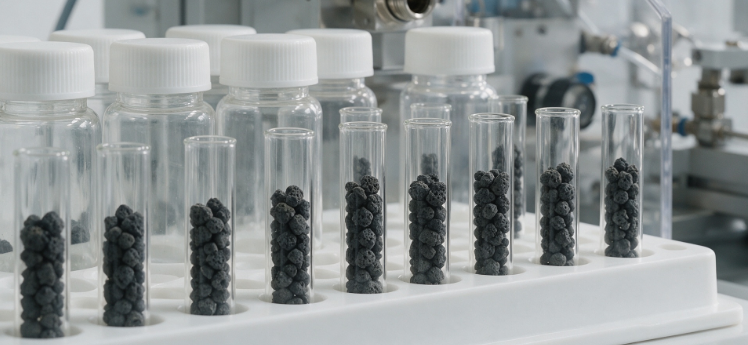
Why Dedicated Testing of p‑Xylene Adsorbents Is Critical for Efficient Aromatics Separation
Clients seeking p‑xylene adsorbent testing frequently encounter challenges such as unexpectedly low p‑xylene purity in the extract product, rapid capacity loss during operation, or poor regeneration efficiency. These issues often stem from non‑optimal Si/Al ratio, inadequate cation exchange (e.g., Ba²⁺, K⁺, Cs⁺) affecting selectivity, pore blocking by heavy hydrocarbons, or structural degradation during thermal regeneration. Moreover, the presence of water, sulfur compounds, or olefins in the feed can severely poison the adsorbent, demanding rigorous characterisation of tolerance limits. Our service provides a systematic evaluation that quantifies equilibrium adsorption capacity (mg/g) for each C₈ isomer, dynamic selectivity (αp/o, αp/m, αp/EB), mass transfer coefficients, breakthrough profiles under fixed‑bed conditions, and regenerability over multiple cycles. By identifying the root causes of performance deficits—such as cation migration, framework dealumination, or coke deposition—we enable clients to optimise adsorbent formulation, select appropriate desorbent (e.g., toluene, p‑diethylbenzene), and establish effective regeneration protocols for reliable, cost‑effective separations.
Our Analytical Capabilities: From Crystal Structure and Pore Architecture to Multicomponent Breakthrough and Long‑Term Stability
Our testing framework is structured into five interconnected modules, each addressing a critical dimension of p‑xylene adsorbent behaviour:
Structural and textural characterisation—We determine specific surface area (BET), micropore volume, and pore size distribution (DFT/BJH) via N₂ physisorption at 77 K, and macropore characteristics by mercury intrusion porosimetry. X‑ray diffraction (XRD) with Rietveld refinement confirms zeolite framework type, crystallinity, and any impurity phases. Scanning electron microscopy (SEM) and transmission electron microscopy (TEM) visualise crystal morphology, grain boundaries, and presence of binder materials. Solid‑state ²⁷Al and ²⁹Si MAS‑NMR quantifies framework Si/Al ratio and extra‑framework aluminium, which directly affect cation exchange capacity and acid site density.
Acidity and cation exchange analysis—We quantify exchangeable cation content (e.g., Na⁺, K⁺, Ba²⁺, Cs⁺) by inductively coupled plasma optical emission spectrometry (ICP‑OES) after acid digestion. Temperature‑programmed desorption of ammonia (NH₃‑TPD) and pyridine‑adsorbed FTIR probe Brønsted and Lewis acidity, which can influence isomerisation side reactions. X‑ray photoelectron spectroscopy (XPS) provides surface cation distribution and identifies any binder‑related impurities.
Equilibrium adsorption of C₈ aromatic isomers—We measure pure‑component and multicomponent adsorption isotherms for p‑xylene, o‑xylene, m‑xylene, and ethylbenzene using a high‑precision gravimetric or volumetric apparatus at temperatures (100‑200 °C) and pressures (0‑10 bar) relevant to industrial simulated moving‑bed (SMB) processes. Langmuir, Freundlich, and Sips models are fitted to extract maximum capacity (Q₀), affinity constants, and isosteric heat of adsorption. For competitive adsorption, we employ liquid‑phase batch equilibrium experiments with model C₈ feeds, using GC‑FID for precise composition analysis, and apply ideal adsorbed solution theory (IAST) to predict multicomponent behaviour.
Dynamic breakthrough and SMB simulation—We operate packed‑bed column rigs with liquid‑phase and vapour‑phase capability, using feeds that mimic industrial C₈ streams (including trace impurities). Breakthrough curves are generated at controlled temperatures (120‑200 °C), pressures, and flow rates. We extract dynamic capacity (at 5 % breakthrough), mass transfer zone (MTZ) length, and bed utilisation efficiency. We also evaluate desorbent performance (toluene, p‑diethylbenzene) by measuring displacement efficiency and purity profiles. For advanced process simulation, we provide axial dispersion and linear driving force (LDF) models validated against experimental data.
Regeneration, cycling stability, and deactivation assessment—We perform thermal (hot gas) and liquid‑phase (desorbent) regeneration cycles, measuring capacity recovery, residual hydrocarbon retention, and energy consumption over multiple cycles (50‑100). Accelerated ageing under high temperature and moisture (simulating regeneration conditions) is conducted, followed by re‑characterisation (XRD, BET, ICP) to quantify cation migration, dealumination, and binder degradation. Thermogravimetric Analysis (TGA) coupled with evolved gas analysis (MS) is used to study coke formation and oxidation kinetics.
High‑Level Predictive Modelling and Diagnostic Interpretation
We integrate equilibrium, breakthrough, and regeneration data with transport‑reaction models (e.g., pore‑diffusion, surface‑diffusion) to predict full‑scale SMB performance under varying feed compositions and operating conditions. Multivariate statistical analysis (PCA, PLS) is used to correlate synthesis parameters (Si/Al ratio, cation type, binder content) with key performance indicators (selectivity, capacity, regeneration efficiency), enabling quality‑by‑design (QbD) optimisation. For post‑mortem analysis, we combine XRD, XPS, TGA, and SEM on deactivated samples to differentiate between coking, cation leaching, framework collapse, and binder degradation as primary deactivation routes.
Regulatory Compliance and Quality Assurance
All test methods align with ASTM, ISO, and UOP standards for aromatics analysis and adsorbent characterisation, including ASTM D5910 (adsorbent performance), D5742 (BET), and UOP 929 (zeolite cation exchange). Our laboratory is ISO/IEC 17025:2017 accredited for a broad scope of petrochemical adsorbent testing. We issue certified test reports with full measurement uncertainty, traceability to NIST/CRM reference materials, and quality control data (reference adsorbents, blanks, duplicate runs). For process licensing and technology transfer, we provide comprehensive data packages with full experimental protocols and raw data archives.
Our Distinctive Advantages in p‑Xylene Adsorbent Testing
Comprehensive isomer discrimination under realistic conditions: We offer multicomponent liquid‑phase breakthrough tests that precisely simulate SMB feed composition and desorbent conditions, delivering selectivity data that directly translates to industrial operation—unlike simplified vapour‑phase or single‑component studies.
Integrated cation‑acidity‑activity correlation: We combine ICP, NH₃‑TPD, pyridine‑FTIR, and breakthrough performance on the same batch, enabling direct correlation between cation exchange level, acidity, and selectivity—critical for optimising zeolite modification strategies.
Realistic poisoning and stability simulation: Our accelerated ageing and regeneration cycling protocols include controlled levels of feed impurities (water, sulfur, olefins) to evaluate lifetime and contaminant tolerance under conditions that closely match industrial feedstocks.
Expert guidance for material and process optimisation: Our team includes petrochemical process engineers and zeolite chemists with extensive experience in C₈ separation. We provide specific recommendations—for example, adjusting the Si/Al ratio to fine‑tune diffusivity, selecting an optimal cation to enhance p‑xylene selectivity, or recommending a pre‑treatment step to remove trace water.
Fast turnaround and flexible sample formats: Our standard full characterisation and breakthrough package is delivered within 10‑14 working days, with expedited 72‑hour screening for key parameters (single‑component capacity and initial selectivity). We handle powder, extrudate, and bead samples, as well as industrially‑formed adsorbents.
End‑to‑End Service Workflow
We initiate each project with a complimentary technical consultation to define your feed composition, operating conditions, and performance targets. We design a customised test plan, including handling and shipping guidelines (e.g., sealed containers to prevent moisture uptake). Upon sample receipt, we perform preconditioning (drying, activation) under controlled conditions. All tests are executed with strict QA/QC—reference adsorbents, blanks, and duplicates. Data are integrated and reviewed by our lead adsorption scientist, then compiled into a comprehensive report containing isotherms, breakthrough curves, selectivity matrices, regeneration profiles, and a clear executive summary with optimisation recommendations. A post‑report meeting is offered to discuss findings and plan further development or scale‑up.
Partner with Us for Reliable p‑Xylene Adsorbent Solutions
Efficient p‑xylene separation is a cornerstone of modern petrochemical production, and the performance of your adsorbent directly impacts product purity and process economics. Our testing service provides the scientific depth, practical realism, and regulatory support necessary to select, qualify, and optimise p‑xylene adsorbents with confidence. We have supported major refining and chemical companies in improving their SMB processes and developing novel adsorbent materials.
We invite you to contact our technical experts to discuss your specific testing needs—whether for media screening, process design, or troubleshooting. With our advanced analytical capabilities, accredited protocols, and deep domain expertise, we provide the clarity and confidence you need to optimise your C₈ separation operations. Request a detailed proposal or schedule a technical consultation today and take the next step towards superior, data‑driven adsorbent solutions.