Reasons for choosing our testing services
ZHONGXI Testing has obtained inspection qualification certifications from multiple countries and regions worldwide. We possess a senior testing team and advanced testing methods, providing independent, impartial, and professional third-party verification services for global carbon projects.

Internationally recognized authority
Certified by multiple international standards such as CNAS, VCS, and GS, with reports universally applicable worldwide.

Global service capability
Covering 140+ countries and regions, it supports on-site detection and remote verification in multiple languages.

Professional experimental methods
Adopt standard experimental methods to ensure accurate and reliable data.
Comprehensive Performance Testing of Activated Carbon Adsorbents for Anti‑Smog Respirators – From Material Screening to Real‑Time Filtration Validation
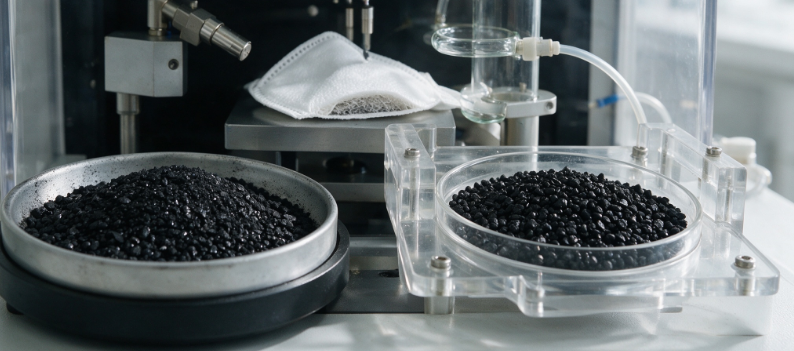
The global proliferation of anti‑smog respirators and personal protective masks has placed stringent demands on the quality and functionality of the activated carbon adsorbents integrated within their filtration layers. These adsorbents are not merely passive filters; they are engineered to capture a broad spectrum of airborne pollutants, including volatile organic compounds (VOCs), ozone, nitrogen dioxide, sulfur dioxide, and particulate‑bound toxicants, while maintaining low breathing resistance and extended service life. The performance of such adsorbents hinges on a complex interplay of specific surface area, pore size distribution, surface chemistry (functional groups), impregnation additives, and resistance to humidity. Variability in raw material (coal, coconut shell, wood), activation method (physical vs. chemical), and post‑treatment (acid washing, metal oxide impregnation) can drastically alter protection efficacy and comfort. Consequently, a rigorous, multi‑parametric testing protocol is indispensable for product development, quality assurance, regulatory compliance, and consumer safety. Our ISO/IEC 17025‑accredited laboratory offers a fully integrated testing service specifically tailored for activated carbon adsorbents used in anti‑smog masks, covering the full chain from fundamental physical properties to dynamic adsorption capacity under simulated breathing conditions.
1. Why Dedicated Testing of Mask Activated Carbon Is Critical
Activated carbon used in respiratory protection faces unique challenges that differ from industrial gas‑phase applications. The adsorbent must operate at high flow rates (up to 85 L/min), variable relative humidity (30–90% RH), and in the presence of both organic and inorganic contaminants. Moreover, the carbon layer must be thin and lightweight to ensure wearer compliance, yet it must offer sufficient capacity to last for typical usage periods (e.g., 8 hours). Traditional single‑point BET or iodine number tests provide only a coarse indication of quality; they fail to predict performance under dynamic, multi‑component challenges. Our testing programme integrates static characterisation with dynamic breakthrough tests using challenge gases and vapours that mimic urban smog conditions. This approach enables manufacturers and regulatory bodies to benchmark materials, optimise impregnation recipes, and certify products against standards such as GB/T 32610, NIOSH 42 CFR 84, and EN 149.
2. Our Analytical and Filtration Testing Platform for Activated Carbon Adsorbents
We provide a modular test suite that covers every critical attribute of the adsorbent, from powder properties to full mask insert performance. All measurements are performed using certified reference materials, calibrated gas mixtures, and validated SOPs.
2.1 Physical Porosity and Surface Area
Nitrogen adsorption at 77 K (BET, t‑plot, BJH) is the cornerstone of carbon characterisation. We report specific surface area (BET), micropore volume (DR and t‑plot), and mesopore size distribution with a precision of ±2%. For ultramicropores (< 0.7 nm) that are crucial for small molecule capture (e.g., formaldehyde, NO₂), we perform CO₂ adsorption at 273 K and apply the Dubinin‑Astakhov (DA) model.
2.2 Surface Chemistry – Functional Groups and Impregnation Analysis
The chemical nature of the carbon surface dictates its affinity for polar vs. non‑polar pollutants. We use X‑ray photoelectron spectroscopy (XPS) to quantify oxygen‑containing groups (carboxyl, carbonyl, hydroxyl) and nitrogen‑/sulfur‑doped species. For impregnated carbons (e.g., with copper, silver, or zinc oxide), we determine the metal loading and oxidation state via ICP‑OES and XPS. Boehm titration is performed to differentiate acidic and basic surface groups, with a detection limit of 0.01 mmol/g.
2.3 Static Adsorption Capacity – Gravimetric and Volumetric Methods
Using a high‑precision gravimetric sorption analyser, we measure equilibrium uptake of key challenge compounds (toluene, cyclohexane, acetone, ammonia, and NO₂) at 25 °C and varying relative pressures. This yields adsorption isotherms and isosteric heats of adsorption, which are critical for understanding the interaction strength and selectivity.
2.4 Dynamic Breakthrough Performance – Fixed‑Bed and Mask‑Segment Tests
Our core service is the dynamic breakthrough test using a custom‑built gas‑phase permeation system. We pack the activated carbon (as loose powder, or as a die‑cut segment of the mask layer) into a temperature‑ and humidity‑controlled cell. The challenge gas (e.g., 50 ppm toluene in air, 10 ppm SO₂, or 0.5 ppm ozone) flows at a controlled rate (15–85 L/min) and breakthrough is monitored by a FID‑GC, UV photometric, or chemiluminescence analyser. We report breakthrough time (tB), adsorption capacity at breakthrough (e.g., at 5% and 50% penetration), and the mass transfer zone length. Tests are performed under dry and humid (80% RH) conditions to assess water competition effects.
2.5 Resistance to Humidity and Regeneration Stability
Humidity significantly reduces the performance of many activated carbons. We evaluate the hydrophobic/hydrophilic balance by measuring water vapour uptake (via DVS) and by performing breakthrough tests after pre‑humidification. For reusable mask inserts, we conduct thermal or vacuum regeneration cycles and re‑measure performance to determine the deactivation rate and reusability.
2.6 Particle Size, Dusting, and Flowability
For powdered or granular carbons used in mask manufacturing, we measure particle size distribution (laser diffraction and sieve analysis), dust generation (via a rotating drum or drop‑test), and flowability (angle of repose). These parameters affect both the uniformity of the adsorbent layer and the risk of inhalation of loose fines—a safety concern addressed by NIOSH standards.
2.7 Leachable and Extractable Compounds – Safety Assessment
Since the adsorbent is in direct contact with the respiratory tract, we perform extraction tests using simulated saliva and sweat (according to EN 1811 and ISO 105‑E04) followed by GC‑MS and ICP‑MS to quantify extractable metals, PAHs, and residual organic solvents. This is essential for biocompatibility and compliance with RoHS and REACH.
3. Advanced Capabilities – Real‑Time Multicomponent Challenge and Mechanistic Insight
For clients seeking to differentiate their product in a competitive market, we offer a set of high‑end, research‑grade tests that go beyond routine certification.
3.1 Multicomponent Breakthrough with Simulated Smog Mixture
We generate a synthetic urban smog mixture containing up to 6 components (e.g., toluene, NO₂, O₃, SO₂, formaldehyde, and acetone) at realistic concentrations. Using online PTR‑MS (proton transfer reaction mass spectrometry), we monitor all components simultaneously with sub‑ppb sensitivity. This reveals competitive adsorption effects, displacement phenomena, and the overall protection time under realistic exposure scenarios.
3.2 In‑Situ FTIR for Surface Reaction Monitoring
During dynamic exposure, we use diffuse reflectance infrared Fourier transform spectroscopy (DRIFTS) to observe the formation of surface intermediates—for instance, the oxidation of NO₂ to nitrate species, or the polymerisation of styrene on the carbon surface. This mechanistic insight helps in designing carbons with tailored catalytic functionality (e.g., chemisorption vs. physisorption).
3.3 Accelerated Aging and Thermal Stability
Using a climatic chamber, we subject the carbon to temperature cycling (−10 to 40 °C) and UV irradiation (simulating sunlight) for up to 500 hours, followed by re‑testing of breakthrough capacity. This predicts the shelf‑life and field durability of the mask adsorbent.
3.4 Computational Modelling – Breakthrough Curve Simulation
Our modelling team uses linear driving force (LDF) and convection‑dispersion models to fit experimental breakthrough curves, extracting mass‑transfer coefficients and effective diffusion constants. These parameters are essential for scaling up from laboratory cell to full mask geometry, and for predicting performance under varying breathing patterns.
3.5 Surface Acidity/Basicity Mapping via Microcalorimetry
To quantify the strength of adsorption sites, we perform microcalorimetric measurements of differential heats of adsorption for probe molecules (NH₃ for acid sites, CO₂ for basic sites). This provides a site‑energy distribution that directly correlates with the affinity for acidic gases like SO₂ or NO₂.
3.6 X‑ray Microtomography (Micro‑CT) for Structural Uniformity
For mask inserts, we use 3D X‑ray microtomography to visualise the distribution and packing density of activated carbon particles within the non‑woven carrier fabric. This non‑destructive method quantifies voids, agglomerates, and thickness variations that may cause preferential flow paths and early breakthrough.
4. Data Quality, Standardisation, and Comprehensive Reporting
All tests are performed under a strict QA/QC framework with daily calibration checks, control charts, and participation in inter‑laboratory comparisons. For every report, we provide: - Detailed test conditions (temperature, RH, flow rate, challenge concentration). - Breakthrough curves with annotated t5%, t50%, and t95%. - Calculated adsorption capacities (mg/g or g/m²) with expanded uncertainty (k=2). - Cross‑validation data where applicable (e.g., BET surface area vs. CO₂ micropore volume). - Comparison with typical performance benchmarks (e.g., NIOSH P100 requirements for chemical agents). - Full chromatograms, mass spectra, and XPS survey scans.
Our final reports are prepared by senior filtration scientists who interpret the results in the context of your specific application—whether it is an urban commuter mask, an industrial respirator, or a children’s safety product. We provide actionable recommendations on carbon selection, impregnation optimisation, or layer design to improve performance and cost‑effectiveness.
Typical turnaround for a complete performance package is 5–7 working days, with urgent testing (48 hours) available for regulatory or quality‑hold issues.
5. Why Our Laboratory Is the Preferred Partner for Mask Carbon Testing
Our competitive advantage lies in the combination of broad analytical capability, deep filtration science, and industry‑specific expertise.
Integrated one‑stop service: We house all necessary instruments—BET, XPS, ICP‑MS, GC‑MS, FTIR, and multiple custom‑built permeation systems—under one roof. This enables seamless sample handling, rapid cross‑correlation of data, and consistent environmental conditions across all tests. We eliminate the fragmentation, delays, and data incompatibility associated with using multiple subcontractors.
Real‑world simulation: Our breakthrough systems are designed to mimic human breathing patterns (sinusoidal flow, tidal volume) and climatic conditions (temperature and humidity ramps). This ensures that the test results are directly translatable to actual wearer protection, not just idealised laboratory ratings.
Expertise in carbon modification: Our team includes chemists with decades of experience in activated carbon manufacturing and impregnation. We can advise on the selection of impregnants (e.g., copper, silver, zinc, or amine species) to target specific pollutants, and we can evaluate the uniformity and stability of these additives using advanced microscopy and spectroscopy.
Regulatory support: We are fully familiar with international standards (GB 2626, EN 149, NIOSH, ASTM F2100) and can tailor our testing to meet the specific requirements of your target market. Our reports are accepted by major certification bodies and have been used in successful product registration processes.
Flexibility and speed: We accept samples in various forms—raw carbon powder, impregnated granules, non‑woven composite sheets, or complete mask inserts. We provide customised sampling instructions and shipping recommendations to preserve the material integrity. Our project managers provide regular updates and can adapt test plans on the fly based on interim results.
Transparent and modular pricing: You pay only for the tests you require, with discounts for multi‑parameter packages or routine quality‑control programmes. There are no hidden charges for data interpretation, statistical analysis, or consultation—these are included as standard.
Our track record includes supporting over 100 respirator manufacturers and carbon producers across Asia, Europe, and the Americas, helping them achieve higher capture efficiencies, longer service lives, and superior user comfort. We invite you to leverage this expertise for your anti‑smog mask adsorbent development and certification.
Elevate your mask protection with scientifically validated activated carbon performance. Contact our technical specialists today to design a tailored testing programme that meets your performance targets and regulatory deadlines. We will provide a detailed proposal and timeline within one business day.