Reasons for choosing our testing services
ZHONGXI Testing has obtained inspection qualification certifications from multiple countries and regions worldwide. We possess a senior testing team and advanced testing methods, providing independent, impartial, and professional third-party verification services for global carbon projects.

Internationally recognized authority
Certified by multiple international standards such as CNAS, VCS, and GS, with reports universally applicable worldwide.

Global service capability
Covering 140+ countries and regions, it supports on-site detection and remote verification in multiple languages.

Professional experimental methods
Adopt standard experimental methods to ensure accurate and reliable data.
Advanced Testing and Performance Validation of Exhaust Gas Purification Catalysts – From Laboratory Characterisation to Industrial Simulation
The abatement of harmful exhaust gases—including nitrogen oxides (NOₓ), carbon monoxide, volatile organic compounds (VOCs), and particulate‑bound toxins—relies on a sophisticated family of catalytic systems, such as V₂O₅‑WO₃/TiO₂ for selective catalytic reduction (NH₃‑SCR), platinum‑group metal (PGM) oxidations catalysts for CO and hydrocarbons, and perovskite or spinel‑based catalysts for VOC combustion. These materials must perform reliably under highly demanding conditions: rapid thermal cycling, high space velocities, variable oxygen and water vapour concentrations, and the presence of catalyst poisons (sulfur, phosphorus, alkali metals, and heavy metals). The efficacy of a catalyst is not an intrinsic constant but a dynamic function of active phase dispersion, support acidity, redox properties, defect chemistry, and resistance to sintering and fouling. Routine characterisation (e.g., BET, XRD, or simple light‑off tests) provides only a superficial indication; a comprehensive evaluation must incorporate kinetic studies, transient response analysis, and multi‑component poisoning protocols that accurately reflect real‑world exhaust conditions. Our ISO/IEC 17025‑accredited laboratory offers a fully integrated testing and characterisation service specifically designed for exhaust gas purification catalysts, covering the entire value chain from fresh material qualification to deactivated catalyst autopsy, and delivering quantitative, traceable data that directly support optimisation, troubleshooting, and regulatory compliance.
1. Why Dedicated Testing of Exhaust Purification Catalysts Is Essential
Exhaust streams from stationary sources (power plants, chemical plants, incinerators) and mobile sources (diesel and gasoline vehicles) present a complex chemical matrix. The catalyst must simultaneously convert multiple pollutants while resisting thermal degradation, chemical poisoning, and mechanical attrition. For example, in NH₃‑SCR, the competing reactions of NO oxidation and NH₃ oxidation determine the temperature window and N₂O selectivity. In VOC oxidation, the presence of chlorinated or sulfur‑containing compounds can cause irreversible deactivation through active‑site blocking or phase transformation. Furthermore, the aging and regeneration history profoundly affect residual activity—a factor that is often overlooked in simple fresh‑catalyst tests. Our service is built on the premise that meaningful performance assessment must be conducted under conditions that simulate the actual exhaust environment, including realistic gas compositions, space velocities, and temperature ramps, while also incorporating accelerated ageing and poison exposure to forecast service life.
2. Our Comprehensive Analytical and Catalytic Testing Platform
We provide a modular, multi‑scale test suite that encompasses both fundamental material characterisation and application‑oriented performance evaluation. All measurements are performed with certified gas mixtures, reference catalysts, and validated protocols to ensure high reproducibility and inter‑laboratory comparability.
2.1 Physicochemical Material Properties
The foundation of catalyst performance lies in its structural and chemical attributes. We determine specific surface area (BET) and pore size distribution (BJH/DFT) via N₂ physisorption; phase composition and crystallite size by powder X‑ray diffraction (XRD) with Rietveld refinement; surface elemental composition and oxidation states by X‑ray photoelectron spectroscopy (XPS) with depth profiling; and redox behaviour by temperature‑programmed reduction (H₂‑TPR) and oxygen storage capacity (OSC) measurements. For supported noble metal catalysts, we use CO chemisorption (static or pulse method) to determine metal dispersion and active surface area.
2.2 Acid‑Base and Surface Functionality
For SCR and oxidation catalysts, acidity is a key descriptor. We quantify total acid site density via NH₃‑TPD, and distinguish Brønsted vs. Lewis acid sites through pyridine‑adsorbed FTIR (DRIFTS). For catalysts containing basic promoters (e.g., alkaline‑earth oxides), we perform CO₂‑TPD to assess basicity. These measurements are correlated with kinetic parameters to establish structure‑activity relationships.
2.3 Steady‑State Catalytic Activity – Light‑Off and Temperature Window
Our fixed‑bed micro‑reactors (quartz or stainless steel, up to 800 °C and 5 MPa) are equipped with precise mass‑flow controllers, gas humidifiers, and online gas analysers (NDIR, chemiluminescence, FID, and paramagnetic O₂ detectors). We measure conversion vs. temperature (light‑off curves) for target reactions: NO reduction (NH₃‑SCR), CO oxidation, and VOC (toluene, propane, or ethylene) total oxidation. From these, we extract light‑off temperature (T₅₀), complete conversion temperature (T₉₀), and apparent activation energy using Arrhenius analysis. For SCR, we also report N₂ selectivity and N₂O formation as a function of temperature.
2.4 Transient and Dynamic Performance
Real exhaust conditions involve rapid changes in temperature and gas composition. We perform temperature‑programmed surface reaction (TPSR) and step‑change experiments (e.g., NO/NH₃ ratio switches) to quantify response time, storage capacity, and hysteresis effects. This is critical for assessing the catalyst’s behaviour during engine cold‑start or transient load changes.
2.5 Poisoning and Durability Testing
Catalyst poisoning by sulfur oxides (SO₂), phosphorus, alkali metals, and heavy metals is a major industrial concern. We conduct accelerated poisoning tests by co‑feeding the poison precursor (e.g., SO₂, or atomised solutions of K, Na, or Pb) under reaction conditions, and monitor activity decay over time. We then perform post‑mortem characterisation (XPS, SEM‑EDS, TEM) to identify the deposition sites and chemical species of poisons. This enables us to propose regeneration strategies (e.g., oxidative or reductive washing) and to predict the catalyst’s operational lifetime.
2.6 Hydrothermal and Thermal Ageing
Using a high‑temperature ageing oven with controlled steam (up to 10% H₂O), we expose the catalyst to accelerated thermal ageing (650–800 °C for up to 100 hours). After ageing, we re‑evaluate the activity, surface area, and crystallinity to quantify the loss due to sintering or phase transformation. This data is essential for predicting performance after extended service.
2.7 Mechanical Integrity and Pressure Drop
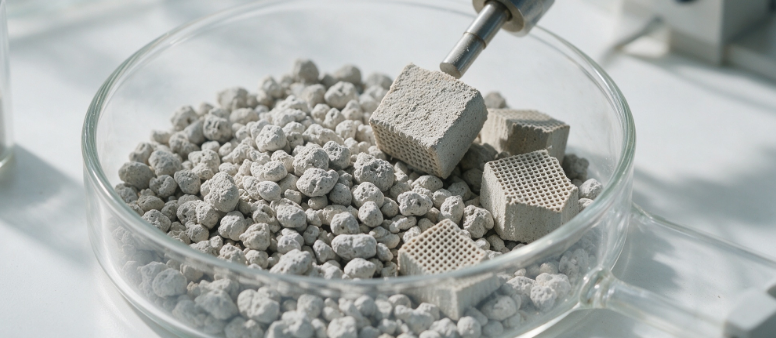
For monolithic or pelletised catalysts, we measure crush strength (radial and axial) and attrition resistance using standardised methods (ASTM D4058, etc.). The pressure drop across the bed or monolith is measured at relevant flow rates to ensure compatibility with existing system designs.
3. Advanced Analytical Capabilities – Mechanistic Insight and Real‑Time Monitoring
For clients who require an in‑depth understanding of reaction mechanisms and deactivation pathways, we offer a suite of cutting‑edge, often custom‑designed, analytical approaches that go far beyond conventional testing.
3.1 In‑Situ/Operando Spectroscopies
We integrate in‑situ DRIFTS and UV‑Vis‑NIR spectroscopy with the reaction cell, allowing real‑time observation of surface intermediates (e.g., adsorbed NH₃, nitrate species, isocyanates) under reaction conditions. This enables the identification of reaction mechanisms and rate‑determining steps for SCR and oxidation processes. For noble metal catalysts, we use ambient‑pressure XPS (AP‑XPS) to track dynamic changes in metal oxidation state under reactive atmospheres.
3.2 High‑Resolution Transmission Electron Microscopy (HRTEM) with EDS/EELS
After reaction or ageing, we employ aberration‑corrected HRTEM to visualise the distribution of active phases, the formation of core‑shell structures, or the migration of support components. Electron energy‑loss spectroscopy (EELS) provides oxidation state and bonding information at the nanoscale, which is invaluable for understanding deactivation mechanisms.
3.3 Isotopic Labelling and Steady‑State Isotopic Transient Kinetic Analysis (SSITKA)
Using ¹⁵N‑labelled NH₃ or ¹⁸O₂, we perform SSITKA experiments to quantify surface coverages, residence times of intermediates, and the number of active sites under steady‑state reaction conditions. This provides a direct measure of the intrinsic reaction kinetics, uncoupled from mass‑transfer limitations.
3.4 Multi‑Component Competitive Reaction Testing
We can simultaneously feed NO, CO, hydrocarbons, and SO₂ to evaluate mutual inhibition or promotion effects. Using online micro‑GC and FTIR gas analysers, we track all components and their conversion, providing a holistic picture of the catalyst’s behaviour in a realistic multicomponent exhaust.
3.5 Computational Fluid Dynamics (CFD) and Kinetic Modelling
Our modelling team develops global and micro‑kinetic models based on experimental data, which are then integrated with CFD simulations of monolith channels. This allows us to predict performance at larger scales, to optimise washcoat loading, and to design better catalyst formulations.
4. Data Quality, Standardisation, and Consulting‑Oriented Reporting
All measurements are executed under a strict quality management system with daily calibration, control charts, and participation in round‑robin tests. For each test, we report: - Complete experimental conditions (temperature, pressure, space velocity, gas composition, pre‑treatment history). - Kinetic parameters (apparent rate constants, activation energies, reaction orders) with confidence intervals. - Deactivation indices (e.g., rate of activity loss per hour, poison uptake efficiency). - Cross‑validation (e.g., active metal dispersion from chemisorption vs. TEM particle counting). - Graphical outputs (light‑off curves, breakthrough profiles, TPR/TPD thermograms) with clear annotations.
Our final reports are prepared by senior catalyst scientists who provide a comprehensive interpretation of the results, linking structure to function and offering tailored recommendations for process optimisation, poison management, or formulation redesign. We also provide benchmarking against industry standards and competitor products, when permitted.
Typical turnaround for a full evaluation (including characterisation, activity, and accelerated ageing) is 8–12 working days, with express options available for urgent troubleshooting.
5. Why Our Laboratory Is the Preferred Partner for Exhaust Catalyst Testing
Our competitive edge is built on a foundation of technical depth, operational agility, and industrial relevance.
Integrated single‑site facility: We house all essential instruments—from XRD, XPS, BET, and TPD to multiple reaction rigs and in‑situ spectroscopy cells—under one roof. This ensures consistent sample handling, rapid cross‑correlation of data, and elimination of the logistical overhead of outsourcing to separate laboratories. Our integrated approach reduces the risk of artefacts caused by different sample pre‑treatment or environmental conditions.
Deep expertise in exhaust catalysis: Our team has over 20 years of combined experience in SCR, DOC, and TWC technologies. We are intimately familiar with the industrial standards (EPA, CARB, Euro VI, GB standards) and the typical performance targets of manufacturers. This enables us to design test protocols that are tailored to your specific application, rather than applying generic procedures.
Flexible reactor configurations: We accept catalysts in all forms—powders, small pellets, monolith cores (up to 2 inches diameter), and full‑size segments. Our rigs are equipped with automatic sample changers and 24/7 data logging for long‑term durability runs.
Poison‑specific diagnostics: We have developed proprietary protocols to identify the dominant deactivation mode (e.g., alkali poisoning vs. sulfur poisoning vs. thermal sintering) by combining multiple characterisation techniques. This diagnostic service is invaluable for plant troubleshooting and for selecting the right regeneration method.
Confidentiality and IP protection: We work with major catalyst manufacturers and end‑users under strict NDA. Our reports are structured to provide the technical depth required for decision‑making while safeguarding your proprietary formulations and process data.
Cost‑effective and transparent pricing: Our modular pricing model allows you to select only the tests you need, with volume discounts for multi‑batch or routine monitoring programmes. There are no hidden fees for interpretation, statistical analysis, or consultation.
Our track record includes supporting over 80 industrial clients in achieving higher NOₓ reduction efficiency, extended catalyst life, and successful compliance with emission regulations. We invite you to leverage this expertise for your exhaust gas purification catalyst testing needs.
Optimise your catalyst performance and ensure regulatory compliance with our comprehensive testing solutions. Contact our technical specialists today to discuss your specific challenges and to design a customised test plan. We will provide a detailed proposal and timeline within one business day.