Reasons for choosing our testing services
ZHONGXI Testing has obtained inspection qualification certifications from multiple countries and regions worldwide. We possess a senior testing team and advanced testing methods, providing independent, impartial, and professional third-party verification services for global carbon projects.

Internationally recognized authority
Certified by multiple international standards such as CNAS, VCS, and GS, with reports universally applicable worldwide.

Global service capability
Covering 140+ countries and regions, it supports on-site detection and remote verification in multiple languages.

Professional experimental methods
Adopt standard experimental methods to ensure accurate and reliable data.
Comprehensive Testing and Performance Validation of Modified Activated Carbons for Wastewater Treatment – From Adsorbent Characterisation to Dynamic Purification Efficiency
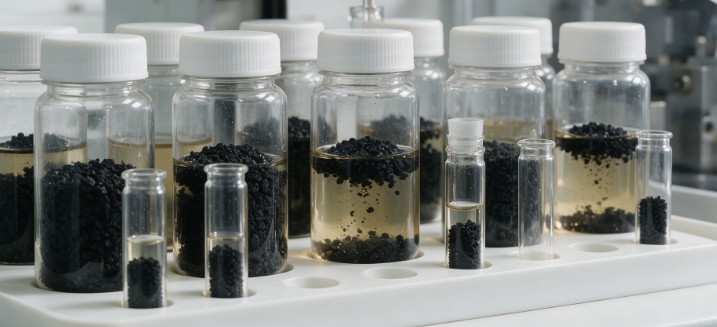
The application of modified activated carbons (MACs) in wastewater treatment has expanded dramatically, driven by their superior ability to remove recalcitrant organic pollutants, heavy metals, emerging contaminants (pharmaceuticals, pesticides), and even pathogenic microorganisms. Unlike conventional activated carbons, MACs are engineered through chemical, physical, or biological modifications—such as surface oxidation, nitrogen doping, metal impregnation (Fe, Ag, Mn), or coating with polymers or surfactants—to enhance specific adsorption capacity, selectivity, and catalytic degradation activity. However, the performance of these advanced materials is highly sensitive to pore architecture, surface functional groups, zero‑point charge, modification homogeneity, and long‑term stability under real wastewater matrices. Variability in raw material (coal, coconut shell, wood) and modification protocols often leads to inconsistent treatment outcomes, premature saturation, or leaching of toxic modifiers. Consequently, a rigorous, multi‑parametric testing regimen is indispensable for process design, quality assurance, environmental compliance, and cost‑effective operation. Our ISO/IEC 17025‑accredited laboratory delivers a fully integrated testing service specifically tailored for modified activated carbons used in wastewater treatment, covering the entire spectrum from fundamental adsorbent properties to dynamic column performance and regenerability, while also assessing the safety of the treated effluent.
1. The Critical Need for Specialised Testing of Modified Activated Carbons in Water Treatment
Wastewater matrices are notoriously complex—they contain dissolved organic matter, inorganic salts, surfactants, and competing ions that can drastically alter the adsorption behaviour of MACs. For example, the presence of humic acids can block micropores, while high ionic strength can compress the electrical double layer and reduce electrostatic attraction. Moreover, modifications designed to enhance affinity for one pollutant may inadvertently increase leaching of impregnated metals or reduce mechanical strength. Traditional indicators such as iodine number or methylene blue index provide only a crude estimate of total surface area and pore volume; they fail to predict equilibrium capacity for specific pollutants, adsorption kinetics, or the effect of pH and temperature. Our approach combines static equilibrium studies, dynamic breakthrough experiments, and pilot‑scale simulation using real or synthetic wastewater that mimics the target industrial or municipal effluent. This ensures that our data are directly translatable to plant‑scale design and regulatory reporting.
2. Our Analytical and Performance Testing Platform for Modified Activated Carbons
We provide a modular test suite that covers physical, chemical, and functional attributes of the MAC, as well as the safety and quality of treated water. All analyses are conducted with certified reference materials, standardised methods (ASTM, ISO, EPA), and rigorous internal quality controls.
2.1 Physicochemical Characterisation of the Modified Carbon
The core properties are quantified using N₂ physisorption (BET surface area, micropore volume via t‑plot and DR, mesopore size distribution via BJH/DFT), mercury intrusion porosimetry for macroporosity, and helium pycnometry for skeletal density. The modification degree is assessed by X‑ray photoelectron spectroscopy (XPS) for surface elemental composition and functional groups (e.g., C‑O, C=O, N‑containing species), and FTIR spectroscopy for bulk chemical bonding. For metal‑impregnated carbons, we measure total metal content via ICP‑OES after acid digestion, and surface metal distribution by SEM‑EDS. The point of zero charge (pHPZC) is determined by the drift method, which is essential for predicting electrostatic interactions with ionic pollutants.
2.2 Static Adsorption Studies – Isotherms, Kinetics, and Thermodynamics
Using a set of model pollutants representative of your wastewater—such as methylene blue (cationic dye), Congo red (anionic dye), phenol (neutral organic), Cd²⁺ or Pb²⁺ (heavy metals), and ibuprofen or atrazine (emerging contaminants)—we perform batch equilibrium experiments at varying initial concentrations, contact times, pH, and temperatures. The data are fitted to Langmuir, Freundlich, Temkin, and Dubinin‑Radushkevich isotherm models to extract maximum adsorption capacity (qmax), adsorption intensity, and mean free energy. Kinetic data are modelled using pseudo‑first‑order, pseudo‑second‑order, and intraparticle diffusion models to determine rate‑limiting steps. Thermodynamic parameters (ΔG°, ΔH°, ΔS°) are calculated from temperature‑dependent isotherms to evaluate the spontaneity and nature of the adsorption process.
2.3 Dynamic Column Breakthrough Tests – Fixed‑Bed and Expanded‑Bed Systems
To simulate real treatment conditions, we pack the MAC into glass or stainless‑steel columns (diameter 1–5 cm, bed height 10–50 cm) and feed a synthetic or real wastewater stream at controlled flow rates (1–20 L/h). Effluent concentrations are monitored online by UV‑Vis spectrophotometry, TOC analysers, or HPLC. We record breakthrough curves and calculate bed adsorption capacity at 10% and 50% breakthrough, the length of mass transfer zone (MTZ), and the empty bed contact time (EBCT) required for a given removal efficiency. These parameters are essential for scaling up to full‑size adsorbers.
2.4 Competitive Adsorption in Multicomponent Systems
Real wastewater contains multiple pollutants. We perform binary and ternary adsorption experiments to assess competitive effects. For instance, the simultaneous removal of Pb²⁺ and phenol, or Cd²⁺ and methylene blue, often reveals antagonistic or synergistic behaviour. We use modified Langmuir (extended) and Ideal Adsorbed Solution Theory (IAST) to model competition, providing a realistic picture of the carbon’s performance.
2.5 Regeneration and Reusability Testing
The economic viability of MACs depends on their ability to be regenerated. We apply thermal regeneration (under N₂ or mild oxidative atmosphere), chemical regeneration (solvent washing, acid/alkali treatment), or microwave‑assisted regeneration, and then re‑evaluate the adsorption capacity over multiple cycles (typically 5–10). The loss of mass, surface area, and functional groups after each cycle is monitored, and we recommend the optimal regeneration protocol for your specific carbon and pollutant type.
2.6 Leaching and Water Safety Analysis
A critical concern with modified carbons is the potential release of surface‑bound species (e.g., metals, organic modifiers) into the treated water. We perform leaching tests by contacting the MAC with deionised water and synthetic wastewater under agitation, and analyse the supernatant for metals (ICP‑MS), total organic carbon (TOC), and specific organic compounds (GC‑MS). The results are compared against WHO and EPA drinking water limits to ensure the treated effluent is safe for discharge or reuse.
2.7 Mechanical and Physical Durability
For granular or extruded carbons, we measure attrition resistance (ASTM D4058), crush strength, and bulk density to evaluate their suitability for high‑flow and backwashing operations.
3. Advanced Capabilities – Unravelling Mechanisms and Predicting Long‑Term Performance
For clients seeking deeper insight into the adsorption mechanism or requiring predictive modelling for process optimisation, we offer a set of advanced, research‑grade analytical tools.
3.1 In‑Situ Spectroscopic Monitoring of Adsorption Processes
Using in‑situ ATR‑FTIR and Raman spectroscopy with a flow‑through cell, we monitor the real‑time evolution of surface species during pollutant uptake. For example, we can observe the formation of metal‑ligand complexes, the protonation of amine groups, or the π‑π stacking of aromatic rings on the carbon surface. This mechanistic insight allows us to tailor the modification chemistry for higher affinity and selectivity.
3.2 X‑ray Absorption Spectroscopy (XAS) for Speciation of Impregnated Metals
In collaboration with synchrotron facilities, we perform XANES and EXAFS to determine the oxidation state and local coordination environment of metal species (e.g., Fe, Ag, Mn) on the carbon surface. This is crucial for understanding whether the metal acts as a adsorption site, a catalyst for oxidative degradation, or both, and how it evolves during usage and regeneration.
3.3 Molecular Dynamics (MD) and Density Functional Theory (DFT) Simulations
Our computational team models the interaction energies of water and target pollutants with various surface functional groups using DFT, and simulates the diffusion of molecules through the porous network using MD. These simulations help to explain experimental observations and guide the rational design of new modified carbons.
3.4 High‑Performance Liquid Chromatography with High‑Resolution Mass Spectrometry (LC‑HRMS)
For non‑target screening of organic pollutants and their transformation products, we use LC‑Orbitrap MS to identify unknown compounds in the influent and effluent. This is particularly valuable for assessing the degradation of emerging contaminants and for detecting potentially toxic by‑products.
3.5 Biological Toxicity Assessment of Treated Effluent
To complement chemical analyses, we perform bioassays using luminescent bacteria (e.g., Vibrio fischeri Microtox) and algal growth inhibition tests to evaluate the overall toxicity of treated water. This integrates the cumulative effect of residual pollutants and leaching products, providing a holistic safety endpoint.
4. Data Quality, Standardisation, and Comprehensive Reporting
All measurements are performed under a strict quality system with regular calibration, internal reference samples, and participation in proficiency testing. Our reports include: - Full experimental conditions (adsorbent dosage, initial concentration, pH, temperature, shaking speed). - Isotherm and kinetic parameters with statistical fits (R², residuals, and confidence intervals). - Breakthrough curves and calculated design parameters (e.g., bed capacity, MTZ length). - Leaching results and comparison with regulatory limits. - Uncertainty budgets for key parameters (e.g., qmax ± expanded uncertainty). - Graphical and tabular summaries, with clear interpretation by our environmental chemists.
We provide actionable recommendations on the optimal modification type, dosage, contact time, and regeneration frequency, based on your specific wastewater characteristics and treatment goals. Typical turnaround for a full characterisation and performance study is 7–10 working days, with expedited services for urgent project needs.
5. Why Our Laboratory Is the Ideal Partner for Modified Carbon Testing
Our service is distinguished by a combination of analytical breadth, real‑world relevance, and process engineering insight.
Integrated multi‑technique facility: We host all essential instruments—BET, XPS, ICP‑MS, FTIR, GC‑MS, LC‑HRMS, and multiple column rigs—under one roof, ensuring seamless sample handling and cross‑correlation of data. This eliminates the inefficiencies of using multiple vendors and reduces the risk of artefacts due to different sample pre‑treatment.
Real wastewater expertise: We have extensive experience with industrial effluents (textile, pharmaceutical, petrochemical, and municipal). We can design test protocols using real wastewater samples (sent by you) or synthetic mixtures that closely mimic your specific matrix, ensuring that our findings are directly applicable to your facility.
Regulatory and safety focus: Our methods are aligned with EPA, EU Water Framework Directive, and Chinese GB standards for water quality and adsorbent testing. We provide data suitable for permitting, compliance reporting, and technology validation.
Flexibility in sample forms: We accept powdered, granular, extruded, and even fibrous activated carbons, as well as spent carbons from your plant. We also support the testing of novel modification types, including green chemicals and biomodified carbons.
Consultative approach: Our team includes experienced water treatment engineers who can interpret the results in the context of your treatment train (e.g., pre‑treatment, ozonation, biological stages). We offer advice on integrating the MAC with other processes for overall cost and performance optimisation.
Cost‑effective and transparent pricing: Our modular pricing allows you to select only the tests you need, with discounts for combined packages or routine quality‑control programmes. There are no hidden charges for interpretation, statistical analysis, or consultation.
To date, we have supported over 90 clients in the water sector—from municipal utilities to specialty chemical producers—helping them achieve higher removal efficiencies, extended carbon life, and reduced treatment costs. We invite you to leverage this expertise for your modified activated carbon evaluation.
Unlock the full potential of your modified activated carbon for wastewater treatment. Contact our technical experts today to design a tailored testing plan that addresses your specific pollutant challenges, regulatory requirements, and operational targets. We will provide a detailed proposal and timeline within one business day.