Reasons for choosing our testing services
ZHONGXI Testing has obtained inspection qualification certifications from multiple countries and regions worldwide. We possess a senior testing team and advanced testing methods, providing independent, impartial, and professional third-party verification services for global carbon projects.

Internationally recognized authority
Certified by multiple international standards such as CNAS, VCS, and GS, with reports universally applicable worldwide.

Global service capability
Covering 140+ countries and regions, it supports on-site detection and remote verification in multiple languages.

Professional experimental methods
Adopt standard experimental methods to ensure accurate and reliable data.
Comprehensive Testing and Performance Evaluation of Adsorbents for Wastewater Treatment – From Fundamental Characterisation to Process Simulation
The effective removal of diverse contaminants—including heavy metals, organic dyes, pharmaceutical residues, pesticides, and emerging micropollutants—from industrial and municipal wastewater relies heavily on advanced adsorption technologies. A wide spectrum of adsorbent materials, such as activated carbons, zeolites, polymeric resins, biochars, metal‑organic frameworks (MOFs), and composite materials, have been developed and modified to enhance selectivity, capacity, and kinetics. However, the practical performance of any adsorbent is not an intrinsic constant; it is critically governed by surface chemistry, pore architecture, particle size, mechanical stability, and the complex interactions with the wastewater matrix (pH, ionic strength, temperature, and competing solutes). Moreover, the long‑term feasibility depends on regenerability, leaching behaviour, and cost‑effectiveness. Routine screening tests (e.g., iodine number or single‑solute batch experiments) are insufficient to predict performance under real conditions, where multicomponent competition, fouling, and hydraulic constraints dominate. Our ISO/IEC 17025‑accredited laboratory offers a fully integrated, multi‑scale testing service tailored for wastewater treatment adsorbents, covering the entire chain from detailed physicochemical characterisation to dynamic column breakthrough studies, pilot‑scale simulation, and post‑use safety assessment—delivering quantitative, traceable data that directly support process design, optimisation, and regulatory compliance.
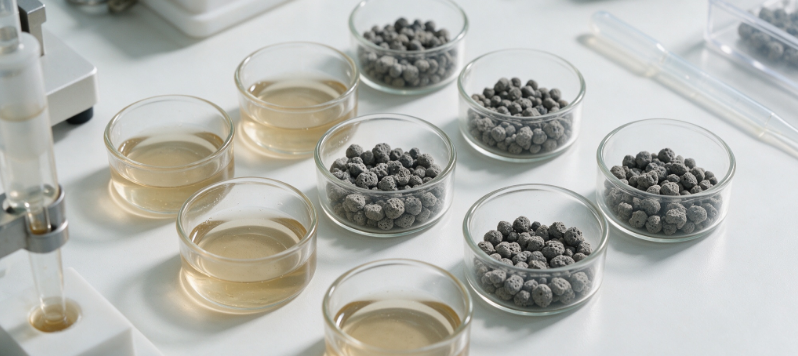
1. The Scientific and Practical Imperative for Rigorous Adsorbent Testing
Wastewater streams are inherently heterogeneous, containing dissolved organic matter, colloidal particles, inorganic salts, and surfactants that can alter adsorption equilibria and kinetics. For example, the presence of humic substances can block pores, while high ionic strength may compress the electrical double layer and reduce electrostatic attractions—particularly relevant for charged adsorbents (e.g., ion‑exchange resins or functionalised carbons). Additionally, adsorbents are often required to operate under variable flow rates, hydraulic shocks, and intermittent loading, which demand robust mechanical strength and resistance to attrition. A single‑parameter test (e.g., BET surface area) provides no indication of intraparticle diffusion resistance, competitive displacement, or irreversible fouling. Our approach combines static equilibrium studies, dynamic column experiments, and mathematical modelling using real or synthetic wastewaters that closely mimic your target effluent, ensuring that our results are directly applicable to plant‑scale design, troubleshooting, and cost estimation.
2. Our Comprehensive Analytical and Performance Testing Platform for Wastewater Adsorbents
We offer a modular, fully customisable test suite that covers all critical attributes of the adsorbent, as well as the quality of the treated effluent. All measurements are conducted with certified reference materials, standardised methods (ASTM, ISO, EPA, and national standards), and rigorous quality control to ensure high reproducibility and inter‑laboratory comparability.
2.1 Physicochemical Characterisation of the Adsorbent
The foundation of any evaluation is a thorough material fingerprint. We determine specific surface area (BET) and pore size distribution (micropores via t‑plot and DR, mesopores via BJH/DFT) using N₂ and CO₂ physisorption. Particle size distribution (laser diffraction), bulk and skeletal density (helium pycnometry), and mechanical strength (crush resistance and attrition index) are measured according to industry standards. Surface chemistry is probed by X‑ray photoelectron spectroscopy (XPS) for elemental composition and functional groups, FTIR spectroscopy for organic moieties, and Boehm titration for acidic/basic site quantification. For crystalline adsorbents (zeolites, MOFs), we perform powder XRD with Rietveld refinement to verify phase purity and crystallinity.
2.2 Static (Batch) Adsorption – Isotherms, Kinetics, and Thermodynamics
Using representative pollutants—selected from heavy metals (Pb²⁺, Cd²⁺, Ni²⁺), dyes (methylene blue, Congo red, acid orange), pharmaceuticals (ibuprofen, diclofenac), or pesticides (atrazine, glyphosate)—we conduct equilibrium isotherm experiments at controlled pH, temperature, and adsorbent dosage. Data are fitted to Langmuir, Freundlich, Sips, and Dubinin‑Radushkevich models to extract maximum capacity (qmax), affinity constants, and heterogeneity factors. Kinetic experiments are modelled using pseudo‑first‑order, pseudo‑second‑order, Elovich, and intraparticle diffusion models to identify the rate‑controlling step. Thermodynamic parameters (ΔG°, ΔH°, ΔS°) are derived from temperature‑dependent isotherms to evaluate spontaneity and the nature of adsorption (physisorption vs. chemisorption). All experiments are performed in triplicate, and the results are reported with full statistical uncertainty.
2.3 Dynamic Column Breakthrough Tests – Fixed‑Bed and Fluidised‑Bed Systems
To simulate continuous treatment, we pack the adsorbent into transparent or stainless‑steel columns (diameters from 1 to 10 cm, bed heights up to 1 m) and operate under controlled flow rates (0.5–20 L/h), with online monitoring of influent and effluent by UV‑Vis spectrophotometry, TOC analysers, or HPLC. We record breakthrough curves and calculate bed capacity at 10% and 50% breakthrough, the length of mass transfer zone (MTZ), and the empty bed contact time (EBCT) required for target removal. The effect of flow rate, influent concentration, and pH is systematically studied. For scale‑up, we also provide mathematical modelling using the Thomas, Yoon‑Nelson, and Adams‑Bohart models to predict long‑term performance.
2.4 Multicomponent and Competitive Adsorption
Real wastewaters contain multiple solutes that compete for adsorption sites. We perform binary and ternary systems (e.g., heavy metal + dye, or two pharmaceuticals) to quantify selectivity factors, displacement effects, and synergistic/antagonistic interactions. The data are interpreted using extended Langmuir and Ideal Adsorbed Solution Theory (IAST) to provide a realistic capacity under actual conditions.
2.5 Regeneration and Reusability Cycles
The economic viability of an adsorbent depends on its regenerability. We apply chemical (acid/alkali/solvent washing), thermal (oxidative or inert atmosphere), or combined regeneration methods, and then repeat adsorption–desorption cycles (typically 5–10). We monitor the loss in capacity, surface area, and functional groups after each cycle, and recommend the most cost‑effective regeneration protocol for your specific adsorbent–pollutant system.
2.6 Leaching and Treated Water Quality
To ensure environmental safety, we conduct leaching tests by contacting the adsorbent with deionised water and synthetic wastewater under dynamic conditions, and analyse the eluate for metals (ICP‑MS), total organic carbon (TOC), and specific organic leachables (GC‑MS). The results are compared against WHO, EPA, and EU drinking water standards to confirm that the treated water is safe for discharge or reuse.
2.7 Physical and Hydraulic Performance
For granular or pelletised adsorbents, we measure pressure drop across the bed as a function of flow rate, bulk density, and settling velocity for fluidised beds. These parameters are crucial for pump sizing and energy cost estimation.
3. Advanced Capabilities – Unravelling Mechanisms and Predicting Full‑Scale Behaviour
For clients who require deeper mechanistic understanding or predictive modelling beyond standard tests, we offer a suite of cutting‑edge, often custom‑designed, analytical and computational tools.
3.1 In‑Situ Spectroscopic Monitoring During Adsorption
Using in‑situ ATR‑FTIR and Raman spectroscopy with a flow‑through cell, we monitor the real‑time evolution of surface complexes—for example, the coordination of metal ions with carboxyl groups, or the π‑π stacking of aromatic dyes. This provides direct evidence of the binding mechanism and guides the rational design of surface modifications.
3.2 High‑Resolution Microscopy and Microanalysis
We employ transmission electron microscopy (TEM) with energy‑dispersive X‑ray spectroscopy (EDS) and electron energy‑loss spectroscopy (EELS) to visualise the distribution of impregnated active phases (e.g., nano‑zero‑valent iron) and to assess their oxidation state changes after use. This is critical for understanding deactivation mechanisms in composite adsorbents.
3.3 X‑ray Absorption Spectroscopy (XAS) – Synchrotron‑Based Speciation
In collaboration with synchrotron facilities, we perform XANES and EXAFS to determine the local coordination environment and oxidation state of metal species in situ, without altering the sample. This is invaluable for adsorbents with redox‑active metals (e.g., Mn, Ce, Fe) that participate in catalytic degradation or reductive precipitation.
3.4 Computational Modelling – DFT and Molecular Dynamics (MD)
Our computational team uses density functional theory (DFT) to calculate binding energies and charge transfer between pollutants and surface functional groups, and MD simulations to model the diffusion of molecules through the pore network. These simulations help to interpret experimental data and to predict the effect of structural modifications on adsorption performance.
3.5 Pilot‑Scale Studies and Field Validation
For large‑scale projects, we offer pilot‑scale column tests (up to 50 L bed volume) using real wastewater from your site, with full hydraulic and sampling protocols. We can also conduct on‑site monitoring and troubleshooting, providing a seamless transition from laboratory findings to full‑scale implementation.
3.6 Toxicity Assessment of Treated Effluent
Beyond chemical analysis, we perform ecotoxicological tests using Vibrio fischeri (Microtox), algal growth inhibition, and Daphnia magna acute toxicity tests to ensure that the treated water meets the required environmental safety criteria.
4. Data Quality, Standardisation, and Actionable Reporting
All analyses are performed under a strict quality management system with daily instrument calibration, use of certified reference materials, and participation in international proficiency testing schemes. For each test, we provide: - Full experimental conditions (adsorbent dosage, pollutant concentration, pH, temperature, mixing rate, flow rate, and bed dimensions). - Isotherm and kinetic parameters with statistical goodness‑of‑fit (R², residual analysis, and 95% confidence intervals). - Breakthrough curves and derived design parameters (capacity at breakthrough, MTZ length, and EBCT). - Leaching results and comparison with relevant standards. - Graphical summaries (adsorption isotherms, kinetic plots, column profiles, and spectra) with clear annotations. - Uncertainty budgets (expanded uncertainty at k=2) for all reported values.
Our final reports are prepared by senior environmental chemists and process engineers, who provide a comprehensive interpretation linking structure to function, and offer tailored recommendations on adsorbent selection, modification, operating conditions, and regeneration scheduling. We also benchmark your material against commercial alternatives if desired.
Typical turnaround for a complete evaluation (characterisation + batch + column + regeneration) is 8–12 working days, with expedited options available for urgent projects.
5. Why Our Laboratory Is the Preferred Partner for Wastewater Adsorbent Testing
Our service stands out through a combination of technological breadth, real‑world applicability, and deep domain knowledge.
Integrated single‑site infrastructure: We house all necessary instruments—including BET, XPS, ICP‑MS, FTIR, GC‑MS, LC‑HRMS, and multiple dynamic column rigs—under one roof. This enables rapid cross‑validation of data (e.g., pore volume from N₂ adsorption vs. mercury porosimetry; surface groups from XPS vs. Boehm titration) and eliminates the logistical complexities of outsourcing.
Real‑world simulation capability: Our test protocols are designed to mimic actual wastewater conditions—we can adjust pH, ionic strength, organic loading, and flow patterns to match your specific industrial or municipal effluent. We also offer testing with real wastewater (sent by you) to guarantee relevance.
Broad material compatibility: We have extensive experience with a wide range of adsorbents: carbons, zeolites, MOFs, mesoporous silicas, polymeric resins, biochars, and composite/hybrid materials. We understand the specific challenges of each—such as MOF moisture sensitivity or biochar heterogeneity—and adapt our methods accordingly.
Regulatory and safety assurance: Our methods are aligned with EPA, EU Water Framework Directive, and Chinese GB/T standards. We provide data suitable for environmental impact assessments, discharge permits, and technology validation reports.
Process‑oriented consultancy: Our team includes process engineers who can translate the test results into design parameters for full‑scale adsorbers, including vessel sizing, media volume, backwash frequency, and regeneration scheduling. This bridges the gap between laboratory data and operational implementation.
Flexible and transparent pricing: Our modular pricing allows you to select only the tests you need, with significant discounts for bundled packages, multi‑batch screening, or long‑term monitoring contracts. There are no hidden fees for interpretation, statistical analysis, or consultancy.
Our track record includes successful collaborations with over 100 water treatment companies, municipal utilities, and industrial plants, helping them achieve higher pollutant removal, reduced operating costs, and improved regulatory compliance. We invite you to leverage this expertise for your wastewater adsorbent testing needs.
Ensure optimal performance and regulatory confidence with our comprehensive adsorbent testing services. Contact our technical specialists today to design a customised test programme that addresses your specific contaminants, operational conditions, and project goals. We will respond with a detailed proposal and timeline within one business day.