Reasons for choosing our testing services
ZHONGXI Testing has obtained inspection qualification certifications from multiple countries and regions worldwide. We possess a senior testing team and advanced testing methods, providing independent, impartial, and professional third-party verification services for global carbon projects.

Internationally recognized authority
Certified by multiple international standards such as CNAS, VCS, and GS, with reports universally applicable worldwide.

Global service capability
Covering 140+ countries and regions, it supports on-site detection and remote verification in multiple languages.

Professional experimental methods
Adopt standard experimental methods to ensure accurate and reliable data.
Comprehensive Testing and Performance Validation Services for Hydrazine Decomposition Catalysts
The catalytic decomposition of hydrazine (N₂H₄) is a cornerstone reaction in space propulsion (monopropellant thrusters), emergency power systems, and chemical synthesis, where the catalyst must deliver rapid ignition, stable gas generation, and exceptional durability under extreme thermal and pressure transients. Whether based on supported noble metals (Ir, Pt, Ru), transition metal oxides (Mo, Ni, Co), or promoted zeolites, the practical efficiency of a hydrazine decomposition catalyst is determined by a complex interplay of active phase dispersion, metal-support interaction, surface acidity, reducibility, and resistance to coking or poisoning. A suboptimal catalyst can lead to prolonged ignition delays, elevated ammonia by‑product formation, or catastrophic thermal runaway. Consequently, a dedicated, multi‑technique evaluation is indispensable for material selection, quality assurance, process optimisation, and safety certification. Our ISO/IEC 17025‑accredited laboratory provides a fully integrated testing service tailored for hydrazine decomposition catalysts, covering the entire chain from detailed physicochemical characterisation to dynamic activity tests under simulated operational conditions—delivering quantitative, traceable data that directly support thruster design, plant safety, and life‑cycle management.
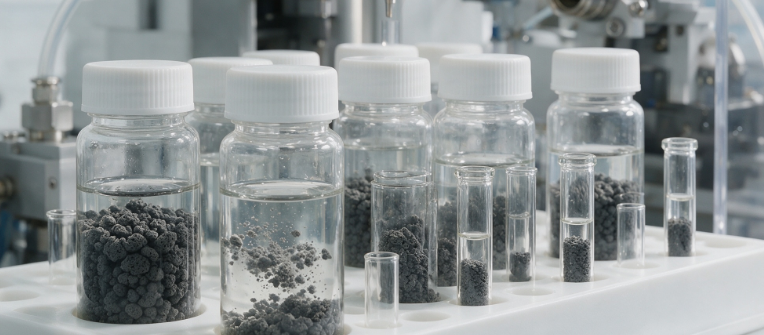
1. The Critical Need for Rigorous Hydrazine Decomposition Catalyst Testing
Hydrazine decomposition is a highly exothermic, gas‑generating reaction that follows two parallel pathways: complete decomposition (3 N₂H₄ → 4 NH₃ + N₂) and the more desirable ammonia‑cracking pathway (N₂H₄ → N₂ + 2 H₂). The selectivity towards the latter—which maximises thrust and minimises toxic exhaust—depends on the type of active sites (metallic vs. acidic), their ensemble size, and the operating temperature. Furthermore, real‑world hydrazine feeds often contain trace water, carbon dioxide, or dissolved oxygen, which can irreversibly adsorb on active centres and increase ignition delay time (IDT)—a critical safety parameter for spacecraft attitude control. Routine surface area or bulk composition analyses cannot predict these dynamic behaviours; only a combination of reduction‑oxidation profiling, temperature‑programmed surface reaction, and pulsed‑flow micro‑reactor tests can faithfully replicate the transient start‑up and steady‑state operation. Our service is specifically architected to meet these challenges, providing a complete “health check” for both fresh and aged catalysts, and offering actionable diagnostics to enhance performance and extend service life.
2. Our Comprehensive Analytical and Catalytic Testing Platform for Hydrazine Decomposition Catalysts
We offer a modular, fully customisable test suite that spans fundamental material attributes to dynamic kinetic performance. All measurements are performed using certified reference materials, highly purified gases, and validated protocols under strict safety controls for handling hypergolic and toxic substances.
2.1 Detailed Physicochemical Characterisation
We quantify the specific surface area (BET) and pore architecture (BJH/DFT) via N₂ and Ar physisorption. The crystal structure and phase purity are determined by X‑ray diffraction (XRD) with Rietveld refinement, while the active metal loading and dispersion are measured by ICP‑OES and CO/H₂ chemisorption at cryogenic temperatures. The surface chemical state—critical for understanding the metal‑support interaction—is probed by X‑ray photoelectron spectroscopy (XPS), providing oxidation states and surface enrichment of the noble or base metal components. For supported catalysts, we perform transmission electron microscopy (TEM) coupled with energy‑dispersive X‑ray spectroscopy (EDS) to map the size distribution and homogeneity of active nanoparticles.
2.2 Reduction Behaviour and Surface Acidity
The catalyst’s reducibility directly influences its start‑up performance. We conduct temperature‑programmed reduction (H₂‑TPR) to identify the reduction temperature of the active phase and any metal‑support interactions that may stabilise or poison the sites. The surface acidity—which affects the NH₃ dehydrogenation step—is quantified by NH₃ temperature‑programmed desorption (NH₃‑TPD) and further differentiated into Brønsted and Lewis acid sites by pyridine‑adsorbed DRIFTS. These data are essential for correlating acid‑base properties with the selectivity towards hydrogen‑rich gas mixtures.
2.3 Dynamic Activity and Ignition Performance (Micro‑Reactor Tests)
We operate high‑pressure pulsed‑flow and continuous‑flow micro‑reactors (up to 5 MPa, 800 °C) equipped with online mass spectrometry (MS) and gas chromatography (GC‑TCD/FID) for real‑time product analysis. The key performance indicators we measure include: ignition delay time (IDT) upon hydrazine injection, steady‑state conversion, selectivity to N₂ and H₂ vs. NH₃, and heat release rate derived from temperature profiles along the catalyst bed. We also perform long‑duration stability tests (up to 500 hours) to simulate operational lifetimes and assess deactivation kinetics.
2.4 Poisoning and Impurity Tolerance
We simulate the effect of common impurities—water vapour, CO₂, O₂, and trace metallic contaminants—by introducing them in controlled concentrations into the hydrazine feed. The subsequent degradation in activity and selectivity is quantified, providing a sensitivity matrix that guides feed purification requirements and predicts field performance.
2.5 Thermal Stability and Accelerated Ageing
To mimic the harsh thermal cycles encountered in thruster applications, we subject the catalyst to high‑temperature ageing (up to 900 °C in inert and oxidative atmospheres) followed by re‑characterisation of dispersion, crystallinity, and activity. This enables a quantitative lifetime forecast and identifies the onset of sintering or phase segregation.
2.6 Mechanical and Structural Integrity
For shaped catalysts (pellets, extrudates, or monoliths), we measure crush strength, attrition resistance, and bulk density using standardised protocols. We also perform X‑ray micro‑CT to inspect for internal cracks or void formation after thermal cycling, ensuring the structural stability of the catalytic bed under vibration and flow stress.
3. Advanced Capabilities – In‑Situ Kinetics and Material Evolution Tracking
For clients demanding an atomic‑level understanding of the decomposition mechanism or requiring predictive models for system integration, we offer a suite of cutting‑edge research‑grade diagnostics.
3.1 In‑Situ X‑ray Diffraction and X‑ray Absorption Spectroscopy (XAS)
Using our synchrotron‑compatible in‑situ cells, we monitor the evolution of the active phase under reaction conditions (in‑situ XRD) and determine the dynamic changes in the local coordination environment (EXAFS) and oxidation state (XANES) of the metal centres during hydrazine pulse sequences. This directly reveals whether the active surface undergoes reversible redox cycling or irreversible restructuring during operation.
3.2 Operando Mass Spectrometry with Isotopic Labelling
We utilise ¹⁵N‑labelled hydrazine and online membrane‑inlet mass spectrometry to trace the nitrogen atom pathways, differentiating between the intramolecular and intermolecular mechanisms of N₂ formation. This is essential for validating proposed reaction mechanisms and for designing catalysts with intrinsically higher selectivity to H₂.
3.3 Temperature‑Programmed Hydrazine Decomposition (TP‑HD)
This custom‑developed technique monitors the product evolution during a controlled linear temperature ramp, providing a complete activity “fingerprint” from room temperature to the operating regime. It reveals the onset temperatures for the primary decomposition and the secondary NH₃ cracking, and is highly sensitive to the presence of poisons or structural defects.
3.4 Computational Kinetics and Reactor Modelling
Our chemical engineers use detailed kinetic models (e.g., micro‑kinetic schemes) combined with computational fluid dynamics (CFD) to simulate the catalyst bed behaviour under non‑isothermal, non‑adiabatic conditions. These models are calibrated using our experimental data and can predict the performance of scaled‑up systems, reducing costly trial‑and‑error in thruster or reactor design.
3.5 Post‑Reaction Fine Analysis – ToF‑SIMS and TEM‑EELS
After testing, we perform time‑of‑flight secondary ion mass spectrometry (ToF‑SIMS) to map the spatial distribution of carbonaceous deposits, nitrogen species, and residual impurities on the catalyst surface. Electron energy‑loss spectroscopy (EELS) in the TEM provides chemical bonding information for the sub‑surface layers, detecting early signs of intermetallic compound formation or support migration.
4. Data Quality, Standardisation, and Comprehensive Reporting
All tests are executed under a strict quality management system that includes daily calibration with gas standards, in‑line reference catalysts, and regular participation in international proficiency testing. Our deliverables provide: - Full experimental details (feed composition, temperature ramps, pressure, catalyst preconditioning). - Kinetic and performance parameters (ignition delay, conversion, selectivity, deactivation rate constants) with expanded uncertainty at 95% confidence. - Breakthrough curves and transient profiles for both fresh and aged catalysts. - Cross‑validated material data (e.g., dispersion from chemisorption vs. particle size from TEM; acidity from NH₃‑TPD vs. DRIFTS). - Graphical summaries (activity maps, Arrhenius plots, mass spectra, and chromatograms) with complete annotations. - Direct benchmarking against standard reference catalysts (e.g., 20% Ir/Al₂O₃) to contextualise your material's performance.
Our reports are authored by senior propulsion chemists and catalytic engineers who interpret the data in the context of your application—providing tailored recommendations on formulation adjustments, pre‑treatment protocols, or operating windows to maximise thrust efficiency, minimise ammonia slip, and ensure a safe ignition margin.
Typical turnaround for a complete evaluation package (characterisation + activity + accelerated ageing) is 8–12 working days, with urgent “hot‑fire” assessment available within 48 hours for mission‑critical troubleshooting.
5. Why Our Laboratory Is the Optimal Choice for Your Hydrazine Catalyst Testing
Our service is uniquely positioned through the convergence of advanced instrumentation, profound safety expertise, and aerospace‑grade analytical rigour.
Integrated single‑site infrastructure: We house all required instruments—BET, XPS, XRD, TEM, TPR/TPD, multiple micro‑reactors, and in‑situ spectroscopy cells—under one roof, ensuring consistent sample handling and instantaneous data cross‑correlation. This eliminates the fragmentation and communication gaps typical of multi‑vendor testing.
Uncompromising safety and handling: Hydrazine is highly toxic and flammable. Our facility is equipped with specialised gas‑tight enclosures, scrubbers, and explosion‑proof evacuation systems. Our operators are extensively trained in handling hypergolic materials, and our standard operating procedures (SOPs) meet the strictest aerospace and industrial safety regulations, providing you with peace of mind throughout the testing programme.
Deep expertise in propellant chemistry: Our team includes scientists with direct experience in developing and qualifying catalysts for satellite thrusters and emergency generators. We understand the criticality of ignition delay, pulse‑mode durability, and chamber pressure dynamics, and we tailor our test conditions to replicate your specific duty cycle—whether it is a short‑duration pulsed burn or continuous operation over several hours.
Flexibility with all material forms: We accept powders, formed pellets, wash‑coated monoliths, and even complete thruster segments. We can also evaluate catalysts that have been stored for extended periods or subjected to adverse environmental conditions, providing a realistic assessment of shelf‑life stability.
Predictive model integration: Unlike many testing houses, we bridge the gap between experimental data and engineering design. We provide kinetic rate expressions and bed‑scale performance maps that can be directly imported into your system‑level simulations, accelerating the integration process and reducing development risks.
Transparent and modular pricing: You select only the analyses relevant to your project—whether it is a rapid screening of a new formulation or a full qualification campaign. We offer volume discounts for long‑term monitoring and development partnerships, with no hidden fees for interpretation or consultation.
With a proven track record of supporting over 60 aerospace, defence, and chemical clients, our data has been instrumental in achieving faster ignition, more stable combustion, and extended operational lifetimes. We invite you to partner with us to rigorously validate and optimise your hydrazine decomposition catalyst.
Ensure mission‑ready performance and safety with our specialised hydrazine catalyst testing services. Contact our technical specialists today to design a customised test programme that addresses your specific operational parameters and performance targets. We will provide a detailed proposal and timeline within one business day.