Reasons for choosing our testing services
ZHONGXI Testing has obtained inspection qualification certifications from multiple countries and regions worldwide. We possess a senior testing team and advanced testing methods, providing independent, impartial, and professional third-party verification services for global carbon projects.

Internationally recognized authority
Certified by multiple international standards such as CNAS, VCS, and GS, with reports universally applicable worldwide.

Global service capability
Covering 140+ countries and regions, it supports on-site detection and remote verification in multiple languages.

Professional experimental methods
Adopt standard experimental methods to ensure accurate and reliable data.
Comprehensive Testing and Performance Validation Services for Honeycomb Ceramic Catalysts – From Material Integrity to Full‑Scale Emission Control
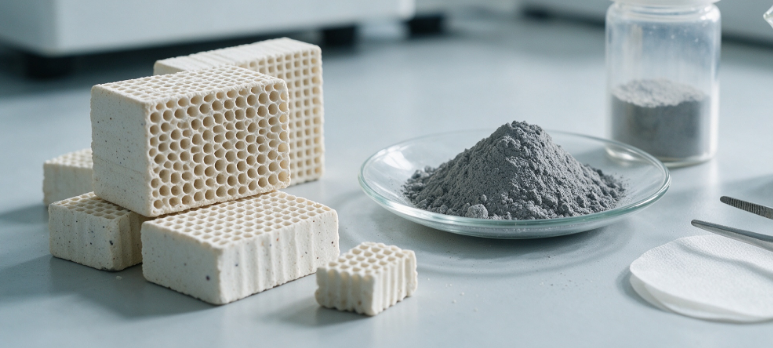
The widespread adoption of honeycomb ceramic catalysts in automotive exhaust after‑treatment (three‑way catalysts, diesel oxidation catalysts, selective catalytic reduction systems), stationary source emission control (VOC oxidation, DeNOx), and chemical process intensification has made their reliable performance a cornerstone of environmental compliance and industrial efficiency. These structured catalysts, typically composed of cordierite, mullite, or silicon carbide substrates coated with a high‑surface‑area washcoat (e.g., γ‑alumina, ceria‑zirconia) and impregnated with noble metals (Pt, Pd, Rh) or base metal oxides (V₂O₅, WO₃, MnOₓ), offer exceptional geometric surface area, low pressure drop, and high thermal shock resistance. However, the practical efficacy of a honeycomb catalyst is not a fixed parameter; it is governed by a complex interplay of cell geometry, wall thickness, washcoat homogeneity, active phase dispersion, mechanical strength, and resistance to thermal ageing and chemical poisoning. Furthermore, the performance under transient conditions—rapid temperature changes, variable space velocities, and fluctuating feed compositions—demands a sophisticated evaluation strategy. Routine bulk analyses (e.g., cell density count or light‑off temperature) provide only a superficial snapshot; a comprehensive assessment must integrate advanced structural characterisation, dynamic catalytic testing, and accelerated ageing protocols. Our ISO/IEC 17025‑accredited laboratory offers a fully integrated, multi‑scale testing service specifically designed for honeycomb ceramic catalysts, covering the entire spectrum from detailed material characterisation to performance simulation under realistic operating conditions—delivering quantitative, traceable data that directly support catalyst development, quality assurance, process optimisation, and regulatory certification.
1. The Scientific and Regulatory Imperative for In‑Depth Honeycomb Catalyst Testing
Honeycomb catalysts operate under severe conditions: rapid thermal transients (e.g., cold start in vehicles), high space velocities (up to 100,000 h⁻¹), and exposure to poisons (sulphur, phosphorus, alkali metals). The conversion efficiency of key pollutants—NOx, CO, hydrocarbons, and NH₃ slip—depends not only on the intrinsic activity of the catalytic coating but also on the interaction between gas flow and the monolith structure, including channel‑to‑channel maldistribution, diffusion limitations, and radial heat transfer. A catalyst that performs well in a powder test may fail in a monolithic form due to poor washcoat adhesion, uneven coating, or thermal stress‑induced cracking. Furthermore, regulatory frameworks (e.g., Euro VI, EPA Tier 3, China VI) impose stringent emission limits that require robust proof of durability, light‑off performance, and conversion efficiency across the entire operating map. Our service bridges this gap by combining non‑destructive geometric analysis, washcoat characterisation, bench‑scale flow reactor tests, and engine‑dynamometer or pilot‑scale simulations, ensuring that the performance data are directly applicable to real‑world deployment.
2. Our Comprehensive Analytical and Performance Testing Platform for Honeycomb Catalysts
We offer a modular, fully customisable test suite that covers all critical attributes of the honeycomb catalyst, from substrate and washcoat to the finished product, and from fresh to aged samples. All measurements are conducted with certified reference materials, standardised methods (ASTM, ISO, SAE, and national guidelines), and stringent internal quality controls.
2.1 Geometric and Structural Integrity Assessment
The physical dimensions and channel architecture are critical for hydraulic performance. We use optical microscopy, digital calipers, and X‑ray computed tomography (X‑ray CT) to measure cell density (cpsi), wall thickness, channel opening, and overall dimensions. X‑ray CT also enables non‑destructive inspection of internal defects, such as cracks, voids, washcoat delamination, and blockages. We quantify the geometric surface area per unit volume (GSA) and the open frontal area (OFA) to predict pressure drop and mass transfer characteristics.
2.2 Washcoat Characterisation – Loading, Adhesion, and Morphology
The functional layer is critical for performance. We quantify the washcoat loading (g/in³) by weighing before and after washcoat removal (via acid digestion or ultrasonic stripping). Scanning electron microscopy (SEM) coupled with energy‑dispersive X‑ray spectroscopy (EDS) reveals washcoat thickness, uniformity, and distribution across the channel corners and walls. Surface area (BET) and pore size distribution of the washcoat are measured by N₂ physisorption. X‑ray diffraction (XRD) identifies the washcoat phases (e.g., γ‑Al₂O₃, CeO₂‑ZrO₂). Adhesion strength is assessed by a pull‑off test or ultrasonic vibration test to quantify the resistance to mechanical and thermal stress.
2.3 Active Phase Dispersion and Chemical State
The noble metal or oxide active phase must be well‑dispersed and in the correct oxidation state. We use CO or H₂ chemisorption (pulse or static method) to determine metal dispersion (D%) and active surface area. X‑ray photoelectron spectroscopy (XPS) provides the surface elemental composition and chemical states (e.g., Pt⁰/Pt²⁺, Pd⁰/PdO, Ce³⁺/Ce⁴⁺ ratios). Transmission electron microscopy (TEM) with particle size analysis gives direct visualisation of the nanoparticle size distribution and their interaction with the support.
2.4 Catalytic Activity – Steady‑State and Transient Light‑Off Tests
We operate bench‑scale flow reactor systems (quartz or stainless steel) capable of handling monolithic cores (up to 2‑inch diameter and 6‑inch length) with precise gas mixing (NO, CO, C₃H₆, O₂, CO₂, H₂O, N₂) and online gas analysers (NDIR for CO/CO₂, chemiluminescence for NOx, FID for hydrocarbons). We perform light‑off experiments (temperature‑ramped conversion) to determine T₅₀ and T₉₀ for each pollutant. Steady‑state conversion is measured at multiple temperatures and space velocities to generate performance maps. For TWC catalysts, we also evaluate the air‑fuel ratio (λ) window and the oxygen storage capacity (OSC) via pulse experiments.
2.5 Pressure Drop and Flow Distribution
The pressure drop across the monolith is measured as a function of flow rate using a differential pressure transducer. We also perform flow visualisation (using laser‑based methods) or velocity profile mapping at the outlet to detect maldistribution, which may arise from non‑uniform washcoat deposition or channel blockage.
2.6 Accelerated Ageing and Durability Testing
We simulate the effects of long‑term operation using engine‑dynamometer ageing (thermal cycles up to 950 °C) or oven ageing with steam (up to 800 °C, 10% H₂O, up to 100 hours). After ageing, we re‑measure the activity, dispersion, and structural integrity to quantify deactivation due to sintering, washcoat phase transformation, or poison accumulation. We also conduct chemical poisoning tests by adding SO₂ or phosphorus‑bearing compounds to the feed stream.
2.7 Mechanical Strength and Thermal Shock Resistance
We measure the compressive strength (radial and axial) using a universal testing machine, following ASTM C1673. Thermal shock resistance is evaluated by cycling the catalyst between high temperature (e.g., 800 °C) and room temperature, followed by visual inspection and pressure‑drop measurements to detect cracking.
3. Advanced Analytical Capabilities – Mechanistic Insight and Predictive Tools
For clients requiring a deeper understanding of catalyst behaviour or predictive models for system integration, we offer a suite of cutting‑edge, research‑grade techniques.
3.1 In‑Situ / Operando Spectroscopies
We integrate in‑situ DRIFTS and UV‑Vis‑NIR spectroscopy with the flow reactor to monitor the evolution of surface species (e.g., adsorbed CO, nitrates, isocyanates) under reaction conditions. This enables the identification of reaction pathways, active site transformations, and poisoning mechanisms in real time.
3.2 X‑ray Absorption Spectroscopy (XAS) – Synchrotron‑Based
In collaboration with synchrotron facilities, we perform XANES and EXAFS on the intact monolith to determine the oxidation state and local coordination environment of noble metals and promoters (Ce, Zr) under reactive atmospheres. This provides direct evidence of the redox behaviour that governs OSC and light‑off performance.
3.3 Computational Fluid Dynamics (CFD) and Kinetic Modelling
Our modelling team constructs 1D‑plus‑channel models and 3D CFD simulations of the monolith reactor, incorporating detailed surface kinetics derived from our experimental data. These models predict the effect of cell geometry, washcoat thickness, and ageing on conversion efficiency, enabling optimisation without extensive physical testing.
3.4 Accelerated Poison Profiling – ToF‑SIMS and SEM‑EDS Mapping
After poisoning tests, we use time‑of‑flight secondary ion mass spectrometry (ToF‑SIMS) to spatially map the distribution of poisons (S, P, Ca, Zn) across the channel cross‑section, revealing whether poisoning is front‑end dominated or uniformly distributed. This guides the design of poison‑tolerant formulations.
3.5 Acoustic Emission Monitoring During Thermal Cycling
We employ acoustic emission (AE) sensors during thermal shock tests to detect the onset of micro‑cracking in the substrate or washcoat, providing a quantitative measure of the critical temperature differential that the catalyst can withstand without structural damage.
4. Data Quality, Standardisation, and Comprehensive Reporting
All tests are performed under a strict quality management system with daily calibration, certified internal standards, and participation in proficiency testing schemes. Our reports deliver: - Full experimental conditions (gas composition, temperature ramps, space velocity, sample pre‑treatment). - Geometric data (cpsi, wall thickness, GSA, OFA) with dimensional tolerances. - Washcoat characterisation (loading, surface area, adhesion score, phase composition). - Light‑off and steady‑state conversion data with T₅₀/T₉₀ values and conversion maps. - Pressure drop vs. flow rate curves. - Ageing results (activity loss, metal sintering, washcoat degradation) with statistical comparisons. - Failure analysis (crack location, poison distribution) with supporting images (SEM, CT, SIMS). - Uncertainty budgets (expanded uncertainty at k=2) for key performance indicators.
Our final documents are authored by senior catalyst scientists and exhaust after‑treatment engineers who provide a comprehensive interpretation of the data, linking material attributes to emission performance, and offering tailored recommendations on formulation, coating process, ageing strategies, or operating conditions. We also provide benchmark comparisons against industry‑standard reference catalysts.
Typical turnaround for a full evaluation (characterisation + fresh activity + accelerated ageing + post‑age analysis) is 10–15 working days, with urgent “hot‑line” testing available for emergency troubleshooting.
5. Why Our Laboratory Is the Preferred Partner for Honeycomb Catalyst Testing
Our service is distinguished by a unique combination of technical breadth, industrial relevance, and operational agility.
Integrated single‑site infrastructure: We house all essential instruments—X‑ray CT, SEM‑EDS, BET, XPS, TEM, chemisorption, flow reactor rigs, and ageing ovens—under one roof, ensuring seamless sample handling and rapid cross‑validation of data, eliminating the fragmentation and delays of multi‑vendor testing.
Full‑scale core capability: Unlike many labs limited to powder or small‑core testing, our reactors can accommodate full‑size monolith cores (up to 5″ diameter and 12″ length), allowing testing under conditions that closely mimic the real installation—including realistic space velocities and thermal gradients.
Deep expertise in emission control systems: Our team includes engineers with extensive experience in OEM and Tier‑1 catalyst development. We understand the integration of the catalyst with engine control strategies, exhaust architecture, and on‑board diagnostics, allowing us to provide not only data but also strategic advice on system optimisation.
Real‑world dynamic testing: We offer transient test cycles (e.g., FTP‑75, WLTC, NRTC) on our engine‑dynamometer or synthetic gas bench, enabling evaluation of the catalyst under representative cold‑start, acceleration, and deceleration modes—critical for compliance with modern emission standards.
Poison and durability expertise: We have extensive experience in sulphur, phosphorus, and thermal ageing, and can design customised ageing protocols that match your specific field operating conditions (e.g., high‑sulphur fuel, high‑temperature excursions). We also offer post‑mortem forensic analysis to diagnose field failures.
Flexibility and rapid turnaround: We accept samples in any form—as‑received coated monoliths, uncoated substrates, or even partially aged catalysts from your fleet. We provide clear guidance on core cutting, packaging, and shipping to preserve integrity.
Cost‑effective and transparent pricing: Our modular pricing allows you to select only the tests you need, with discounts for multi‑core screening or long‑term durability programmes. There are no hidden fees for interpretation, modelling, or engineering consultancy.
Our track record includes successful collaborations with over 50 automotive, heavy‑duty, and stationary emission control companies worldwide, helping them achieve lower emissions, faster light‑off, and longer catalyst lifetime. We invite you to leverage this expertise for your honeycomb catalyst development, quality assurance, or regulatory compliance needs.
Ensure your honeycomb catalyst meets the most demanding performance and durability standards. Contact our technical specialists today to design a customised test programme that addresses your specific emission targets, operating constraints, and development timelines. We will provide a detailed proposal and timeline within one business day.