Reasons for choosing our testing services
ZHONGXI Testing has obtained inspection qualification certifications from multiple countries and regions worldwide. We possess a senior testing team and advanced testing methods, providing independent, impartial, and professional third-party verification services for global carbon projects.

Internationally recognized authority
Certified by multiple international standards such as CNAS, VCS, and GS, with reports universally applicable worldwide.

Global service capability
Covering 140+ countries and regions, it supports on-site detection and remote verification in multiple languages.

Professional experimental methods
Adopt standard experimental methods to ensure accurate and reliable data.
Comprehensive Testing and Performance Evaluation Services for Fluoride Adsorbents – From Fundamental Sorption Science to Process Engineering
The pervasive contamination of groundwater and industrial wastewater by elevated fluoride concentrations—often exceeding the WHO guideline of 1.5 mg/L—has driven the development of a wide array of fluoride‑selective adsorbents, including activated alumina, hydroxyapatite, layered double hydroxides (LDHs), rare‑earth based materials (lanthanum, cerium), carbonaceous composites, and metal‑organic frameworks (MOFs). While these materials exhibit promising fluoride uptake capacities under ideal laboratory conditions, their practical performance is profoundly influenced by solution pH, ionic strength, the presence of competing anions (sulphate, phosphate, bicarbonate, chloride), temperature, and the specific surface chemistry of the adsorbent. Furthermore, the long‑term viability of a fluoride adsorption process depends on regenerability, mechanical stability, leaching of toxic components, and hydraulic behaviour in fixed‑bed or fluidised‑bed systems. Routine screening tests, such as single‑point batch experiments with deionised water, often provide an overly optimistic baseline and fail to predict performance under real‑world water matrices. Consequently, a comprehensive, multi‑scale evaluation is indispensable for material selection, process design, regulatory compliance, and cost‑effective operation. Our ISO/IEC 17025‑accredited laboratory offers a fully integrated, multi‑technique testing service specifically tailored for fluoride adsorbents, covering the entire chain from detailed physicochemical characterisation to dynamic column breakthrough simulation, regeneration cycling, and environmental safety assessment—delivering quantitative, traceable data that directly support technology validation, plant‑scale design, and regulatory submissions.
1. The Scientific and Practical Drivers for Rigorous Fluoride Adsorbent Testing
Fluoride ions are small, highly electronegative, and exhibit strong complexation tendencies with aluminium, iron, and lanthanide species. Their adsorption behaviour is highly sensitive to pH, with the speciation shifting between HF (pKₐ ≈ 3.2) and F⁻, and the surface charge of the adsorbent (point of zero charge) dictating electrostatic attraction or repulsion. Competing anions, particularly phosphate and sulphate, often outcompete fluoride for binding sites due to higher charge density or stronger complexation, leading to significant reductions in effective capacity. Moreover, many advanced adsorbents rely on ligand‑exchange or ion‑exchange mechanisms that can be irreversibly fouled by organic matter or multivalent cations. Standard indicators such as Langmuir qmax from pure water tests do not predict breakthrough behaviour, mass transfer zone length, or the frequency of regeneration. Our approach integrates equilibrium isotherm modelling, kinetic profiling, fixed‑bed column experiments, and competitive ion studies using both synthetic and real water matrices (provided by you), ensuring that our recommendations are directly applicable to your specific water quality and treatment goals.
2. Our Comprehensive Analytical and Performance Testing Platform for Fluoride Adsorbents
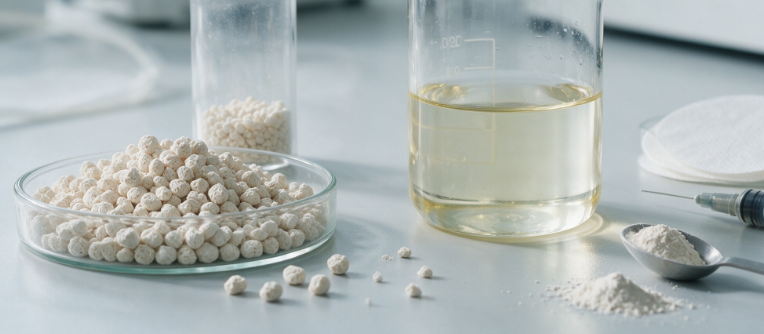
We offer a modular, fully customisable test suite that covers all critical attributes of the adsorbent, from powder properties to pelletised or granular forms, and from fresh to spent samples. All measurements are conducted with certified reference materials, standardised protocols (ASTM, ISO, EPA, and WHO guidelines), and stringent internal quality controls.
2.1 Fundamental Material Characterisation
The intrinsic properties of the adsorbent are quantified using: N₂ physisorption (BET surface area, micropore volume via t‑plot and DR, mesopore distribution via BJH/DFT), mercury intrusion porosimetry for macroporosity, and helium pycnometry for true density. Powder X‑ray diffraction (XRD) with Rietveld refinement identifies crystalline phases and quantifies amorphous content. X‑ray photoelectron spectroscopy (XPS) provides surface elemental composition and oxidation states of active metals (e.g., Al, La, Fe). Fourier‑transform infrared spectroscopy (FTIR) in ATR mode detects surface functional groups (e.g., hydroxyl, carbonate, phosphate). The point of zero charge (pHPZC) is determined by the drift method. For composite or impregnated materials, we perform ICP‑OES after acid digestion to quantify total active metal content.
2.2 Equilibrium Fluoride Adsorption – Isotherms and Thermodynamics
We conduct batch isotherm experiments using fluoride standard solutions (0.5–50 mg/L) at controlled temperatures (15–45 °C), pH (3–11), and background ionic strength, with and without competing anions (sulphate, phosphate, chloride, bicarbonate). The equilibrium data are fitted to Langmuir, Freundlich, Sips, and Redlich‑Peterson models to extract maximum capacity (qmax), affinity constants, and heterogeneity indices. Thermodynamic parameters (ΔG°, ΔH°, ΔS°) are calculated from temperature dependence to distinguish physisorption from chemisorption. Fluoride concentration is measured by ion‑selective electrode (ISE) or ion chromatography (IC), with a detection limit of 0.02 mg/L and full uncertainty reporting.
2.3 Adsorption Kinetics – Rate and Mechanism
Kinetic experiments are performed at optimal pH and temperature, with samples withdrawn at timed intervals. Data are fitted to pseudo‑first‑order, pseudo‑second‑order, Elovich, and intraparticle diffusion models to determine the rate‑limiting step (film diffusion, pore diffusion, or surface reaction). We also calculate the initial adsorption rate (h) to compare the performance of different adsorbents.
2.4 Dynamic Column Breakthrough Performance
To simulate continuous treatment, we pack the adsorbent (granules, pellets, or beads) into lab‑scale glass or stainless‑steel columns (inner diameter 1–5 cm, bed height 10–50 cm). A synthetic or real water feed containing fluoride and competing ions is passed at controlled flow rates (1–20 mL/min). Effluent fluoride is monitored online or by periodic sampling with IC or ISE. We record breakthrough curves and calculate bed capacity at 10%, 50%, and 90% breakthrough, the length of mass transfer zone (MTZ), and the empty bed contact time (EBCT) required for a target effluent concentration. The effect of flow rate, influent concentration, and pH is systematically studied. Data are further analysed with Thomas, Yoon‑Nelson, and Adams‑Bohart models to estimate kinetic parameters for scale‑up.
2.5 Effect of Competing Ions and Real‑Matrix Interference
We systematically evaluate the interference of sulphate (10–500 mg/L), phosphate (1–50 mg/L), chloride (100–1000 mg/L), and bicarbonate (50–500 mg/L) on fluoride uptake, using both batch and column modes. The selectivity coefficient for fluoride over each competing anion is calculated, providing a realistic performance indicator for real effluents.
2.6 Regeneration and Reuse Cycles
The economic and environmental sustainability of the adsorbent is assessed by applying chemical regeneration using NaOH, alum, or acid solutions, followed by re‑equilibration. We typically perform 5–10 adsorption‑regeneration cycles, monitoring the loss in capacity, structural integrity (XRD, BET), and any leaching of active metals. Based on the results, we recommend the optimal regeneration agent, concentration, contact time, and cycle frequency.
2.7 Leaching and Treated Water Safety
A critical concern is the potential release of toxic metals (e.g., aluminium, lanthanum) or organic modifiers from the adsorbent. We conduct leaching tests by contacting the adsorbent with deionised water and synthetic wastewater under dynamic conditions, and analyse the eluate for metals (ICP‑MS), total aluminium, and other species, as well as pH and conductivity. The results are compared against WHO, EPA, and national discharge standards to ensure the treated water is safe.
2.8 Physical and Hydraulic Characterisation
For granular adsorbents, we measure attrition resistance (ASTM D4058), crush strength, bulk density, and pressure drop across the packed bed, which are essential for designing filtration vessels and estimating pumping energy.
3. Advanced Analytical Capabilities – Mechanistic Insight and Predictive Modelling
For clients seeking to understand the fundamental fluoride uptake mechanism or to predict long‑term behaviour under variable conditions, we offer a set of specialised, research‑grade techniques.
3.1 In‑Situ Spectroscopic Monitoring of Fluoride Adsorption
Using in‑situ ATR‑FTIR and Raman spectroscopy coupled with a flow‑cell, we monitor the real‑time evolution of surface complexes, such as the replacement of hydroxyl groups by fluoride on alumina or lanthanum sites. This provides direct evidence of the ligand‑exchange mechanism and helps optimise the surface chemistry for higher affinity.
3.2 High‑Resolution X‑ray Photoelectron Spectroscopy (HR‑XPS) with Depth Profiling
After fluoride exposure, we perform HR‑XPS with argon cluster sputtering to analyse the distribution of fluoride in the near‑surface region and to detect any chemical shifts in the active metal binding energies, confirming chemisorption vs. physisorption.
3.3 X‑ray Absorption Spectroscopy (XAS) – Synchrotron‑Based Speciation
In collaboration with synchrotron beamlines, we conduct XANES and EXAFS to determine the local coordination environment of the active metal (e.g., Al, La) before and after fluoride uptake, revealing the exact bond distances and coordination numbers changes, which are essential for understanding the adsorption mechanism and the stability of the active phase.
3.4 Computational Modelling – Density Functional Theory (DFT) and Grand Canonical Monte Carlo (GCMC)
Our computational chemists use DFT to calculate the binding energies of fluoride and competing anions on various surface terminations, and GCMC to simulate the diffusion and adsorption of fluoride through the porous network. These models help to explain experimental observations and to predict the effect of doping or structural modifications on selectivity and capacity.
3.5 Pilot‑Scale Evaluation with Real Industrial Water
We offer pilot‑scale column tests (bed volume up to 50 L) using actual water from your facility, with full automation for feed, sampling, and regeneration. This service bridges the gap between laboratory findings and full‑scale implementation, providing confidence in the design parameters and operational costs.
3.6 Ecotoxicity Assessment of Treated Effluent
Beyond chemical analysis, we perform bioassays using Vibrio fischeri (Microtox) and algal growth inhibition to assess the overall toxicity of the treated water, ensuring that no harmful by‑products or residual metals compromise the environmental safety.
4. Data Quality, Standardisation, and Consulting‑Oriented Reporting
All tests are performed under a strict quality management system that includes daily calibration, certified internal standards, and regular participation in proficiency testing schemes. Our reports deliver: - Full experimental conditions (adsorbent dosage, initial fluoride concentration, pH, temperature, mixing/flow parameters). - Isotherm and kinetic parameters with statistical fits (R², residual plots, 95% confidence intervals). - Breakthrough curves with calculated design parameters (capacity at breakthrough, MTZ length, EBCT). - Competitive ion effects and selectivity coefficients. - Regeneration efficiency and capacity loss per cycle. - Leaching results and compliance with regulatory limits. - Uncertainty budgets (expanded uncertainty at k=2) for all reported values.
Our final documents are prepared by senior environmental engineers and surface chemists who provide a comprehensive interpretation of the data, linking material properties to performance, and offering tailored recommendations on adsorbent selection, process optimisation, regeneration strategy, and cost estimation. We also provide benchmarking against commercially available adsorbents if required.
Typical turnaround for a full evaluation (characterisation + batch + column + regeneration) is 8–12 working days, with express options available for urgent project needs.
5. Why Our Laboratory Is the Preferred Partner for Fluoride Adsorbent Testing
Our service is distinguished by a unique combination of scientific depth, practical relevance, and operational flexibility.
Integrated multi‑technique infrastructure: We host all essential instruments—BET, XRD, XPS, ICP‑MS, FTIR, IC, ISE, and multiple automated column rigs—under one roof. This ensures seamless sample handling, rapid cross‑validation of data, and consistent environmental conditions, eliminating the risks of subcontracting and data fragmentation.
Real‑water expertise: We have extensive experience with groundwater, surface water, and industrial effluents from the semiconductor, electroplating, fertiliser, and glass manufacturing industries. We can design test protocols using real water samples (provided by you) or synthetic mixtures that accurately reflect your specific matrix, ensuring that our results are directly applicable to your facility.
Regulatory and compliance focus: Our methods are aligned with WHO, EPA, EU Drinking Water Directive, and Chinese GB/T 7484 standards. We provide data suitable for environmental impact assessments, discharge permit applications, and technology validation reports.
Flexibility in sample forms and scales: We accept all forms of fluoride adsorbents—powders, granules, pellets, extrudates, and even composite membranes. We also support the testing of novel materials, including layered double hydroxides, MOFs, and hybrid sorbents.
Process engineering consultancy: Our team includes experienced process engineers who can translate the test results into full‑scale adsorber design, including vessel dimensions, media inventory, backwash cycles, and regeneration scheduling. This bridges the gap between analytical data and operational implementation.
Cost‑effective and transparent pricing: Our modular pricing allows you to select only the tests you need, with significant discounts for bundled packages, multi‑batch screening, or long‑term monitoring programmes. There are no hidden charges for interpretation, statistical analysis, or consultancy.
Our track record includes successful collaborations with over 70 industrial clients and municipal water utilities, helping them achieve consistent fluoride removal below 1 mg/L, extended media life, and reduced disposal costs. We invite you to leverage this expertise for your fluoride adsorbent evaluation.
Ensure reliable, cost‑effective fluoride removal with our comprehensive testing services. Contact our technical specialists today to design a customised test programme that addresses your specific water quality challenges and operational constraints. We will provide a detailed proposal and timeline within one business day.