Reasons for choosing our testing services
ZHONGXI Testing has obtained inspection qualification certifications from multiple countries and regions worldwide. We possess a senior testing team and advanced testing methods, providing independent, impartial, and professional third-party verification services for global carbon projects.

Internationally recognized authority
Certified by multiple international standards such as CNAS, VCS, and GS, with reports universally applicable worldwide.

Global service capability
Covering 140+ countries and regions, it supports on-site detection and remote verification in multiple languages.

Professional experimental methods
Adopt standard experimental methods to ensure accurate and reliable data.
Comprehensive Testing and Performance Validation of Negative‑Ion Releasing Activated Carbon – From Emission Characteristics to Application‑Specific Efficacy
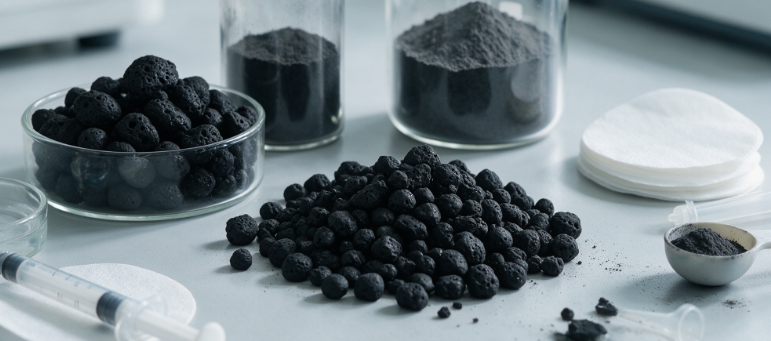
The emergence of negative‑ion functionalised activated carbon—a composite material that combines the high surface area and adsorption capacity of activated carbon with the ability to continuously generate negative air ions (NAIs)—has opened new frontiers in air purification, odour control, and health‑oriented environmental improvement. These advanced materials are typically engineered by incorporating tourmaline, rare‑earth minerals, or nanostructured metal oxides (e.g., ZnO, TiO₂, MnO₂) into the carbon matrix, leveraging the polarisation or catalytic properties to produce negative ions through water‑vapour dissociation or triboelectric effects. However, the practical efficacy of such a hybrid material is not an intrinsic constant; it is governed by a complex interplay of ion generation rate, emission stability, environmental dependence (humidity, temperature, airflow), the accessibility of ion‑producing sites, and the preservation of the carbon’s adsorptive capacity. Furthermore, the long‑term reliability depends on resistance to surface contamination, mechanical integrity, and the absence of harmful by‑products (e.g., ozone). Routine characterisation—such as simple iodine number or a basic ion‑counter reading under arbitrary conditions—provides only a superficial snapshot and fails to predict performance under real‑world ventilation scenarios. Consequently, a rigorous, multi‑parametric evaluation is indispensable for quality assurance, product certification, performance benchmarking, and process optimisation. Our ISO/IEC 17025‑accredited laboratory offers a fully integrated, multi‑scale testing service specifically designed for negative‑ion activated carbon, covering the entire spectrum from detailed material characterisation to dynamic ion‑emission profiling under controlled environmental parameters, and delivering quantitative, traceable data that directly support product development, regulatory compliance, and consumer confidence.
1. The Scientific and Commercial Imperative for In‑Depth Negative‑Ion Activated Carbon Testing
The performance of negative‑ion activated carbon is inherently bifunctional: it must simultaneously provide high adsorption capacity for gaseous pollutants (VOCs, formaldehyde, odours) and sustained, stable negative‑ion generation over extended periods. These two functions are often in competition, as the incorporation of ion‑producing additives may reduce pore volume or surface area, while the accumulation of adsorbed contaminants can block the ion‑emission sites. Moreover, the ion generation rate (number of ions per cubic centimetre per second) is highly sensitive to relative humidity (RH) and air velocity—conditions that vary widely in practical indoor environments. Many commercial products claim high ion counts, but these are frequently measured under non‑standardised conditions (e.g., static, enclosed chambers) that bear little resemblance to actual room air circulation. Our testing protocols follow the emerging standards (e.g., GB/T 18801, JIS B 9929, and ASTM D6007 adaptations) and incorporate controlled environmental chambers, precision ion counters, and simultaneous gas‑phase adsorption measurements to provide a holistic and realistic assessment. This enables us to separate intrinsic material performance from environmental artefacts, and to advise on optimal operating conditions for your specific product or application.
2. Our Comprehensive Analytical and Performance Testing Platform for Negative‑Ion Activated Carbon
We offer a modular, fully customisable test suite that covers all critical attributes of the negative‑ion activated carbon, from raw material to finished product, and from fresh to aged samples. All measurements are conducted with certified reference materials, standardised protocols, and rigorous internal quality controls.
2.1 Fundamental Physicochemical Characterisation
The adsorption substrate must retain its capacity despite the functionalisation. We characterise the BET specific surface area, micropore volume (t‑plot and DR), and mesopore size distribution (BJH/DFT) via N₂ physisorption. X‑ray fluorescence (XRF) and inductively coupled plasma optical emission spectrometry (ICP‑OES) quantify the loading of ion‑producing additives (e.g., boron, lithium, rare‑earths). X‑ray diffraction (XRD) identifies the crystalline phases of the additive. Scanning electron microscopy (SEM) with energy‑dispersive X‑ray spectroscopy (EDS) reveals the distribution of the additive on the carbon surface and within the pores. The surface chemistry is probed by X‑ray photoelectron spectroscopy (XPS) and Fourier‑transform infrared spectroscopy (FTIR) to detect the presence of polar groups (e.g., hydroxyl, carboxyl) that may influence ion generation and water adsorption.
2.2 Negative‑Ion Emission Characteristics – Static and Dynamic Modes
We use air‑ion counters (conforming to JIS B 9929) with a measurement range of 10–10⁷ ions/cm³, capable of differentiating negative and positive ions. Tests are performed in a temperature‑ and humidity‑controlled environmental chamber (0–40 °C, 10–90% RH). We measure: - Static emission rate: The sample is placed in a sealed chamber, and the ion concentration is monitored over time until equilibrium, allowing calculation of the steady‑state emission flux (ions per unit area per second). - Dynamic emission under airflow: The sample is placed in a duct with controlled air velocity (0.1–2.0 m/s), and ion concentration is measured downstream, enabling the determination of emission efficiency (ions per gram of material per minute) and its dependence on flow rate. - Decay curve and half‑life: The decrease of ion concentration after removal of the sample provides information on the ion generation kinetics.
2.3 Environmental Sensitivity – Temperature, Humidity, and Air Velocity
Using the dynamic test setup, we systematically vary RH (20–90%), temperature (10–40 °C), and air velocity (0.1–2.0 m/s) to generate performance maps that show how ion emission changes with these parameters. This is critical for predicting product performance in different climates and usage scenarios. We also measure the effect of interfering gases (e.g., CO₂, NH₃, VOCs) to assess whether competitive adsorption alters the ion generation.
2.4 Simultaneous Adsorption and Ion‑Emission Performance
Our unique dual‑function test system integrates a gas‑phase adsorption bed with an ion counter and a gas chromatograph / photoacoustic gas analyser. This allows us to measure, simultaneously, the breakthrough of a test gas (e.g., formaldehyde or toluene) and the ion concentration in the effluent. We assess whether the presence of adsorbed pollutants reduces ion emission, and whether the negative ions contribute to pollutant degradation (oxidation) beyond simple adsorption.
2.5 Ozone and By‑Product Assessment
A critical safety concern is the potential formation of ozone (O₃) as a by‑product of ionisation. We measure ozone concentration using a UV photometric ozone analyser (detection limit 0.5 ppb) under all test conditions, ensuring compliance with safety limits (e.g., FDA limit of 50 ppb for indoor devices). We also screen for other reactive species (e.g., NOx) using chemiluminescence detectors.
2.6 Long‑Term Stability and Accelerated Ageing
We subject the samples to accelerated ageing by exposing them to elevated temperature (50 °C), humidity (80% RH), and cyclic conditions for up to 1000 hours. After ageing, we re‑measure the BET surface area, ion emission rate, and adsorption capacity to quantify performance degradation due to additive leaching, pore blocking, or surface oxidation. We also simulate dust loading by coating the sample with standardised test dust (e.g., ISO 12103‑1) and re‑testing to assess the robustness of the ion‑emitting surface.
2.7 Leaching and Environmental Safety
To ensure that the functional additives do not leach into the environment (e.g., in humid conditions), we perform water‑leaching tests (batch and dynamic) and analyse the extract for heavy metals (ICP‑MS) and boron/lithium (IC or ICP). The results are compared against REACH, RoHS, and EPA safety limits.
2.8 Particle Size, Dusting, and Handling Properties
For granulated or powdered materials, we measure particle size distribution, dust generation (via rotating drum), and flowability to assess the suitability for different product forms (sachets, filters, panels).
3. Advanced Capabilities – Mechanistic Insight and Predictive Modelling
For clients requiring a deeper understanding of the ion‑generation mechanism or the interaction between adsorption and ionisation, we offer a suite of cutting‑edge, research‑grade techniques.
3.1 In‑Situ Spectroscopic Monitoring of Surface Charge and Water Interaction
Using in‑situ ambient‑pressure XPS (AP‑XPS) and Kelvin probe force microscopy (KPFM), we directly measure the surface potential and work function of the carbon‑additive interface under controlled humidity. This reveals the electronic driving forces for water dissociation and ion generation.
3.2 Time‑Resolved Ion Emission and Charge Decay
With a fast‑response ion counter (response time < 1 s) and an electrostatic voltmeter, we study the transient ion emission upon sudden humidity or temperature changes, providing insights into the relaxation times of the polarisation process.
3.3 Computational Modelling – DFT and Molecular Dynamics
Our computational team uses density functional theory (DFT) to calculate the adsorption energies of water molecules and their dissociation barriers on different additive surfaces, and molecular dynamics (MD) to simulate ion migration through the carbon pores. These models help to optimise additive composition and carbon pore structure for enhanced ion yield.
3.4 Accelerated Life Testing with Real‑World Contaminant Profiles
We can design customised ageing protocols that simulate the cumulative exposure to typical indoor pollutants (e.g., tobacco smoke, cooking fumes, cleaning agents) over several years, and then re‑evaluate both adsorption and ion‑emission performance to provide realistic lifetime predictions.
3.5 Biological Efficacy Validation (Optional)
For health‑oriented applications, we offer collaborative studies with microbiological laboratories to assess the effect of emitted negative ions on airborne bacteria (e.g., E. coli, Staphylococcus) and on allergen neutralisation, following standardised bioaerosol test methods.
4. Data Quality, Standardisation, and Comprehensive Reporting
All tests are performed under a strict quality management system with daily calibration, certified internal standards, and participation in proficiency testing schemes. Our reports deliver: - Full experimental conditions (temperature, RH, airflow, sample geometry, pre‑treatment). - Adsorption properties (BET, pore volume, isotherm parameters) before and after functionalisation. - Ion emission rates under static and dynamic conditions, with environmental sensitivity maps. - Simultaneous adsorption‑ionisation data (breakthrough curves coupled with ion counts). - Ozone and by‑product concentrations with compliance statements. - Ageing results (capacity loss, emission degradation) with statistical confidence intervals. - Leaching profiles and safety validation. - Uncertainty budgets (expanded uncertainty at k=2) for all key performance indicators.
Our final documents are prepared by senior material scientists and environmental engineers who provide a comprehensive interpretation of the data, linking material composition and structure to the observed dual‑function performance, and offering tailored recommendations on additive formulation, carbon grade selection, product geometry, and operating conditions to maximise efficacy and durability.
Typical turnaround for a full evaluation (characterisation + static/dynamic ion testing + accelerated ageing) is 8–10 working days, with express services available for product release or urgent certification.
5. Why Our Laboratory Is the Preferred Partner for Negative‑Ion Activated Carbon Testing
Our service is distinguished by a unique combination of technical breadth, environmental realism, and application‑oriented consulting.
Integrated one‑stop infrastructure: We host all essential instruments—BET, XRF, XRD, SEM‑EDS, XPS, FTIR, ICP‑MS, environmental chambers, ion counters, gas analysers, and ozone monitors—under one roof, ensuring seamless sample handling and rapid cross‑validation of data, eliminating the fragmentation and delays of multi‑vendor testing.
Real‑world simulation: Our dynamic ion tests are conducted under controlled airflow and humidity profiles that mimic actual indoor ventilation, and we can incorporate cyclic conditions to assess resilience. We also offer testing with real‑room simulated setups (large‑volume chambers) for a holistic assessment.
Deep expertise in functional carbon materials: Our team has extensive experience with activated carbon modifications, including mineral impregnation, surface oxidation, and nanostructure engineering. We understand the subtle trade‑offs between adsorption and ion generation, and we can provide expert diagnostics on why a particular formulation may underperform.
Regulatory and certification support: We are familiar with the requirements of CE, FCC, EPA, and GB standards for air purifiers and ion‑generating materials. Our reports are structured to support product certification and consumer marketing claims with robust, defensible data.
Flexibility and rapid response: We accept samples in any form—powders, granules, coated fabrics, honeycomb monoliths, or complete filter assemblies. We provide clear guidance on sample packaging and conditioning to maintain ion‑generating activity prior to testing.
Cost‑effective and transparent pricing: Our modular pricing allows you to select only the tests you need, with discounts for multi‑product screening or long‑term development partnerships. There are no hidden fees for interpretation, statistical analysis, or consultancy.
Our track record includes successful collaborations with over 50 companies in the air purification, automotive cabin filter, and building material sectors, helping them optimise ion output, ensure safety, and achieve regulatory approval. We invite you to leverage this expertise for your negative‑ion activated carbon evaluation.
Validate the dual performance of your negative‑ion activated carbon with confidence. Contact our technical specialists today to design a customised test programme that addresses your specific product targets and operational environments. We will provide a detailed proposal and timeline within one business day.