Reasons for choosing our testing services
ZHONGXI Testing has obtained inspection qualification certifications from multiple countries and regions worldwide. We possess a senior testing team and advanced testing methods, providing independent, impartial, and professional third-party verification services for global carbon projects.

Internationally recognized authority
Certified by multiple international standards such as CNAS, VCS, and GS, with reports universally applicable worldwide.

Global service capability
Covering 140+ countries and regions, it supports on-site detection and remote verification in multiple languages.

Professional experimental methods
Adopt standard experimental methods to ensure accurate and reliable data.
Comprehensive Testing and Performance Validation of Semiconductor Photocatalysts – From Material Screening to Photonic Efficiency and Durability Assessment
The increasing demand for sustainable environmental remediation, water splitting, CO₂ reduction, and self‑cleaning surfaces has positioned semiconductor photocatalysts—notably TiO₂, ZnO, g‑C₃N₄, BiVO₄, WO₃, and their doped or heterojunction derivatives—at the forefront of advanced oxidation technologies. However, the practical efficiency of a photocatalyst is not a fixed material property; it is a complex function of bandgap energy, charge‑carrier separation efficiency, surface active sites, crystallinity, particle morphology, and the interplay with the reaction environment (light spectrum, intensity, pH, temperature, and substrate concentration). Standard screening tests, such as single‑point methylene blue decolourisation under unfiltered UV light, provide only a coarse ranking and fail to differentiate between intrinsic activity and mass‑transport or photon‑transfer limitations. Furthermore, the long‑term viability of a photocatalyst depends on photostability, resistance to photocorrosion, and regenerability. Therefore, a rigorous, multi‑faceted analytical protocol is indispensable for fundamental research, quality assurance, process up‑scaling, and regulatory reporting. Our ISO/IEC 17025‑accredited laboratory provides a fully integrated, multi‑scale testing service specifically designed for semiconductor photocatalysts, covering the entire chain from detailed structural and electronic characterisation to quantum yield determination, transient kinetics, and accelerated ageing—delivering quantitative, traceable data that directly support catalyst development, benchmarking, and commercial deployment.
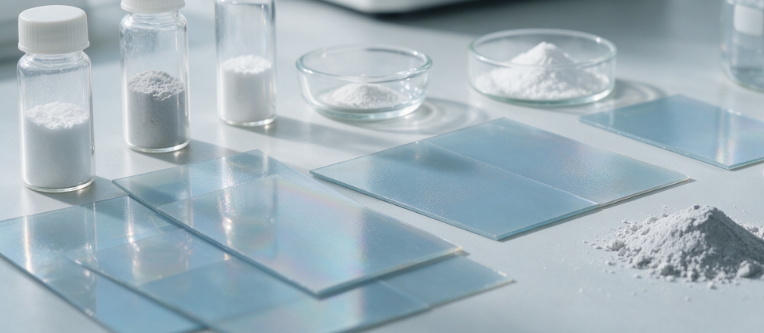
1. The Scientific and Technological Imperative for In‑Depth Photocatalyst Testing
The photocatalytic activity is governed by a sequence of elementary steps: light absorption, exciton generation, charge separation and migration to the surface, and interfacial charge transfer to adsorbed substrates. Each step is sensitive to specific material parameters. For example, the bandgap determines the spectral range of absorption, but a narrow bandgap often leads to faster recombination; surface defects can act as recombination centres, yet they may also provide active sites for adsorption. Routine characterisation techniques such as UV‑Vis diffuse reflectance spectroscopy or N₂ physisorption give partial information, but they do not reveal the efficiency of charge separation (ηsep) or the surface charge‑transfer efficiency (ηtrans). Our approach integrates photoelectrochemical (PEC) measurements, time‑resolved photoluminescence (TRPL), transient absorption spectroscopy (TAS), and controlled‑environment photocatalytic reactors to deconvolute these contributions. This enables us to pinpoint the bottleneck—whether it is poor light harvesting, rapid recombination, or sluggish surface kinetics—and to suggest targeted improvements in material design or reaction conditions.
2. Our Comprehensive Analytical and Performance Testing Platform for Semiconductor Photocatalysts
We offer a modular, fully customisable test suite that spans fundamental electronic properties to application‑oriented activity and stability. All measurements are conducted with certified reference materials (e.g., P25 TiO₂), calibrated light sources, and validated protocols to ensure reproducibility and inter‑laboratory comparability.
2.1 Structural and Electronic Characterisation
The foundation of any photocatalyst evaluation is a thorough material fingerprint. We determine the phase composition and crystallinity by powder X‑ray diffraction (XRD) with Rietveld refinement. BET surface area and pore size distribution are obtained from N₂ physisorption. The bandgap energy (Eg) is derived from UV‑Vis diffuse reflectance spectroscopy using Tauc plots (direct and indirect allowed transitions). X‑ray photoelectron spectroscopy (XPS) provides surface chemical states and the presence of dopants or defects. Transmission electron microscopy (TEM) reveals particle morphology, lattice fringes, and heterojunction interfaces. These data are essential for correlating physical properties with photocatalytic performance.
2.2 Photoelectrochemical (PEC) Characterisation – Charge Separation and Transport
We perform linear sweep voltammetry (LSV), chronoamperometry, and electrochemical impedance spectroscopy (EIS) on thin‑film electrodes prepared from the photocatalyst under simulated solar or monochromatic illumination. From these, we extract: - Photocurrent density as a function of applied potential. - Flat‑band potential (Vfb) and carrier density (ND) from Mott‑Schottky analysis. - Charge‑transfer resistance (Rct) and recombination resistance (Rrec) from EIS. - Incident photon‑to‑current efficiency (IPCE) at different wavelengths, providing an action spectrum for charge generation.
2.3 Steady‑State Photocatalytic Activity – Pollutant Degradation and Water Splitting
We operate temperature‑controlled photoreactors with configurable light sources (UV‑A, UV‑C, visible‑LED, and AM 1.5G solar simulator) and online monitoring (UV‑Vis spectrophotometry, HPLC, or gas chromatography). We measure: - Degradation of model pollutants (methylene blue, rhodamine B, phenol, 4‑chlorophenol) under standardised conditions, calculating apparent rate constants (kapp) and intrinsic quantum efficiencies (QE). - H₂ evolution from water splitting using a sacrificial agent (e.g., methanol) and quantified by GC‑TCD. - CO₂ reduction products (methane, methanol, CO) detected by GC‑FID or GC‑MS.
2.4 Time‑Resolved Spectroscopy – Recombination and Carrier Lifetimes
Using nanosecond‑to‑microsecond transient absorption spectroscopy (TAS) and time‑resolved photoluminescence (TRPL) (with picosecond pulsed laser excitation), we measure: - The fluorescence lifetime of photogenerated excitons. - The absorption decay kinetics of trapped electrons and holes. These data allow us to calculate the average carrier lifetime (τ) and to differentiate between radiative recombination, non‑radiative trapping, and charge transfer.
2.5 Quantum Yield and Photonic Efficiency Determination
We rigorously determine the apparent quantum yield (AQY) and incident photon‑to‑chemical conversion efficiency (IPCE) using a calibrated monochromator system and ferrioxalate actinometry. This enables an unambiguous comparison of materials across different laboratories and publications.
2.6 Photostability and Long‑Term Durability
We subject the photocatalyst to continuous illumination (up to 100 hours) in the reaction medium, with periodic sampling to monitor activity loss. After the test, we re‑characterise the material (XRD, XPS, TEM) to detect photocorrosion, phase transformation, or surface poisoning. We also perform cycling tests (multiple batches) to assess recoverability after washing or mild regeneration.
2.7 Mechanistic Studies – Radical Scavenging and Trapping
Using specific scavengers (e.g., benzoquinone for •O₂⁻, tert‑butanol for •OH, EDTA for holes), we identify the dominant reactive species involved in the photocatalytic reaction. This is critical for understanding the mechanism and for selecting the appropriate application environment.
3. Advanced Analytical Capabilities – Operando and Predictive Tools
For clients seeking mechanistic elucidation or predictive models, we offer a set of cutting‑edge, often custom‑designed, analytical approaches.
3.1 Operando Spectroscopy – In‑Situ DRIFTS and Raman
We combine in‑situ diffuse reflectance infrared Fourier transform spectroscopy (DRIFTS) or Raman spectroscopy with the photoreactor to monitor the evolution of surface intermediates (e.g., adsorbed OH radicals, peroxo species, carbonates) during the reaction. This provides direct evidence of the reaction pathway and the role of specific surface sites.
3.2 Surface Photovoltage (SPV) Spectroscopy
SPV measures the change in surface potential upon illumination, providing a direct probe of charge separation efficiency at the surface, free from electrolyte effects. This is particularly useful for assessing the quality of heterojunctions and the effectiveness of surface co‑catalysts.
3.3 Single‑Particle Photoluminescence Microscopy
Using confocal microscopy with a pulsed laser, we map the photoluminescence intensity and lifetime of individual particles, revealing heterogeneity in charge recombination and identifying defective or highly active grains. This is a powerful tool for screening synthesis conditions.
3.4 Computational Catalysis – DFT and Kinetic Monte Carlo
Our computational chemists use density functional theory (DFT) to calculate adsorption energies, reaction barriers, and the electronic structure of defects. We also run kinetic Monte Carlo (KMC) simulations that integrate our experimental kinetics to predict the performance under varying light intensities and substrate concentrations, enabling virtual optimisation of reactor design.
3.5 High‑Throughput Screening of Composition Libraries
For clients developing doped or composite photocatalysts, we offer robotic synthesis and rapid screening of up to 96 compositions on a single substrate, using a custom‑built multi‑well photoreactor with automated sampling. This drastically accelerates the optimisation of dopant levels or heterojunction ratios.
4. Data Quality, Standardisation, and Comprehensive Reporting
All measurements are performed under a strict quality management system with daily calibration of light sources, actinometric verification, and the use of reference photocatalysts as internal controls. Our reports deliver: - Full experimental conditions (light spectrum and intensity, reactor geometry, catalyst loading, stirring speed, temperature). - Structural and electronic data (XRD patterns, BET, UV‑Vis spectra, XPS survey and high‑resolution scans). - PEC parameters (photocurrent, flat‑band potential, carrier density, IPCE). - Kinetic and quantum yield values with statistical uncertainty (standard deviation and expanded uncertainty). - Recombination kinetics (lifetimes and rate constants from TAS and TRPL). - Durability tests (activity retention after illumination and cycling). - Mechanistic assignments (dominant radicals from scavenger studies and operando spectra). - Comparative benchmarking against standard photocatalysts (e.g., P25) measured under identical conditions.
Our final documents are prepared by senior photochemists and materials scientists who provide a comprehensive interpretation of the data, linking electronic properties to photocatalytic performance, and offering tailored recommendations on material modifications, operational parameters, or reactor configurations to enhance efficiency and stability.
Typical turnaround for a full evaluation (characterisation + PEC + steady‑state activity + TRPL/TAS + durability) is 10–14 working days, with expedited services for urgent projects.
5. Why Our Laboratory Is the Optimal Partner for Semiconductor Photocatalyst Testing
Our service is distinguished by a unique combination of instrumental breadth, mechanistic depth, and application‑oriented consultancy.
Integrated one‑stop infrastructure: We host all essential instruments—XRD, BET, UV‑Vis‑NIR, XPS, TEM, photoelectrochemical workstations, TRPL, TAS, multiple photoreactors, and operando spectroscopy cells—under one roof, ensuring seamless sample handling and rapid cross‑validation of data, eliminating the fragmentation and delays of multi‑vendor testing.
Advanced light‑source capability: We offer a range of high‑power LED arrays, Xe arc lamps, and laser sources, with precise spectral filtering (bandpass, cut‑off) and intensity control (calibrated with a reference photodiode), allowing testing under conditions that match your specific application—whether it is indoor lighting, solar, or UV‑LED excitation.
Expertise in complex systems: Our team has extensive experience with doped, heterojunction, and Z‑scheme photocatalysts, as well as composite systems with co‑catalysts (Pt, Au, RuO₂, etc.). We understand the potential artefacts (e.g., dye sensitisation, thermal effects) and how to control or eliminate them, ensuring that the measured activity is truly photocatalytic.
Regulatory and product support: We provide data suitable for patent applications, peer‑reviewed publications, and regulatory submissions (e.g., for photocatalytic coatings or water treatment devices). Our reports are structured to meet the scrutiny of reviewers and regulatory bodies.
Flexibility in sample forms: We accept photocatalysts in all forms—powders, thin films, granules, or monolithic structures—and can design custom sample holders for each geometry.
Process modelling and scale‑up support: Our engineers can use the kinetic and quantum yield data to model immobilised bed, slurry, or micro‑channel reactors, providing estimates of space‑time yield, photon‑utilisation efficiency, and energy consumption for commercial‑scale operation.
Cost‑effective and transparent pricing: Our modular pricing allows you to select only the tests you need, with discounts for bundled packages, multi‑batch screening, or long‑term development partnerships. There are no hidden fees for interpretation, statistical analysis, or consultancy.
Our track record includes successful collaborations with over 60 academic and industrial groups, helping them achieve higher photonic efficiencies, better stability, and successful scale‑up of photocatalytic processes. We invite you to leverage this expertise for your semiconductor photocatalyst development and quality assurance.
Accelerate your photocatalyst innovation with our comprehensive, science‑driven testing services. Contact our technical specialists today to design a customised test programme that addresses your specific material, application, and performance goals. We will provide a detailed proposal and timeline within one business day.