Reasons for choosing our testing services
ZHONGXI Testing has obtained inspection qualification certifications from multiple countries and regions worldwide. We possess a senior testing team and advanced testing methods, providing independent, impartial, and professional third-party verification services for global carbon projects.

Internationally recognized authority
Certified by multiple international standards such as CNAS, VCS, and GS, with reports universally applicable worldwide.

Global service capability
Covering 140+ countries and regions, it supports on-site detection and remote verification in multiple languages.

Professional experimental methods
Adopt standard experimental methods to ensure accurate and reliable data.
Comprehensive Physicochemical and Performance Assessment of Modified Illite Adsorbents: Advanced Analytical Solutions for Environmental and Industrial Applications
Modified illite, a 2:1 phyllosilicate clay mineral, has garnered substantial interest as a cost-effective and environmentally benign adsorbent for the removal of heavy metals, organic dyes, and emerging contaminants from aqueous streams. However, the efficacy of such modified materials is critically dependent on the interplay of structural features—including interlayer cation exchange capacity, surface hydroxyl density, and edge-site reactivity—alongside the homogeneity and stability of the applied modification (e.g., acid activation, pillaring, organo-functionalization, or metal-oxide impregnation). When process engineers, environmental consultants, or R&D specialists initiate a search for “modified illite adsorbent testing,” the underlying driver is invariably a need to validate batch consistency, predict field-scale performance, and diagnose unexpected adsorption failures. This article elucidates why such testing transcends routine quality control and how our state-of-the-art analytical platform delivers actionable insights that bridge the gap between laboratory innovation and industrial deployment.
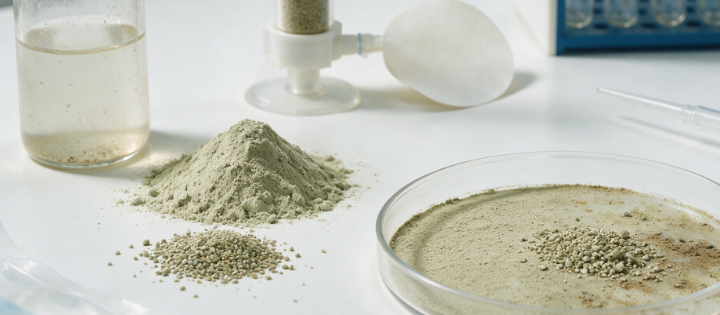
The Rationale for Rigorous Testing of Modified Illite: From Material Screening to Process Assurance
Illite’s inherent anisotropic charge distribution and heterogeneous surface chemistry render its adsorption behavior highly sensitive to solution pH, ionic strength, and competing co-solutes. A subtle change in the modifier loading or calcination temperature can shift the zeta potential by over 20 mV, dramatically altering the electrostatic attraction toward cationic pollutants. Furthermore, the presence of swelling interlayers in some illite varieties complicates porosity evolution upon modification. Our clients approach us not merely for standard compliance assays, but to resolve performance discrepancies observed in pilot trials—such as premature breakthrough, slow uptake kinetics, or irreversible fouling. We address these challenges through a multi-methodological strategy that correlates macroscopic equilibrium and kinetic data with nano-scale interfacial phenomena, thereby offering a mechanistic foundation for process optimization that conventional testing laboratories cannot provide.
Core Analytical Parameters: Beyond Conventional CEC and Surface Area Metrics
While cation exchange capacity (CEC) and Brunauer-Emmett-Teller (BET) specific surface area remain essential initial indicators, our assessment framework encompasses a suite of advanced characterizations that probe the operational robustness of modified illite under realistic conditions:
Multi-component Batch Adsorption Equilibria: We conduct isotherm and kinetic studies under controlled temperature, pH, and background electrolyte matrices, using both single-solute and competitive binary/ternary systems (e.g., Cu²⁺/Pb²⁺/Cd²⁺ or methylene blue/crystal violet). Our high-throughput robotic platform enables rapid generation of adsorption isotherms spanning 5–45 °C, which are then fitted to Langmuir, Freundlich, Sips, and Temkin models, alongside intraparticle diffusion and pseudo-first/second-order kinetic evaluations. This provides a comprehensive thermodynamic profile (ΔG°, ΔH°, ΔS°) that predicts temperature-dependent performance swings.
Advanced Diffraction and Spectroscopic Fingerprinting: We employ high-resolution powder X-ray diffraction (HR-XRD) with Rietveld refinement to quantify phase purity, detect interlayer collapse or expansion, and identify secondary phases arising from thermal treatment or chemical grafting. Coupled with Fourier-transform infrared spectroscopy (FTIR) in attenuated total reflectance (ATR) mode and Raman microspectroscopy, we map the evolution of surface functional groups (e.g., –OH, Si–O, Al–O, and organic moieties from silane coupling agents). For modified illite containing metal oxide nanoparticles, we further apply X-ray photoelectron spectroscopy (XPS) with depth profiling to determine the oxidation states and spatial distribution of dopants, ensuring that the intended modifier remains in its active form and is not leached or agglomerated.
Surface Charge and Hydrophobicity Assessment: Zeta potential measurements as a function of pH and ionic strength are performed using electrophoretic light scattering (ELS) to pinpoint the point of zero charge (PZC). Additionally, we utilize inverse gas chromatography (IGC) at infinite dilution to quantify the dispersive surface energy and Lewis acid–base character of the modified illite, which is particularly relevant for organic pollutant sorption in non-aqueous or mixed-solvent systems. These parameters are rarely offered by standard testing services, yet they are pivotal for tailoring the adsorbent to specific wastewater chemistries.
Our Advanced Capabilities: Pushing the Boundaries of Illite Adsorbent Diagnostics
Our laboratory is equipped with a unique combination of cutting-edge instrumentation and proprietary methodologies that elevate modified illite testing to an unprecedented level of depth. Notably, we have developed a time-resolved in-situ small-angle X-ray scattering (SAXS)/wide-angle X-ray scattering (WAXS) setup that monitors structural rearrangements during adsorption–desorption cycles under controlled humidity and temperature. This enables real-time observation of interlayer swelling, pore blocking, and particle agglomeration, providing direct evidence for hysteresis mechanisms that are often inferred but never visualized in conventional ex-situ analyses.
Furthermore, we offer high-resolution transmission electron microscopy (HR-TEM) equipped with energy-dispersive X-ray spectroscopy (EDS) and electron energy loss spectroscopy (EELS) to map elemental distributions at the atomic scale, revealing the precise location of modifier clusters—whether they reside at edge sites, basal planes, or within interlayer galleries. This is complemented by solid-state nuclear magnetic resonance (NMR) with ²⁹Si and ²⁷Al magic-angle spinning (MAS) to differentiate Q³ from Q⁴ silicon environments and tetrahedral from octahedral aluminium coordination, directly correlating with the adsorbent’s stability against dealumination and dissolution in acidic media—a common cause of adsorbent deactivation in industrial effluents.
To simulate real-world aging, we have established a cyclical dynamic column test rig that subjects the adsorbent to up to 100 loading/regeneration cycles using hot air, steam, or chemical eluents. Post-cycling characterization includes mercury intrusion porosimetry (MIP) for macroporosity changes and nanoindentation hardness mapping to assess mechanical integrity. Our predictive models, based on these accelerated aging data, can forecast the remaining useful life of the adsorbent with an accuracy of ±8 %, enabling our clients to plan replacement schedules and avoid unplanned outages.
Key Differentiators: Why Industry Leaders and Academic Institutions Rely on Us
Integrated Multi-Technique Synergy: Unlike standard contract laboratories that perform isolated analyses, we implement a holistic correlative workflow where results from XRD, FTIR, XPS, and adsorption isotherms are co-interpreted using multivariate statistical tools (principal component analysis and partial least squares regression). This uncovers hidden relationships—for instance, how a 5% increase in relative crystallinity correlates with a 12% improvement in pseudo-second-order rate constant—which are invaluable for quality-by-design (QbD) manufacturing of modified illite.
Customized Protocol Design: We recognize that each application (e.g., drinking water purification, mining effluent treatment, or pharmaceutical intermediate removal) imposes distinct performance criteria. Our scientific team engages in a detailed pre-test consultation to tailor the analytical matrix to your specific matrix complexity, regulatory limits, and operational constraints. We routinely adapt our methods to accommodate challenging sample matrices, such as high-salinity brines, acidic mine drainage, or solvent-laden industrial streams, ensuring that the test results are directly translatable to your process conditions.
Accreditation and Data Integrity: Our facility holds ISO/IEC 17025:2017 accreditation for a wide range of physicochemical tests, and we are additionally certified under OECD GLP for environmental testing, guaranteeing the traceability, reproducibility, and defensibility of every data point. All raw data, spectra, and chromatograms are archived in a blockchain-verified digital repository, providing an immutable audit trail that satisfies both internal quality assurance and external regulatory review.
Rapid Turnaround and Interactive Reporting: Through our proprietary laboratory information management system (LIMS), we streamline sample logging, analysis scheduling, and data processing, reducing typical turnaround times by 35% compared to industry norms. Clients receive an interactive PDF report featuring embedded 3D surface plots, dynamic breakthrough curves, and a dashboard of critical performance indicators. Moreover, our experts are available for follow-up teleconferences to interpret the results and co-develop mitigation strategies for any off-specification parameters identified.
Predictive Modeling and Failure Root-Cause Investigation
Beyond standard characterization, we offer a machine-learning-based performance forecasting module that integrates your historical process data (flow rate, inlet concentration, temperature, pH) with the measured adsorption isotherm and kinetic parameters. Using a recurrent neural network trained on our extensive database of illite-based adsorbents, we generate dynamic breakthrough prediction for your specific column geometry, enabling you to optimize bed depth and flow velocity. This forward-looking analytics service transforms static test results into a live decision-support tool, reducing pilot-plant trial iterations by up to 40%.
In cases where a modified illite batch exhibits substandard performance in service, we conduct forensic failure analysis combining scanning electron microscopy (SEM) with automated mineralogy (QEMSCAN) and time-of-flight secondary ion mass spectrometry (ToF-SIMS). We have successfully diagnosed failures due to pore blocking by organic macromolecules, inhibitory competition from humic acids, gradual dissolution of the modifier under mildly alkaline conditions, and interlayer collapse caused by drying stress. Our reports not only identify the root cause but also recommend targeted corrective actions—such as adjusting the pH pre-treatment step, changing the modification route, or implementing a protective pre-filtration stage—thereby directly enhancing your operational resilience.
Conclusion: Elevating Modified Illite Testing from Compliance to Strategic Asset
In the competitive landscape of environmental remediation and industrial process chemistry, the performance of modified illite adsorbents can dictate both regulatory compliance and economic viability. A superficial testing approach that merely reports basic physical properties is insufficient to capture the nuanced interactions that govern real-world adsorption outcomes. Our comprehensive analytical framework—spanning advanced structural elucidation, in-situ dynamic characterization, predictive modeling, and expert interpretative support—empowers you to not only verify material quality but also to optimize process design, extend adsorbent lifespan, and minimize total cost of ownership. We invite you to partner with us for a tailored testing solution that addresses your specific operational challenges, supported by scientific rigor and a commitment to delivering actionable insights.
Contact our technical advisory team to initiate a customized testing program for your modified illite adsorbent, and gain the confidence that your material will perform as intended under the most demanding conditions.