Reasons for choosing our testing services
ZHONGXI Testing has obtained inspection qualification certifications from multiple countries and regions worldwide. We possess a senior testing team and advanced testing methods, providing independent, impartial, and professional third-party verification services for global carbon projects.

Internationally recognized authority
Certified by multiple international standards such as CNAS, VCS, and GS, with reports universally applicable worldwide.

Global service capability
Covering 140+ countries and regions, it supports on-site detection and remote verification in multiple languages.

Professional experimental methods
Adopt standard experimental methods to ensure accurate and reliable data.
Advanced Multi-Modal Characterisation and Environmental Performance Assessment of Calcium‑Magnesium Mineralised Biochar: A Comprehensive Analytical Framework for Sustainable Soil Remediation and Carbon Sequestration
Calcium‑ and magnesium‑mineralised biochars have attracted substantial interdisciplinary interest as multifunctional materials that combine the recalcitrant carbon pool of pyrolysed biomass with the reactivity of alkaline earth carbonates, oxides, and hydroxides. These engineered sorbents are increasingly deployed for heavy metal immobilisation in contaminated soils, phosphate recovery from agricultural runoff, acid mine drainage neutralisation, and even as additives for enhanced weathering carbon capture. However, the term “mineralised” encompasses a wide spectrum of actual chemical forms—from co‑precipitated Ca/Mg‑carbonates on the biochar surface to substitutional incorporation within the carbon matrix and discrete nano‑particulate oxides—each imparting vastly different reactivity, longevity, and environmental mobility. When environmental consultants, waste managers, or soil remediation specialists search for “calcium‑magnesium mineralised biochar testing,” their underlying objective is far more nuanced than confirming bulk elemental composition. They need to know: Is the mineral phase predominantly calcite, dolomite, or periclase? How homogeneously are these phases distributed at the micro‑scale? What fraction of the Ca and Mg is bioavailable versus sequestered in non‑exchangeable forms? Will the material release alkalinity over a sufficient time horizon to neutralise persistent acidity, or will it rapidly dissolve, causing unintended salinisation? This article articulates the scientific rationale for such comprehensive testing and demonstrates how our state‑of‑the‑art analytical ecosystem provides not only definitive answers to these questions but also predictive models for field‑scale performance, enabling our clients to de‑risk large‑scale environmental applications and optimise the formulation of next‑generation mineralised biochars.
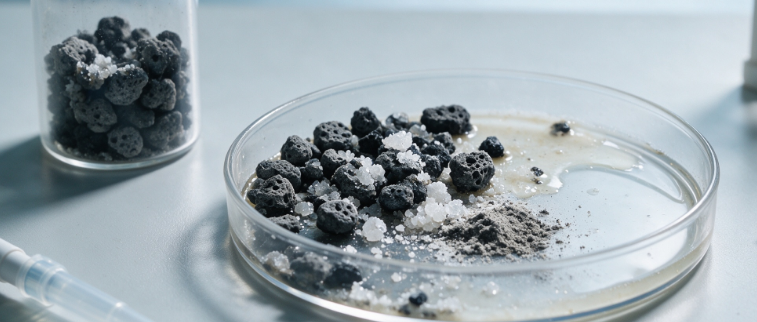
Unravelling the Complexity: Why Bulk Elemental Analysis and Standard pH Measurements Are Insufficient
Conventional testing of mineralised biochar typically relies on X‑ray fluorescence (XRF) for total Ca/Mg content, loss on ignition (LOI) for organic matter, and a simple pH measurement in water. These parameters fail to capture the critical chemical speciation and physical distribution of the mineral phases. For example, calcium present as CaCO₃ (calcite) will release alkalinity slowly and sustainably, while CaO (lime) will hydrolyse violently, causing a rapid pH spike that may harm soil biota. Magnesium may be present as MgCO₃ (magnesite), MgO (periclase), or Mg‑silicate, each with different solubility and cation exchange behaviour. Furthermore, the interaction between the mineral phase and the biochar carbon matrix—whether the minerals are physically adsorbed, chemically bonded via carboxylate linkages, or encapsulated within micropores—determines the resistance to leaching and the rate of nutrient release. Our clients approach us when they observe inconsistent results in field trials, or when they need to validate a new synthesis route that claims to produce “high‑stability” mineralised biochar. We address these challenges by deploying a tiered analytical strategy that integrates bulk mineralogy, surface chemistry, nano‑scale spatial mapping, and dynamic leaching behaviour, providing a level of mechanistic understanding that standard contract laboratories simply cannot deliver.
Core Analytical Parameters: From Crystallographic Phase Identification to Molecular Speciation
High‑Resolution Powder X‑ray Diffraction (HR‑XRD) with Rietveld Quantification: We employ a high‑brilliance laboratory diffractometer equipped with a Cu Kα source and a position‑sensitive detector, achieving an angular resolution of 0.02° 2θ. This allows unambiguous identification of all crystalline phases—calcite (CaCO₃), dolomite (CaMg(CO₃)₂), magnesite (MgCO₃), lime (CaO), periclase (MgO), and any hydroxycarbonate intermediates (e.g., hydromagnesite Mg₅(CO₃)₄(OH)₂·4H₂O). Through Rietveld refinement, we quantify the weight fractions of each phase with an uncertainty of < ±1.5 wt%, even in complex multi‑phase systems. For amorphous or poorly crystalline mineral phases, we complement this with pair distribution function (PDF) analysis using synchrotron total scattering, which reveals the short‑range order (up to 5 Å) of Ca and Mg coordination, providing insight into incipient mineral nucleation that is invisible to conventional XRD.
X‑ray Photoelectron Spectroscopy (XPS) with Depth Profiling: Using monochromatic Al Kα radiation and a cluster ion gun for gentle sputtering, we obtain non‑destructive depth profiles (0–100 nm) of Ca 2p, Mg 1s, C 1s, O 1s, and Si 2p (from inherent silica in biochar). This reveals whether the mineral phase is enriched at the outermost surface (indicating a coating) or distributed more uniformly through the carbon matrix. The chemical shift of Ca 2p₃/₂ (binding energy ~347.2 eV for CaCO₃ vs. ~346.5 eV for CaO) and Mg 1s (~1304.5 eV for MgO vs. ~1305.8 eV for MgCO₃) allows us to distinguish oxide from carbonate forms at each sputter depth, thus identifying any core‑shell structures that may develop during pyrolysis or post‑synthesis mineralisation.
Fourier‑Transform Infrared Spectroscopy (FTIR) and Raman Microspectroscopy: We use ATR‑FTIR to detect characteristic vibrational modes of carbonate (ν₃ at ~1420 cm⁻¹, ν₂ at ~875 cm⁻¹, ν₄ at ~712 cm⁻¹), which can be deconvoluted to differentiate calcite, dolomite, and aragonite. Additionally, our confocal Raman microscope provides micrometre‑scale mapping of the D and G bands of the carbonaceous matrix (indicating graphitisation degree) simultaneously with the carbonate lattice modes, enabling a direct correlation between carbon structural order and mineral nucleation. This is particularly valuable for assessing whether the mineralisation procedure alters the biochar’s intrinsic stability.
Environmental Scanning Electron Microscopy (ESEM) with EDS and EBSD: Operating in low‑vacuum mode, we image the biochar particles without gold coating, preserving the hydrated state of any hygroscopic minerals. Coupled with energy‑dispersive spectroscopy (EDS), we obtain elemental maps of Ca, Mg, C, O, and other trace elements (P, S, Fe) at sub‑micron resolution. We further employ electron backscatter diffraction (EBSD) to determine the crystallographic orientation of individual carbonate grains, which can indicate whether the mineral precipitated abiotically or via biogenic (microbial) processes—an important distinction for biochars produced via vermicomposting or co‑composting.
Dynamic Leaching and Bioavailability Assessment
The environmental performance of Ca/Mg‑mineralised biochar is governed by its release kinetics of alkalinity and essential nutrients. We perform long‑term flow‑through column leaching tests (up to 50 pore volumes) using synthetic rainwater or acidified groundwater (pH 4–6) at controlled flow rates, with online pH, electrical conductivity, and ICP‑OES monitoring of effluent Ca, Mg, alkalinity, and dissolved organic carbon. The breakthrough curves are fitted to transport models (advection‑dispersion with rate‑limited dissolution) to extract dissolution rate constants for each mineral phase, allowing us to forecast the acid‑neutralisation capacity (ANC) over a 10‑year horizon. For agro‑environmental applications, we conduct sequential extraction (modified BCR scheme) to fractionate Ca and Mg into exchangeable, reducible, oxidisable, and residual pools, providing a direct measure of plant‑available nutrients versus geochemically sequestered fractions. This is critical for predicting the fertiliser value of the material.
Moreover, we perform toxicity characteristic leaching procedure (TCLP) and synthetic precipitation leaching procedure (SPLP) to assess the potential mobilisation of trace metals (e.g., Pb, Cu, Zn) that may be co‑precipitated with the Ca/Mg phases. Our tests are conducted under both acid and alkaline leaching conditions, simulating the worst‑case disposal or field‑exposure scenarios.
Advanced Nano‑Scale and Isotopic Capabilities
Transmission Electron Microscopy (TEM) with SAED and EELS: We prepare ultramicrotomed cross‑sections of mineralised biochar particles and image them using a 200 kV TEM, revealing the intimate contact between the carbon matrix and mineral nanocrystals (typically 5–50 nm). Selected‑area electron diffraction (SAED) confirms the crystal structure of individual grains, while electron energy‑loss spectroscopy (EELS) maps the valence state of Ca and Mg, distinguishing between ionic (carbonate/oxide) and metallic or carbide forms—the latter being extremely rare but potentially reactive.
Stable Isotope Fingerprinting (δ¹³C and δ¹⁸O): For biochars intended for carbon‑credit schemes, we offer isotope ratio mass spectrometry (IRMS) of the carbonate fraction to determine whether the mineralisation sourced atmospheric CO₂ (negative δ¹³C, typical of plant‑derived carbonates) or geogenic limestone (near‑zero δ¹³C). This provides an objective metric for the “additional” carbon sequestration benefit, a critical parameter for applications in enhanced weathering and soil organic carbon modelling.
High‑Energy X‑ray Micro‑Computed Tomography (µ‑CT): At synchrotron facilities, we perform 3D tomography at 1‑µm voxel size to visualise the spatial distribution of mineral‑filled pores versus empty macropores. By thresholding based on attenuation coefficients, we quantify the volume fraction of mineral deposits, the tortuosity of the pore network, and the connectivity of the carbon skeleton after mineralisation. This information is essential for predicting the transport of water and solutes through a packed bed of the biochar.
Our Distinctive Differentiators: Scientific Depth and Customised Interpretation
Integrated Data Fusion and Mechanistic Modelling: We do not simply provide a stack of separate analytical reports. Our team of geochemists, material scientists, and environmental engineers integrates the XRD, XPS, TEM, and leaching data into a unified “Mineral‑Carbon Interaction Model” that describes the spatial association, dissolution kinetics, and long‑term stability of each mineral phase. This model is validated against our proprietary database of >500 mineralised biochar samples, allowing us to benchmark your material against industry standards and to identify outliers that may indicate synthesis inconsistencies or contamination.
Tailored Protocols for Specific End‑Uses: We recognise that a biochar intended for acidic mine tailings neutralisation has different performance requirements than one designed for phosphorus recovery from wastewater or as a slow‑release fertiliser in alkaline soils. Our pre‑test consultation defines the key performance indicators (KPIs) relevant to your application—for example, rapid initial alkalinity release vs. sustained buffering capacity, or high Ca²⁺ availability for flocculation vs. low Mg²⁺ to avoid soil dispersion. We then customise the leaching conditions, target analytes, and timescale of the tests accordingly, ensuring that the results are directly actionable for your process design.
Accredited Quality and Full Traceability: Our core laboratory holds ISO/IEC 17025:2017 accreditation for all physico‑chemical tests, and we are OECD GLP compliant for environmental fate studies. All raw data, spectra, and chromatograms are archived in a secure electronic laboratory notebook (ELN) with blockchain‑based timestamping, providing an immutable audit trail that satisfies both internal quality assurance and external regulatory reviewers (e.g., EPA, REACH, or local environmental agencies).
Predictive Field‑Scale Performance Modelling: By combining our leaching kinetics with a reactive transport model (e.g., PHREEQC or MIN3P) parameterised with your site‑specific soil properties (pH, cation exchange capacity, clay content), we can simulate the spatial and temporal evolution of the biochar’s geochemical impact over a 5‑ to 20‑year horizon. This service has been instrumental for our clients in securing environmental permits and optimising the dosage and placement of mineralised biochar in large‑scale remediation projects.
Root‑Cause Failure Diagnostics for Inconsistent Field Performance
When a mineralised biochar batch fails to meet neutralisation or nutrient‑release expectations in the field, our forensic investigation employs a combination of back‑scattered electron (BSE) imaging, automated mineralogy (QEMSCAN), and selective dissolution assays to identify the cause. We have successfully diagnosed cases where the failure was due to preferential dissolution of Mg‑carbonate leaving a Ca‑rich residual that is less reactive, formation of stable Ca‑silicate phases due to interaction with soil silica, or grain‑size segregation during transport causing heterogeneous application. Our reports provide prescriptive remedies, such as adjusting the pyrolysis temperature to enhance mineral‑carbon bonding, incorporating a partial acidification step to pre‑activate the carbonates, or modifying the granulation process to improve particle‑size uniformity.
Conclusion: Elevating Mineralised Biochar Testing from Routine Compliance to Strategic Environmental Engineering
The deployment of calcium‑magnesium mineralised biochar represents a convergence of waste valorisation, soil health improvement, and carbon dioxide removal. However, the inherent complexity of these hybrid materials demands a level of analytical scrutiny that far exceeds traditional bulk composition and pH measurements. Our comprehensive test portfolio—spanning crystallographic phase quantification, nanoscale spatial mapping, dynamic leaching kinetics, and predictive reactive transport modelling—empowers you to fully characterise your material, to optimise its formulation for specific environmental challenges, and to substantiate its performance with scientifically robust data. Whether you are a biochar producer seeking to certify your product, an environmental consultant designing a remediation strategy, or a researcher developing novel mineral‑carbon composites, our services provide the depth, accuracy, and actionable insights required to succeed in a competitive and increasingly regulated market. We invite you to engage with our scientific team to design a customised testing protocol that addresses your specific performance criteria and regulatory obligations.
Contact our environmental materials characterisation group today to initiate a comprehensive assessment of your calcium‑magnesium mineralised biochar and to unlock its full potential for sustainable environmental management.