Reasons for choosing our testing services
ZHONGXI Testing has obtained inspection qualification certifications from multiple countries and regions worldwide. We possess a senior testing team and advanced testing methods, providing independent, impartial, and professional third-party verification services for global carbon projects.

Internationally recognized authority
Certified by multiple international standards such as CNAS, VCS, and GS, with reports universally applicable worldwide.

Global service capability
Covering 140+ countries and regions, it supports on-site detection and remote verification in multiple languages.

Professional experimental methods
Adopt standard experimental methods to ensure accurate and reliable data.
Comprehensive Food Contact Packaging Testing Services – Ensuring Safety, Compliance, and Performance
Food contact packaging is far more than a container; it is a critical safety barrier that protects food from contamination, preserves freshness, and extends shelf life. However, the interaction between packaging materials and food can lead to the migration of chemicals, off‑flavors, and potentially harmful substances into the food, posing health risks and regulatory non‑compliance. Clients seeking food contact packaging testing services typically aim to: (i) verify compliance with global regulations such as FDA 21 CFR, EU 10/2011, GB 4806, and Mercosur, (ii) quantify overall and specific migration of additives, monomers, and contaminants, (iii) assess sensory changes in food due to packaging, (iv) evaluate mechanical and barrier properties that ensure package integrity, and (v) generate certification data for market access, customer audits, and product liability defense. Our laboratory offers a fully integrated, ISO/IEC 17025‑accredited food contact packaging testing service that combines chemical migration, sensory, mechanical, barrier, and advanced instrumental analysis into a unified assessment platform. We do not merely report pass/fail results; we deliver a holistic packaging safety and performance fingerprint that correlates material composition, processing parameters, and intended use conditions with real‑world behavior, empowering our clients to accelerate development, reduce risk, and achieve global market access with confidence.
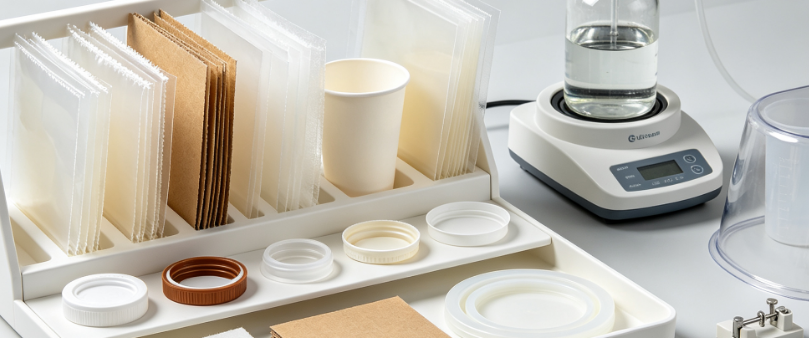
Why Professional Food Contact Packaging Testing Is Indispensable for Safety and Regulatory Compliance
Food contact materials (FCMs) are subject to stringent regulations worldwide because of the direct impact on consumer health. The EU Framework Regulation (EC) No 1935/2004 and the Plastics Regulation (EU) 10/2011 set strict limits on overall migration (10 mg/dm² or 60 mg/kg) and specific migration for hundreds of substances. The U.S. FDA requires compliance with 21 CFR Parts 174–190, and China’s GB 4806 series mandates testing for migration, heavy metals, and additives. Non‑compliance can lead to product recalls, import bans, fines, and reputational damage. Our testing services provide the objective evidence needed to demonstrate conformity, support declarations of compliance, and win certification. We help clients navigate the complex landscape of standards, including EN 1186, EN 13130, ISO 22000, ASTM D4754, and GB 31604, ensuring that every packaging material meets the requirements of its intended application and regulatory jurisdiction.
Our Comprehensive Testing Capabilities – From Migration to Mechanical Performance
We evaluate food contact packaging across the entire lifecycle, from raw material verification to finished article performance. Our capabilities include:
Overall Migration Testing: Determination of total non‑volatile substances transferred from the packaging to food simulants (water, acetic acid, ethanol, olive oil) under standardized conditions (EU 10/2011, EN 1186, FDA). We use gravimetric methods with a detection limit of 0.1 mg/dm².
Specific Migration Testing: Quantification of individual substances such as monomers (e.g., styrene, vinyl chloride), additives (e.g., phthalates, antioxidants, UV stabilizers), and process aids (e.g., lubricants, antistatic agents) using GC‑MS and LC‑MS/MS. We follow EN 13130, CEN/TS 13130, and FDA guidelines, with detection limits down to 0.01 mg/kg.
Heavy Metals and Trace Elements: ICP‑MS and ICP‑OES (EN 15768, GB 31604.49) to quantify lead, cadmium, chromium, mercury, arsenic, and other toxic elements in packaging and food simulants.
Sensory and Organoleptic Testing: Trained sensory panels and instrumental methods (GC‑MS olfactometry, e‑nose) to assess odor, taste, and taint transfer from packaging to food, ensuring no negative impact on product quality.
Mechanical and Physical Properties: tensile strength, elongation, tear resistance, seal strength, puncture resistance, and burst testing (ASTM D882, D1938, F88, F1140) to ensure package integrity during filling, transport, and storage.
Barrier Properties: Oxygen transmission rate (OTR), water vapor transmission rate (WVTR), and carbon dioxide transmission rate (CO₂TR) using ASTM D3985, F1249, and F2476, critical for modified atmosphere packaging and shelf‑life prediction.
Thermal and Chemical Resistance: Evaluation of packaging performance under microwave, oven, and freezer conditions, as well as resistance to acids, oils, and detergents (FDA, EU, GB).
All tests are conducted under controlled environmental conditions (23 ± 2 °C, 50 ± 5% RH) with calibrated instrumentation, and results are reported with statistical confidence intervals.
Chemical Migration and Safety Assessment – Overall and Specific Migration Testing
Migration testing is the cornerstone of food contact safety. We perform migration experiments using food simulants (aqueous, acidic, alcoholic, fatty) and standardized exposure conditions (time, temperature) that simulate worst‑case use. Our laboratory operates a suite of migration cells and incubation chambers to accommodate different packaging formats: films, containers, closures, and multi‑layer laminates. For overall migration, we use evaporation and gravimetric determination; for specific migration, we employ gas chromatography‑mass spectrometry (GC‑MS), liquid chromatography‑tandem mass spectrometry (LC‑MS/MS), and high‑performance liquid chromatography (HPLC) with diode array detection. We maintain an extensive library of certified reference standards and participate in international proficiency testing programs (e.g., FAPAS, BIPEA) to ensure accuracy and comparability. Our reports include migration values, comparison with regulatory limits, and a clear compliance statement.
Sensory and Organoleptic Testing – Ensuring No Taste or Odor Transfer
Even if a packaging material is chemically compliant, it can still impart off‑flavors or odors to food, leading to consumer rejection. Our sensory testing service combines trained human panels (ISO 8586, ISO 4120) with instrumental analysis (GC‑MS olfactometry, electronic nose) to identify and quantify volatile organic compounds (VOCs) responsible for taint. We perform triangle tests, descriptive analysis, and preference tests to assess the impact of packaging on food sensory quality. For instrumental analysis, we use headspace solid‑phase microextraction (HS‑SPME) coupled with GC‑MS to detect trace odorants at parts‑per‑trillion levels. Our reports provide actionable recommendations for material or process changes to eliminate sensory issues.
Mechanical and Physical Properties – Durability, Seal Integrity, and Barrier Performance
Packaging must withstand the rigors of filling, sealing, transportation, and consumer handling without failure. Our mechanical testing suite includes:
Tensile and Elongation: ASTM D882, ISO 527‑3 for films and laminates, measuring strength and flexibility.
Seal Strength and Integrity: ASTM F88, F1921, and F2029 for heat seals, evaluating peel strength and failure mode.
Puncture and impact resistance: ASTM D1709, D3420, and F1306 for films and rigid containers.
Burst Testing: ASTM F1140 and F2054 for packages, measuring the pressure required to rupture.
Barrier Properties: OTR (ASTM D3985), WVTR (ASTM F1249), and CO₂TR (ASTM F2476) using Mocon or similar instruments, critical for shelf‑life prediction and modified atmosphere packaging.
Leak Testing: ASTM D3078, D4991, and F2338 for package integrity, including dye penetration and vacuum decay methods.
These tests ensure that packaging performs as intended, protecting food from physical damage, moisture, and oxygen.
Regulatory Compliance and Certification – FDA, EU, GB, and Beyond
Our laboratory provides comprehensive testing to support regulatory compliance in all major markets. We are recognized by certification bodies and offer testing for:
FDA: 21 CFR Parts 174–190, including food additive petitions and food contact substance notifications (FCN).
EU: Regulation (EC) No 1935/2004, Regulation (EU) 10/2011, and national regulations for non‑plastic materials (e.g., German BfR, French DGCCRF).
China: GB 4806 series, GB 31604 series, and GB 9685 for additives.
Mercosur: GMC Resolutions 02/12, 32/07, and 39/19.
Other: Swiss Ordinance, Japanese Positive List, and Korean Food Code.
We provide declarations of compliance (DoC), test reports, and migration modeling to support your regulatory submissions. Our regulatory specialists stay up‑to‑date with changing requirements and can advise on the most efficient testing strategy for your product.
Advanced Instrumental Analysis – GC‑MS, LC‑MS/MS, ICP‑MS, and More
To diagnose failures and identify unknown migrants, we offer a comprehensive suite of instrumental techniques:
Gas Chromatography‑Mass Spectrometry (GC‑MS): For volatile and semi‑volatile organic compounds, including solvents, monomers, plasticizers, and antioxidants.
Liquid Chromatography‑Tandem Mass Spectrometry (LC‑MS/MS): For non‑volatile and thermally labile compounds, including additives, colorants, and degradation products.
Inductively Coupled Plasma‑Mass Spectrometry (ICP‑MS): For trace metals and heavy metals with detection limits down to parts‑per‑trillion.
Fourier‑Transform Infrared Spectroscopy (FTIR): For polymer identification and additive screening.
Scanning Electron Microscopy with Energy‑Dispersive X‑ray Spectroscopy (SEM‑EDS): For surface morphology, cross‑sectional analysis, and elemental mapping.
Thermal Analysis (DSC, TGA): For thermal stability, melting behavior, and composition.
These techniques allow us to identify the root cause of non‑compliance, contamination, or failure, and to recommend corrective actions at the formulation or process level.
Our Distinctive Competencies – Accreditation, Expertise, and Rapid Turnaround
What sets our food contact packaging testing service apart is the seamless integration of chemical, sensory, mechanical, and barrier testing within a single laboratory, enabling correlative interpretation that is impossible when samples are shipped between multiple vendors. Our team comprises PhD‑level polymer scientists, chemists, and packaging engineers with extensive experience in food contact materials, migration science, and regulatory affairs. We do not simply report numbers; we interpret them in terms of material composition, processing parameters, and end‑use conditions – for example, distinguishing between migration from the bulk versus from a surface coating, or identifying the root cause of seal failure as inadequate temperature versus contamination.
Our laboratory is ISO/IEC 17025 accredited for a wide range of food contact test methods, and we are recognized by major certification bodies (e.g., FAPAS, BIPEA) as an approved testing partner. We maintain NIST‑traceable calibrations for all equipment and participate in international proficiency testing programs to ensure global comparability. We offer rapid turnaround – typically 5–7 business days for standard testing packages, with expedited options available – and we accept samples in various forms: films, sheets, containers, closures, and finished packages. Our data analytics platform employs statistical process control and machine learning to identify trends and anomalies across batches, helping clients monitor supplier quality and optimize their own production.
We also provide custom test plans for novel packaging materials (e.g., bio‑based, recycled, nanocomposites) and for specific food types (e.g., acidic, fatty, alcoholic, dry). Our consulting services include material selection, compliance strategy, and failure analysis with root‑cause determination. We offer pre‑submission reviews of technical dossiers to ensure that all required data are complete and compliant with the target market regulations.
Comprehensive Service Modules – Tailored to Your Packaging Type
We organize our testing into modular packages to meet diverse client objectives:
Module 1 – Overall and Specific Migration: EU 10/2011, FDA, GB 4806, and custom migration testing – essential for regulatory compliance.
Module 2 – Sensory and Organoleptic Testing: Odor, taste, and taint assessment – for premium food products where sensory quality is critical.
Module 3 – Mechanical and Physical Properties: Tensile, seal, puncture, burst, and leak testing – for package integrity and durability.
Module 4 – Barrier Properties: OTR, WVTR, and CO₂TR – for shelf‑life prediction and modified atmosphere packaging.
Module 5 – Heavy Metals and Trace Elements: ICP‑MS and ICP‑OES – for compliance with global heavy metal limits.
Module 6 – Advanced Instrumental Analysis: GC‑MS, LC‑MS/MS, FTIR, SEM‑EDS, DSC, and TGA – for failure analysis and unknown migrant identification.
Module 7 – Comprehensive Food Contact Qualification Package: All modules combined into a single project, with integrated analysis, statistical summary, and a detailed interpretive report – suitable for product launch, certification, or regulatory submission.
We also offer on‑site sampling and custom test design for unique packaging systems or applications.
Data Integrity, Security, and Reporting
All measurements are performed under strict SOPs, with fully traceable calibration records and environmental logging. Our Laboratory Information Management System (LIMS) records every operation, operator, and timestamp, ensuring full auditability. We use encrypted data transfer and role‑based access to protect client proprietary information. Our reports include comprehensive tables, graphs, uncertainty statements, and an executive summary that translates technical findings into actionable insights. Raw data files are available upon request. A post‑delivery review meeting is included to discuss results and recommend next steps.
Client Engagement and Workflow
Our engagement begins with a complimentary consultation to understand your packaging type, intended food application, target market, and specific concerns (e.g., migration, sensory, or mechanical failure). We then propose a tailored test plan with a fixed price and timeline. Upon sample receipt, we log and inspect the samples, then commence testing. Clients receive progressive updates through a secure portal, with preliminary data shared on request. The final report is delivered in PDF format, and we offer a follow‑up call to discuss the findings and their implications for your product development or certification.
Conclusion – Ensuring Food Safety and Compliance from Package to Plate
Food contact packaging is a critical component of the food supply chain, and its safety and performance must be verified through rigorous, multidimensional testing. Our comprehensive, ISO‑accredited testing service provides exactly that – a one‑stop solution that combines chemical, sensory, mechanical, and barrier analyses into a unified, interpretable picture. With our advanced instrumentation, deep materials expertise, and global regulatory knowledge, we empower our clients to verify compliance, prevent costly recalls, and confidently bring safe and high‑performance packaging to market. Whether you are developing a new material, qualifying a supplier, or investigating a consumer complaint, our service delivers the clarity and confidence you need to succeed.
We invite you to contact our food contact packaging testing specialists to discuss your specific requirements. Let us partner with you to ensure that your packaging meets the highest standards of safety, quality, and regulatory compliance – from the factory to the consumer’s table. Your journey to packaging excellence begins with our rigorous, integrative, and actionable testing.