Reasons for choosing our testing services
ZHONGXI Testing has obtained inspection qualification certifications from multiple countries and regions worldwide. We possess a senior testing team and advanced testing methods, providing independent, impartial, and professional third-party verification services for global carbon projects.

Internationally recognized authority
Certified by multiple international standards such as CNAS, VCS, and GS, with reports universally applicable worldwide.

Global service capability
Covering 140+ countries and regions, it supports on-site detection and remote verification in multiple languages.

Professional experimental methods
Adopt standard experimental methods to ensure accurate and reliable data.
Comprehensive Analytical and Physiological Profiling of Dunaliella salina for Carotenoid Production, Biotechnology, and Environmental Research
Dunaliella salina is a unicellular, halophilic green alga renowned for its exceptional capacity to accumulate large quantities of β‑carotene and other valuable bioactive compounds, including glycerol, proteins, and essential fatty acids. As a model organism for studying salt tolerance, photosynthetic adaptation, and carotenogenesis, D. salina is of immense importance in biotechnology, aquaculture, nutraceutical manufacturing, and environmental monitoring. The reliable detection and characterisation of its growth, physiological status, biochemical composition, and contaminant levels are essential for optimising cultivation, ensuring product quality, and advancing fundamental research. Our specialised detection platform offers a fully integrated suite of validated assays tailored to D. salina, covering cell viability, growth kinetics, pigment profiling, lipid and protein composition, glycerol content, elemental analysis, and microbiological safety. Whether the client is a large‑scale producer of natural β‑carotene, a research institution studying stress physiology, or a regulatory agency assessing product safety, our service delivers the high‑precision, actionable data required to support cultivation optimisation, quality assurance, and scientific discovery.
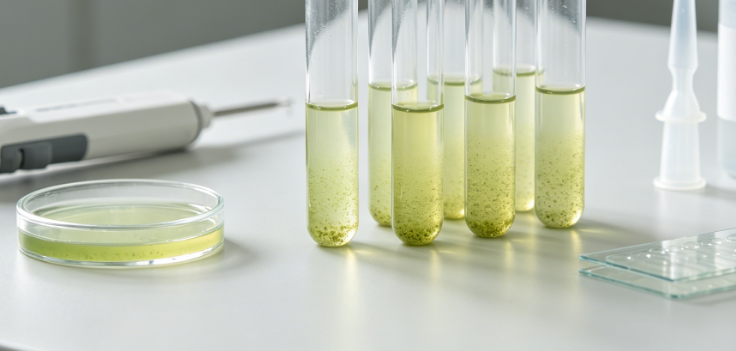
Scientific and Industrial Rationale for Dunaliella salina Analysis
Clients seeking analytical services for D. salina are motivated by diverse strategic objectives. In commercial production of β‑carotene and other carotenoids, the primary need is to quantify the cellular pigment content and to monitor the induction of carotenogenesis under high light and salinity stress, ensuring maximum yield and consistent product quality. In bioprocess optimisation, detailed growth kinetics, nutrient consumption, and oxygen evolution rates are required to design and control photobioreactors effectively. In feed and food applications, verifying the nutritional composition—proteins, lipids, carbohydrates, and micronutrients—is essential for product labelling and for meeting safety standards. In environmental and ecotoxicological research, D. salina serves as a bioindicator of salinity, heavy metals, and other pollutants; sensitive measurements of physiological stress biomarkers (e.g., photosynthetic efficiency, reactive oxygen species) are needed. In fundamental research, detailed metabolomic and transcriptomic profiling is required to unravel the molecular mechanisms of halotolerance and pigment regulation. Our service is architected to address these needs through a flexible, ISO 17025‑accredited analytical framework that adapts to the specific strain, culture conditions, and client objectives.
Integrated Analytical Pipeline for Holistic Dunaliella salina Characterisation
Our analytical platform is organised into five interconnected modules that collectively provide a comprehensive evaluation of D. salina samples. The Cell Viability and Growth Module uses flow cytometry with fluorescent stains (SYTOX Green for dead cells, FDA for esterase activity, and chlorophyll autofluorescence) to determine viable cell counts, cell size distribution, and granularity with precision within ±2% RSD. We also monitor optical density (OD680) and dry weight, calculating specific growth rate (μ) and doubling time with linearity over a range of 10² to 10⁷ cells/mL. The Pigment and Carotenoid Module employs UHPLC‑PDA with a C30 column to separate and quantify β‑carotene, α‑carotene, lutein, zeaxanthin, and chlorophylls a and b with LOQs of 0.01 µg/mL and baseline resolution (Rs > 2.0) for all isomers. For absolute quantitation, we use isotopically labelled internal standards (e.g., β‑carotene‑d6) with recoveries of 96–103%. The Biochemical Composition Module quantifies total proteins (Bradford or BCA assay), total lipids (gravimetric after Bligh‑Dyer extraction), total carbohydrates (phenol‑sulfuric acid), and glycerol by enzymatic colorimetry or UHPLC‑ELSD, with precision within ±3%. The Elemental and Contaminant Module uses ICP‑MS for heavy metals (As, Cd, Pb, Hg, Cu, Zn) with LODs in the low ppt range, and GC‑MS/MS for pesticide residues and polycyclic aromatic hydrocarbons (PAHs) with LOQs at regulatory MRL levels. The Physiological Stress Module measures photosynthetic efficiency (Fv/Fm, ΦPSII) by pulse‑amplitude‑modulated (PAM) fluorometry, reactive oxygen species (ROS) by DCFH‑DA fluorescence, and antioxidant capacity (DPPH, FRAP) with coefficients of variation < 5%. All modules are validated with reference strains (e.g., UTEX 1644) and include rigorous quality controls (system suitability, blank subtraction, and replicate analyses).
Unmatched Analytical Sensitivity, Specificity, and Biological Insight
Our platform routinely delivers performance that far exceeds typical academic and industrial standards. In pigment analysis, our UHPLC‑PDA method resolves all major carotenoids and their geometric isomers, providing mass accuracy < 2 ppm when coupled with Q‑TOF MS, enabling the identification of rare or unknown pigments. For glycerol quantitation, our enzymatic assay achieves LODs of 1 µmol/L and is highly specific, with no interference from other polyols. In flow cytometry, our high‑speed analysis (up to 10,000 events per second) enables the detection of subpopulations with distinct physiological states, including the early stages of stress response. Our PAM fluorometry provides real‑time, non‑invasive monitoring with sub‑second resolution, allowing the capture of rapid changes in photosynthetic performance. Additionally, we offer transcriptomic analysis (RNA‑seq) to profile gene expression patterns associated with carotenogenesis and salt tolerance, and untargeted metabolomics (LC‑QTOF‑MS) to identify novel bioactive metabolites. This multi‑layer data integration provides clients with a systems‑level understanding of their cultures, enabling the prediction of harvest timing and the early detection of stress or contamination.
Distinctive Advantages of Our Dunaliella salina Detection Service
Our service is distinguished by several unique features that directly address client challenges. First, we have developed matrix‑specific extraction protocols for the high‑salt, high‑glycerol medium of D. salina cultures, ensuring efficient recovery of pigments and metabolites with recoveries > 92% for all target analytes. Second, we maintain a comprehensive in‑house reference database of D. salina pigment profiles and fatty acid signatures across different strains and growth conditions, enabling rapid benchmarking and early detection of deviations. Third, we offer a rapid screening service using handheld spectrophotometry for in‑field estimation of β‑carotene and chlorophyll content, with results available within 15 minutes—ideal for daily monitoring in production facilities. Fourth, our customised stress simulation studies can expose cultures to controlled salt shocks, light intensity changes, or nutrient depletion while continuously monitoring physiological parameters, providing data that directly inform process optimisation. Fifth, we provide integrated data reporting that includes a culture health index combining viability, photosynthetic efficiency, and pigment ratios, enabling clients to make rapid, evidence‑based decisions on harvesting or treatment. Sixth, all our methods are accredited under ISO/IEC 17025 and follow OECD, EPA, and AOAC guidelines; we supply full validation dossiers with method performance data (specificity, linearity, accuracy, precision, LOD, LOQ, robustness) that are readily accepted by regulatory authorities. Our team of algal biotechnologists, analytical chemists, and stress physiologists provides consultative interpretation, helping clients to translate analytical findings into actionable improvements—for example, recommending optimal harvest time based on β‑carotene kinetics, or identifying nutrient imbalances from pigment ratios.
Advanced Data Integration, Predictive Modeling, and Reporting
Our reporting transforms analytical data into strategic intelligence. We deliver a comprehensive final report that includes: (i) a certificate of analysis (CoA) summarising key quality attributes (carotenoid content, viability, protein, lipid, glycerol, and heavy metals) with clear pass/fail status against client‑defined specifications; (ii) a detailed analytical section containing raw chromatograms, flow cytometry histograms, PAM traces, and calibration curves; (iii) a statistical summary with means, standard deviations, and confidence intervals; and (iv) an interpretive narrative that discusses the biological significance—for instance, how a decline in the Fv/Fm ratio indicates stress, or how the β‑carotene/chlorophyll ratio can be used to time harvest. For clients with multiple time‑points or cultivation runs, we provide time‑series trend analysis and multivariate analysis (PCA, PLS‑DA) to detect patterns and predict future performance. We also offer predictive models that estimate final β‑carotene yield based on early‑stage pigment data, using our internally developed machine learning algorithms. All raw data files (e.g., .cdf, .fcs, .raw) are provided for full transparency and re‑analysis.
Broad Applications Across Carotenoid Production, Feed, Nutraceutical, and Environmental Sectors
The versatility of our D. salina analytical service makes it indispensable across the entire value chain. In large‑scale β‑carotene production, our routine monitoring supports process control, quality release, and troubleshooting. In aquaculture feed manufacturing, our nutritional and contaminant screening ensures that algal biomass meets the stringent safety standards for fish and shellfish. In nutraceutical and cosmetic industries, our detailed pigment and antioxidant profiling substantiates product claims and supports stability studies. In environmental monitoring, our physiological stress biomarkers are used to assess water quality and pollution effects. In academic research, our comprehensive characterisation supports high‑impact publications on algal stress physiology and synthetic biology. In regulatory compliance, our validated data packages facilitate product registration with EFSA, FDA, and other authorities. Our ability to tailor the analytical package to the specific strain, cultivation system, and end‑use ensures that we serve a diverse global clientele with scientific rigour and practical relevance.
Commitment to Innovation, Quality, and Client Partnership
We are dedicated to advancing the analytical science of halophilic algae through continuous innovation. Our current R&D includes the development of in‑line Raman spectroscopy probes for real‑time, non‑destructive monitoring of carotenoid accumulation in photobioreactors, and the application of deep learning algorithms to predict culture health from flow cytometric data. We actively participate in international proficiency testing for algal pigment and contaminant analysis, and we contribute to the development of standard reference materials. Our quality management system is ISO 9001 and ISO 17025 certified, and we follow GLP for all regulated studies. We offer flexible service models—from single‑sample analysis to long‑term monitoring contracts—with dedicated project managers, volume discounts, and priority handling for time‑sensitive samples. Our global logistics provide specialised shipping kits (with temperature control and preservatives) to ensure sample integrity. Turnaround times range from 1 business day for rapid viability and pigment screening to 10 business days for full comprehensive profiling. We maintain open communication, providing preliminary results upon request and final reports with expert commentary. Our success is measured by the confidence our clients have in their data and their ability to achieve production and research goals. We invite you to partner with us to unlock the full potential of your Dunaliella salina projects.
In summary, our Dunaliella salina detection service delivers a complete, precise, and regulatory‑ready analytical solution that integrates cell viability, pigment profiling, biochemical composition, contaminant screening, and physiological stress assessment. By combining cutting‑edge instrumentation with deep expertise in algal biotechnology, we empower our clients to optimise cultivation, ensure product safety, and advance scientific knowledge. We look forward to supporting your D. salina analysis needs with our unwavering commitment to scientific excellence.