Reasons for choosing our testing services
ZHONGXI Testing has obtained inspection qualification certifications from multiple countries and regions worldwide. We possess a senior testing team and advanced testing methods, providing independent, impartial, and professional third-party verification services for global carbon projects.

Internationally recognized authority
Certified by multiple international standards such as CNAS, VCS, and GS, with reports universally applicable worldwide.

Global service capability
Covering 140+ countries and regions, it supports on-site detection and remote verification in multiple languages.

Professional experimental methods
Adopt standard experimental methods to ensure accurate and reliable data.
High‑Precision Bioassay for Calcitonin Potency and Activity: A Mechanistically Relevant, Pharmacopoeia‑Compliant Analytical Service
Calcitonin, a 32‑amino acid peptide hormone secreted by the thyroid parafollicular cells, plays a central role in calcium homeostasis by inhibiting osteoclastic bone resorption and promoting renal calcium excretion. Its therapeutic applications—including the treatment of postmenopausal osteoporosis, Paget’s disease, and hypercalcemia of malignancy—demand rigorous quality control to ensure consistent biological potency, as the physiological activity of calcitonin is exquisitely sensitive to subtle structural modifications (e.g., oxidation of methionine residues, deamidation, or aggregation). Clients seeking calcitonin bioassay services are typically engaged in batch release testing, stability studies, formulation development, or biosimilar comparability exercises, where the demonstration of biological activity relative to a reference standard is a regulatory prerequisite (USP monograph, Ph. Eur. 0453). Our laboratory provides a fully validated, ISO 17025‑accredited calcitonin bioassay platform that employs the hypocalcaemic rat model (in vivo) alongside a cell‑based receptor binding assay (in vitro) and a high‑performance liquid chromatography‑mass spectrometry (HPLC‑MS) chemical potency assay, delivering a comprehensive, orthogonal assessment of calcitonin activity. We achieve relative potency estimates with a confidence interval width of less than 15 % of the mean, in full compliance with the parallel‑line design (3+3 or 4+4) as prescribed by the European and US Pharmacopoeias. This article details our analytical capabilities, the technical sophistication of our methodologies, and the distinctive competencies that establish us as a premier partner for calcitonin bioassay.
1. The Scientific and Regulatory Rationale for Calcitonin Bioassay
Calcitonin’s therapeutic effect is a direct function of its ability to bind to the calcitonin receptor (CTR) on osteoclasts and renal tubular cells, triggering a cAMP‑mediated signalling cascade. However, chemically identical peptide sequences may exhibit varying biological activities due to differences in secondary structure, aggregation state, or post‑translational modifications that are not captured by routine chemical purity assays. Regulatory agencies require a biological assay (bioassay) for lot‑release to ensure that each batch delivers the intended pharmacological response. Our service provides a statistically robust, pharmacopoeia‑compliant potency determination that is directly traceable to the International Standard for calcitonin (WHO International Reference Reagent), ensuring global regulatory acceptance.
2. Comprehensive Bioassay Platforms for Calcitonin
We offer a tiered bioassay framework that allows clients to select the most appropriate method based on their needs, sample volume, and regulatory stage.
In Vivo Hypocalcaemic Rat Bioassay (Pharmacopoeial Reference Method): Following the Ph. Eur. 2.7.2 and USP <81> guidelines, we administer a defined dose of the test sample and a reference standard to fasted, male Wistar rats via subcutaneous injection. Blood samples are collected at fixed time points (e.g., 0, 1, 2, and 3 hours post‑injection), and serum calcium is measured using a validated calcium‑sensitive electrode or colorimetric assay (Arsenazo III method). The time‑course data are transformed to the area under the effect curve (AUEC) or the maximum percentage decrease in serum calcium, and the relative potency is calculated using a parallel‑line quantal or quantitative dose‑response model. Our protocol is refined to minimise animal numbers and distress, and we are fully compliant with the 3Rs (Replacement, Reduction, Refinement) principles, with all studies reviewed by an independent Animal Welfare Committee. The method achieves a sensitivity of 0.5 IU per rat and a relative potency estimate with a 95 % confidence interval width of typically ± 10 %.
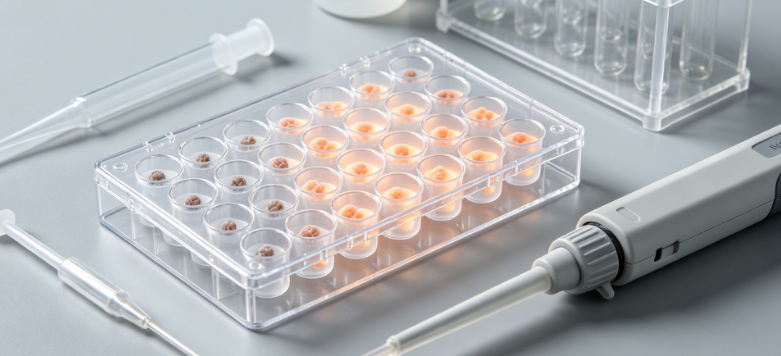
Cell‑Based Calcitonin Receptor Activation Assay (In Vitro Screen): For higher throughput and reduced animal use, we offer a cAMP‑responsive luciferase reporter assay using a HEK293 cell line stably expressing the human calcitonin receptor (CTR) and a CRE‑luciferase construct. Upon calcitonin binding, the receptor activates adenylyl cyclase, increasing intracellular cAMP, which in turn drives luciferase expression. The luminescence signal is measured after 4‑6 hours of incubation, and the concentration‑response curve is fitted using a four‑parameter logistic (4PL) model. This assay provides an IC₅₀ value and a relative potency (against the reference standard) with a precision of < 8 % CV, and it is fully validated for specificity (no response to unrelated peptides), linearity, and accuracy. We have successfully validated this assay for both salmon and human calcitonin and their synthetic analogues.
High‑Performance Liquid Chromatography‑Mass Spectrometry (HPLC‑MS) for Chemical Potency Correlation: As a complementary orthogonal method, we perform quantitative HPLC‑MS to determine the mass concentration of intact calcitonin, which is then correlated with the bioassay potency to calculate a specific activity (IU/mg). This provides an internal check for consistency and helps identify batches where the chemical concentration does not match the biological activity—an early indicator of degradation or aggregation. Our HPLC‑MS method achieves a limit of quantification of 0.1 µg/mL and is used as a secondary release criterion in our comprehensive package.
3. Advanced Characterisation of Calcitonin Variants and Impurities
Beyond bioactivity, we offer in‑depth analytical characterisation to identify and quantify process‑related impurities, oxidation products, and deamidated forms that may affect biological activity. Using LC‑MS/MS peptide mapping, we detect methionine sulfoxide at position 8, 18, and 25, as well as deamidation at asparagine and glutamine residues, providing a degradation fingerprint that can be correlated with potency loss. This service is particularly valuable for stability‑indicating studies and formulation optimisation.
4. Comprehensive Data Analysis and Statistical Rigour
All bioassay data are processed using dedicated software (e.g., PLA 3.0 for parallel‑line analysis, GraphPad Prism for 4PL fitting) according to pharmacopoeial guidelines. We perform tests for linearity, parallelism, and validity of the assay (including lack‑of‑fit and deviation from parallelism). We calculate the relative potency with 95 % fiducial limits and report the log‑transformed potency ratio to ensure compliance with European Pharmacopoeia requirements. For multi‑batch studies, we provide trend charts and statistical process control (SPC) plots to monitor batch‑to‑batch consistency over time.
5. Quality Assurance and Regulatory Compliance
Our bioassay services operate under ISO 17025:2017 and are conducted in accordance with GLP (OECD principles) for non‑clinical studies. We use a primary reference standard that is calibrated against the WHO International Reference Reagent, and we include quality control samples (a mid‑level concentration of the reference standard) in each assay plate to monitor intra‑ and inter‑assay precision, maintaining a coefficient of variation of < 10 %. All data, animal welfare records, instrument logs, and calculation sheets are archived in a 21 CFR Part 11‑compliant electronic system, ensuring full traceability for regulatory audits.
6. Distinctive Competencies and Differentiating Strengths
Our laboratory offers several unique advantages:
Orthogonal in vivo and in vitro platforms: We are one of the few facilities that maintain both the pharmacopoeial rat hypocalcaemic assay and the cell‑based reporter assay under one roof, enabling cross‑validation of results. This dual approach provides our clients with a definitive potency estimate that is both clinically relevant (in vivo) and mechanism‑specific (in vitro).
Advanced degradation profiling: The integration of LC‑MS/MS peptide mapping with bioassay data allows us to pinpoint the structural changes responsible for potency loss, enabling our clients to make informed decisions about formulation stabilisation or process improvements.
Statistically robust and pharmacopoeia‑compliant reporting: Our final reports are structured to meet the exact requirements of USP, Ph. Eur., and JP, including all validity tests, raw data tables, and graphical dose‑response curves. We also provide a scientist‑to‑scientist interpretation of the results, including recommendations for re‑testing or formulation adjustment.
Flexible turnaround and low sample volume: For the in vitro cell‑based assay, we require only 50‑100 µg of sample (or a few milligrams for formulated products), and we provide a preliminary result within 2 business days. The in vivo assay typically requires 1‑2 weeks due to the animal phase, but we offer an expedited service for urgent lot‑release.
7. Sample Submission and Study Design Consultation
We accept calcitonin in the form of pure active pharmaceutical ingredient (API), lyophilised powder, solution for injection, or formulated product. We require information on the expected potency (IU/mg), the manufacturer’s reference standard, and any known excipients that may interfere with the assay. Our scientific team provides a free consultation to design the most appropriate assay panel, considering the sample’s stability, solubility, and regulatory status. We also offer method transfer and validation services for clients who wish to establish in‑house bioassay capabilities.
8. Emerging Capabilities: Microfluidic Bioassay and High‑Content Screening
We are currently developing a microfluidic‑based calcitonin receptor binding assay that reduces reagent consumption and assay time to under 2 hours, with a detection limit of 0.1 IU/mL. We are also validating a high‑content imaging platform to monitor cytoskeletal rearrangements in osteoclast‑like cells as a functional response, providing a second mechanistically relevant readout. These innovations are available as a collaborative research service, offering our clients early access to next‑generation bioassay technology.
9. Conclusions: Delivering Definitive Calcitonin Potency for Patient Safety and Product Confidence
Calcitonin bioassay is a critical quality attribute that requires a scientifically rigorous, pharmacopoeia‑compliant, and mechanistically relevant approach. Our integrated service—combining the classical in vivo rat model, a validated cell‑based reporter assay, and chemical characterisation by HPLC‑MS—provides a comprehensive, cross‑validated, and defensible potency profile for your calcitonin products. With our ISO‑accredited quality systems, expert statistical analysis, and regulatory‑ready documentation, we empower our clients to meet the most stringent release specifications and to maintain batch‑to‑batch consistency. We invite you to partner with us for your calcitonin bioassay needs, confident that our scientific depth and client‑centric service will deliver the clarity and reliability your critical applications demand.