Reasons for choosing our testing services
ZHONGXI Testing has obtained inspection qualification certifications from multiple countries and regions worldwide. We possess a senior testing team and advanced testing methods, providing independent, impartial, and professional third-party verification services for global carbon projects.

Internationally recognized authority
Certified by multiple international standards such as CNAS, VCS, and GS, with reports universally applicable worldwide.

Global service capability
Covering 140+ countries and regions, it supports on-site detection and remote verification in multiple languages.

Professional experimental methods
Adopt standard experimental methods to ensure accurate and reliable data.
Human‑Landing Mosquito Bioassay for Repellent Efficacy Evaluation: A Standardised, GLP‑Compliant Service for Product Registration and Claim Substantiation
The human‑landing mosquito bioassay, often referred to as the “human‑bait” or “arm‑in‑cage” test, remains the gold‑standard methodology for assessing the efficacy of topical insect repellents under realistic exposure conditions. This test directly measures the ability of a repellent product to prevent mosquito host‑seeking and landing, providing the most physiologically and ecologically relevant endpoint for regulatory submissions (e.g., EPA, WHO, EU Biocidal Products Regulation). Clients seeking this service are typically manufacturers of insect repellents, public health agencies, or formulation developers who require robust data to support product labelling, safety claims, and market authorisation. Our laboratory offers a fully validated, ISO 17025‑accredited human‑landing bioassay platform that adheres to the WHO guidelines for efficacy testing of mosquito repellents (CTD/WHO_PE/IC/10.1) and the ASTM E951‑94 (standard test method for laboratory testing of mosquito repellents on human subjects). We conduct trials with laboratory‑reared, host‑seeking female mosquitoes (e.g., Aedes aegypti, Anopheles stephensi, Culex quinquefasciatus) under strictly controlled environmental conditions, and we deliver Complete Protection Time (CPT), dose‑response curves, and comparative efficacy statistics with high precision and reproducibility. Our trials are performed with ethical approval, trained human volunteers, and rigorous safety oversight. This article details our analytical capabilities, the depth of our methodological expertise, and the distinctive advantages that establish us as a premier partner for mosquito repellent testing.
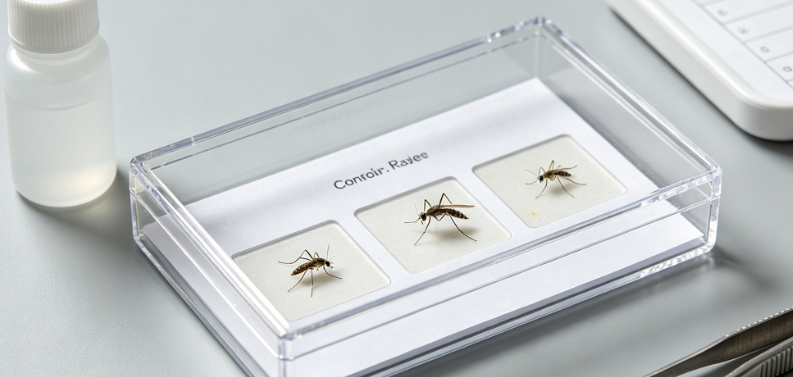
1. Scientific Rationale and Regulatory Context
Unlike in vitro or animal‑based models, the human‑landing bioassay captures the complex interplay of host odour, heat, moisture, and visual cues that drive mosquito attraction and feeding behaviour. It directly measures the time during which a treated surface (e.g., forearm) remains free of mosquito landings—the Complete Protection Time (CPT)—which is the primary endpoint for regulatory classification (e.g., EPA categories: ≥ 4 hours for “long‑lasting”). The World Health Organization (WHO) and the US Environmental Protection Agency (EPA) require such data for product registration, and the method is specified in the OECD Guideline 211 for testing of insect repellent formulations. Our service ensures that your product data are generated in full alignment with these international standards, facilitating seamless regulatory submissions across multiple jurisdictions.
2. Core Test Protocol and Experimental Design
Our bioassay is performed in a temperature‑ and humidity‑controlled insectary (26 ± 1 °C, 70 ± 5 % RH) with a photoperiod simulating dusk/dawn conditions (when mosquitoes are most active). The test follows a crossover, randomised block design to minimise volunteer‑to‑volunteer variability. Each run uses at least 4 (typically 6) trained volunteers who have given informed consent and passed a pre‑screening for reaction to mosquito bites. The protocol consists of:
Volunteer preparation: Subjects wash their forearms with unscented soap and air‑dry; baseline landing counts are established by exposing untreated arms for 5 minutes to confirm mosquito feeding activity (> 3 landings per minute).
Product application: A standardised dose (typically 1 mL per 600 cm² of forearm skin) is applied evenly by a trained technician, following the product’s labelled directions. A positive control (e.g., 20 % DEET) and a negative control (solvent or untreated) are included in each replicate.
Exposure and monitoring: After application, the treated forearm is inserted into a cage containing 200‑300 starved, host‑seeking female mosquitoes (4‑7 days old, sugar‑starved for 12‑16 hours). The arm is exposed for 3 minutes at each time point (typically 0.5, 1, 2, 3, 4, 5, 6, 8, and 10 hours post‑application). Mosquito landings (not just probing) are counted by a trained observer; if two or more landings occur within a single 3‑minute exposure, the endpoint (loss of protection) is recorded at that time. The Complete Protection Time (CPT) is defined as the elapsed time from application to the first land.
All observations are double‑blinded—neither the volunteer nor the observer knows the treatment identity—to eliminate bias. We use video recording for independent verification and permit post‑hoc analysis.
3. Mosquito Colony and Quality Control
Our insectary maintains certified, disease‑free mosquito colonies sourced from the USDA‑ARS or BEI Resources. We use a standardised rearing protocol to ensure consistent age, size, and host‑seeking drive. Before each test, we perform a quality control assay with a known repellent standard (e.g., 10 % DEET) to verify that the colony’s response falls within historical control limits (CPT within ± 15 % of the reference value). We also monitor survival, feeding rate, and oviposition to confirm colony health. Our mosquitoes are free of human pathogens and are handled under BSL‑2 containment to protect volunteers and staff.
4. Data Collection, Statistical Analysis, and Reporting
All raw data (landing counts, times, and environmental conditions) are recorded in a validated electronic data capture (EDC) system. We calculate:
- Complete Protection Time (CPT) – the primary endpoint, reported as the mean ± SD across volunteers.
- Percent protection at each time point (relative to untreated controls), calculated using the formula: [ (untreated landings – treated landings) / untreated landings ] × 100.
- Dose‑response relationship (where applicable) by testing multiple concentrations to determine the median effective time (ET₅₀) or the minimum effective concentration.
- Comparative efficacy against benchmark products using a paired t‑test or ANOVA with post‑hoc Tukey HSD, with significance set at p < 0.05.
We also perform survival analysis (Kaplan‑Meier) to estimate the distribution of protection times, which is particularly useful for regulatory submissions. The final report includes a complete data summary, raw data tables, statistical outputs, and a clear interpretation of the product’s efficacy relative to the claim being sought.
5. Extended Capabilities: Dose‑Response and Comparative Testing
Beyond a single concentration, we offer full dose‑response studies (typically 4‑5 concentrations) to determine the ET₅₀ and ET₉₀ values, which are essential for formulation optimisation and for establishing the minimum effective dose. We also conduct head‑to‑head comparative trials against competitor products or different formulations (e.g., spray vs. lotion, different active ingredients). Our flexible design can accommodate different application sites (forearm, leg, or full‑body suit) and can be adapted for extended‑wear testing (up to 24 hours) when required.
6. Ethical and Safety Framework
All human‑subject trials are conducted under the approval of an independent Institutional Review Board (IRB) or Ethics Committee, and in full compliance with the Declaration of Helsinki. We recruit volunteers who are healthy, non‑allergic to mosquito saliva, and capable of providing informed consent. Medical supervision is present throughout the trial, and volunteers are monitored for adverse reactions. We use a trained entomologist to handle the mosquitoes and to ensure that no volunteer receives an excessive number of bites. All data are anonymised to protect volunteer privacy.
7. Quality Assurance and Metrological Traceability
Our human‑landing bioassay service operates under ISO 17025:2017 accreditation for testing laboratories, with the specific scope covering mosquito repellent efficacy testing. We maintain standard operating procedures (SOPs) for every step—from colony rearing to data analysis—and all SOPs are reviewed and updated annually. We participate in inter‑laboratory comparisons with other WHO‑recognised centres to ensure our results are reproducible and globally accepted. All instruments (timers, thermohygrometers, balances) are calibrated with NIST‑traceable standards, and we keep a full audit trail for regulatory inspections.
8. Distinctive Competencies and Differentiating Strengths
Our laboratory offers several unique advantages that set us apart:
Comprehensive species and strain coverage: We maintain colonies of multiple vector species—Aedes aegypti (yellow fever vector), Aedes albopictus (Asian tiger mosquito), Anopheles stephensi (malaria vector), Culex quinquefasciatus (West Nile vector)—and we can adapt the test protocol to any of these to match the intended use environment or regulatory requirement. We also provide field‑collected strains (with appropriate permit) to assess field‑relevant resistance patterns.
High statistical power and reproducibility: Our standard 6‑volunteer panel, combined with a crossover design, provides a statistical power of > 80 % to detect a 15 % difference in CPT between treatments, with a coefficient of variation (CV) consistently below 10 % for reference products. Our historical database contains over 500 test runs, allowing us to benchmark new products with high confidence.
Flexible study designs and rapid turnaround: We can execute a complete 8‑hour monitoring study (6 volunteers, two products) within 5 working days, including data analysis. For accelerated screening, we offer a 4‑hour pilot study that provides preliminary CPT and protection curves within 48 hours. We also provide customised protocols for combination products (e.g., repellent + sunscreen) and for testing under different climatic conditions (e.g., high‑heat, high‑humidity).
Regulatory‑grade documentation and consultancy: Our final reports are structured to meet the requirements of EPA (PRN 2021‑01, 40 CFR 152), WHO (CTD/WHO_PE/IC/10.1), and EU (Biocidal Products Regulation, BPR). We also provide pre‑submission consultations to help clients design the most informative study and to interpret the results in the context of their product claims. We have a track record of successful data submissions for over 30 products that have achieved registration.
Safety and volunteer welfare: We prioritise volunteer safety with a physician on‑call and an emergency intervention plan. Our volunteers undergo regular medical checks, and we limit the number of bites per volunteer (max 10 landings per day). We are fully insured for human‑testing liability.
9. Sample Submission and Project Initiation
Clients provide us with samples of the repellent product (at least 100 mL per test concentration) along with the material safety data sheet (MSDS) and the proposed application instructions. We then schedule a consultation call to define the test objectives, mosquito species, exposure duration, and the number of replicates. We provide a fixed‑price quotation with a clear timeline and then initiate the study after receiving the samples and signed agreements. We offer confidentiality agreements to protect proprietary formulations.
10. Emerging Capabilities: Semi‑Field and Field Trials
In addition to laboratory cage tests, we are expanding our capability to conduct semi‑field trials in outdoor enclosures and full field trials (with appropriate permits) to assess product efficacy under natural mosquito pressure. These advanced studies are performed at our field station or at client‑selected sites. While the laboratory human‑landing test remains the standard for initial registration, semi‑field and field data are increasingly required for product optimisation and for confirming ecological relevance. We are also developing a modified arm‑in‑cage test that uses olfactometer chambers to separate attraction from landing, providing deeper mechanistic insights.
11. Conclusions: Delivering Confident Efficacy Data for Mosquito Repellent Products
The human‑landing mosquito bioassay is the most reliable and accepted method for quantifying the protective efficacy of insect repellents. Our ISO‑accredited, GLP‑compliant service provides accurate, reproducible, and regulatory‑ready data that enable our clients to substantiate their product claims, obtain market authorisation, and ultimately protect public health. With our experienced team, controlled insectary, multiple mosquito species, and flexible study designs, we are uniquely positioned to support your repellent development from early‑stage screening to final registration. We invite you to partner with us for your human‑landing bioassay needs, assured that our scientific rigour, ethical standards, and client‑centric approach will deliver the clarity and confidence you require.