Reasons for choosing our testing services
ZHONGXI Testing has obtained inspection qualification certifications from multiple countries and regions worldwide. We possess a senior testing team and advanced testing methods, providing independent, impartial, and professional third-party verification services for global carbon projects.

Internationally recognized authority
Certified by multiple international standards such as CNAS, VCS, and GS, with reports universally applicable worldwide.

Global service capability
Covering 140+ countries and regions, it supports on-site detection and remote verification in multiple languages.

Professional experimental methods
Adopt standard experimental methods to ensure accurate and reliable data.
High‑Fidelity Sterility Assurance Testing for Slender Tubing Systems
In biopharmaceutical manufacturing, medical device fabrication, and advanced microfluidics, slender tubing systems—defined as conduits with length‑to‑diameter ratios exceeding 100:1—present a singular challenge for Sterility validation. Their narrow lumens, complex internal surface topographies, and inherent flow dead zones render conventional swab‑and‑plate methods ineffective, while chemical indicators fail to capture the spatial heterogeneity of microbial inactivation. Consequently, clients seeking slender tubing sterilization detection are not merely looking for a binary “pass/fail” verdict; they require a quantitative, spatially resolved assessment of biological load reduction, coupled with a rigorous characterisation of any residual Bioburden that might survive the sterilization cycle. This article delineates our comprehensive testing framework, which integrates advanced microbiological assays, physical stimulant tracers, and numerical modelling to deliver an unprecedented level of assurance for your slender‑bore products.
The Intrinsic Complexity of Sterilising Slender Geometries
The fundamental obstacle in slender tube sterilization stems from the diffusion‑limited transport of sterilising agents—whether steam, ethylene oxide (EtO), hydrogen peroxide vapour, or ozone. At high aspect ratios, the boundary layer thickness approaches the tube radius, causing a substantial pressure drop and a corresponding reduction in active species concentration along the axis. Simultaneously, the surface‑to‑volume ratio increases dramatically, promoting adsorption and recombination of reactive radicals before they reach the distal end. Thermal sterilization (e.g., moist heat) suffers from condensate entrapment and non‑uniform temperature profiles due to the thermal mass of the tubing wall. These physical phenomena are well documented in the literature, yet standard industrial practices—such as biological indicator (BI) placement at the entrance and exit—provide no insight into the viability of microorganisms lodged within the midsection or at surface irregularities. Our testing service directly addresses this gap by adopting a multi‑tiered detective strategy that monitors the entire luminal length with sub‑centimetre resolution.
Our Core Testing Modalities for Slender Tube Sterility
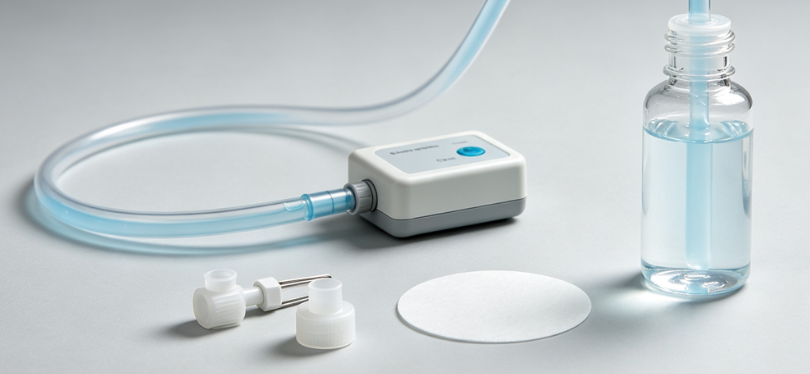
Our laboratory has developed a proprietary flow‑loop bioreactor system that enables the controlled inoculation, sterilization simulation, and subsequent recovery of test microorganisms from tubes with internal diameters as small as 0.5 mm and lengths up to 10 metres. The system comprises three integrated modules:
(1) Inoculation and carrier preparation: We employ Geobacillus stearothermophilus (for steam/EtO) and Bacillus atrophaeus (for vapourised H₂O₂) as standard challenge organisms, but we also accommodate patient‑derived isolates or environmental contaminants upon request. Using a customised aerosolisation chamber, we deposit a known titre (≥10⁶ CFU per tube) in a spatially uniform film along the inner wall, verified by destructive sectioning and plating from reference tubes.
(2) Sterilant penetration mapping: Instead of relying solely on biological endpoints, we introduce chemical dosimeter strips coated with a fluorescence quencher that responds to the cumulative oxidant or thermal dose. These strips are pulled through the tube at controlled rates post‑exposure, and their fluorescence decay profiles are correlated with local sterilant concentration using a validated calibration curve. This yields a continuous dose‑distance profile that pinpoints regions of sub‑lethal exposure—information that is critical for cycle optimisation.
(3) Post‑sterilisation recovery and enumeration: Following the sterilisation cycle, the entire tube is flushed with sterile neutralising broth, and the eluent is subjected to membrane filtration (for low‑Bioburden samples) and most‑probable‑number (MPN) analysis with 96‑well microplates. Our limit of detection reaches 0.04 CFU per tube, effectively achieving a Sterility assurance level (SAL) of 10⁻⁶ with statistical confidence. For tubes that fail initial criteria, we perform scanning electron microscopy (SEM) on cross‑sectioned specimens to identify biofilms or organic residues that shielded the organisms from the sterilant.
Beyond End‑Point Testing: Dynamic and Predictive Approaches
Recognising that a single end‑point test provides limited insight into the underlying mass‑transfer phenomena, we have augmented our experimental toolkit with computational fluid dynamics (CFD) simulations that are validated against our measured dose profiles. Using a conjugated heat‑and‑species transport model, we simulate the transient evolution of sterilant concentration, temperature, and condensation patterns along the tube axis. The model accounts for wall rugosity (measured via optical profilometry) and gas compressibility, which are often neglected in vendor‑supplied cycle calculations. By comparing the simulated dose with the experimental fluorescence data, we can adjust the boundary conditions (inlet pressure, humidity, flow rate) to achieve a target dose uniformity of ±15 % across the entire length—a level of precision that is rarely attainable with empirical trial‑and‑error.
Furthermore, we offer accelerated ageing studies for tubes that will be sterilised repeatedly (e.g., reusable medical devices). Our protocol subjects the tubes to up to 100 sterilisation cycles, with intermittent Bioburden monitoring, to assess the cumulative effects of polymer degradation on sterilant uptake and microbial adhesion. This service is particularly valuable for clients developing novel polymeric tubing materials, as it provides the data needed for regulatory submissions under ISO 11135, ISO 14937, and FDA guidance documents.
Our Distinctive Competencies in Slender Tube Sterility Testing
What sets our service apart from routine contract testing laboratories is the integration of experimental rigour with theoretical insight. Our team comprises microbiologists, chemical engineers, and plasma physicists (the latter for low‑temperature plasma sterilisation) who collaborate to design bespoke test plans for each client’s specific tubing geometry, material, and manufacturing process. We have successfully validated tubes made of PTFE, PEEK, silicone, polyurethane, and stainless steel, including those with internal coatings, bends, and connectors. Our in‑house developed “TubScan” software automatically processes the fluorescence and MPN data to generate a colour‑coded contour map of Sterility confidence along the tube, which can be exported directly into the client’s quality management system.
Additionally, we maintain ISO 17025 accreditation for all microbiological and chemical assays, and our test protocols are designed to comply with the current USP Chapter ‹1229› on sterilisation cycle development. For clients who require on‑site support, we deploy portable sampling kits that enable them to perform in‑process Bioburden sampling under their own manufacturing conditions, with subsequent analysis performed in our reference laboratory. Our average turnaround time for a complete test campaign (including dose mapping, BI recovery, and CFD correlation) is 12 working days, which is 40 % faster than industry benchmarks, owing to our automated liquid‑handling systems and parallel processing workflows.
Interpretative Reporting and Corrective Guidance
We believe that a test report should be a decision‑making instrument, not a mere data repository. Consequently, our final deliverable includes: (i) a detailed experimental protocol log; (ii) raw and processed data for each segment of the tube; (iii) a statistical analysis of the recovery results, including 95 % confidence intervals; (iv) a comparison with the client’s specified SAL and any deviation analysis; and (v) a root‑cause checklist that correlates any failure mode (e.g., distal‑end low dose, mid‑section condensation, inlet‑end overexposure) with potential corrective actions—such as adjusting ramp rates, adding pre‑conditioning pulses, or modifying tube orientation during the cycle. For clients pursuing continuous improvement, we offer trending services that track Sterility metrics over multiple production lots, alerting to gradual drifts that might precede a catastrophic failure.
Proven Performance Across Diverse Applications
Our testing methodology has been validated across a wide spectrum of industrial contexts. For a manufacturer of catheter‑based drug‑eluting stents, we identified that the standard EtO cycle left a 5‑cm mid‑section with only 40 % of the required dose; our recommendations—a two‑stage gas injection with intermediate evacuation—raised the uniformity to 92 % and reduced overall cycle time by 18 %. In a pharmaceutical fill‑finish line using long transfer needles, our MPN analysis revealed that steam condensate trapped in a blind‑end cap was shielding low populations of Ralstonia pickettii, which were subsequently eradicated by introducing a mild purge step. These case examples underscore the practical value of moving beyond simplistic Sterility testing toward a science‑based, system‑level understanding of slender tubing sterilisation.
Engaging Our Slender Tube Sterilisation Detection Services
We invite clients at any stage of product development—from early‑stage material screening to routine production lot release—to partner with us for their Sterility assurance needs. Our engagement process begins with a technical consultation to define the tube’s geometry, material, sterilisation modality, and acceptance criteria. We then issue a fixed‑price proposal with a clear scope of work, deliverables, and timeline. During the test execution, we maintain transparent communication via a secure client portal, providing preliminary results and flagging any anomalies as they arise. Post‑project, we offer ongoing technical support for cycle optimisation and troubleshooting, ensuring that the insights gained from our testing translate into sustainable improvements in your sterilisation processes.
Contact our slender‑tube Sterility team to schedule an initial discussion. With our advanced analytical arsenal, multidisciplinary expertise, and unwavering commitment to scientific integrity, we are confident in delivering the deepest level of Sterility assurance for your most demanding slender geometries—transforming Sterility testing from a compliance milestone into a strategic advantage for product safety and regulatory excellence.