Reasons for choosing our testing services
ZHONGXI Testing has obtained inspection qualification certifications from multiple countries and regions worldwide. We possess a senior testing team and advanced testing methods, providing independent, impartial, and professional third-party verification services for global carbon projects.

Internationally recognized authority
Certified by multiple international standards such as CNAS, VCS, and GS, with reports universally applicable worldwide.

Global service capability
Covering 140+ countries and regions, it supports on-site detection and remote verification in multiple languages.

Professional experimental methods
Adopt standard experimental methods to ensure accurate and reliable data.
Comprehensive Diagnostic Testing of High‑Enthalpy Arc Heaters: From Plasma Flow Characterisation to Long‑Term Reliability
High‑enthalpy arc heaters—also known as plasma arc heaters or arcjet thrusters—are indispensable facilities for ground‑based testing of thermal protection materials (TPS), supersonic combustion research, and space propulsion development. These devices generate extreme thermal fluxes (exceeding 10 MW/m²) and stagnation enthalpies up to 50 MJ/kg, replicating the harsh conditions encountered during atmospheric re‑entry or hypersonic flight. The performance of a high‑enthalpy arc heater is governed by the intricate interplay of the arc column, gas injection, nozzle geometry, electrode erosion, and heat transfer to the cooled walls. Clients seeking high‑enthalpy arc heater testing typically aim to validate new heater designs, characterise the flow uniformity and enthalpy distribution, diagnose performance degradation caused by electrode wear or cooling channel fouling, or qualify the heater for a specific test campaign under stringent aerospace standards. Our laboratory provides a fully integrated, multi‑physics characterisation suite that covers every critical aspect of arc heater behaviour—from the transient electrical arc dynamics and exhaust gas enthalpy mapping to the thermal‑mechanical integrity of the constrictor and electrode assembly. We combine high‑speed electrical diagnostics, optical emission spectroscopy, calorimetric probes, and advanced numerical model validation to deliver a complete performance map, enabling you to optimise operating parameters, extend component life, and ensure repeatable test conditions.
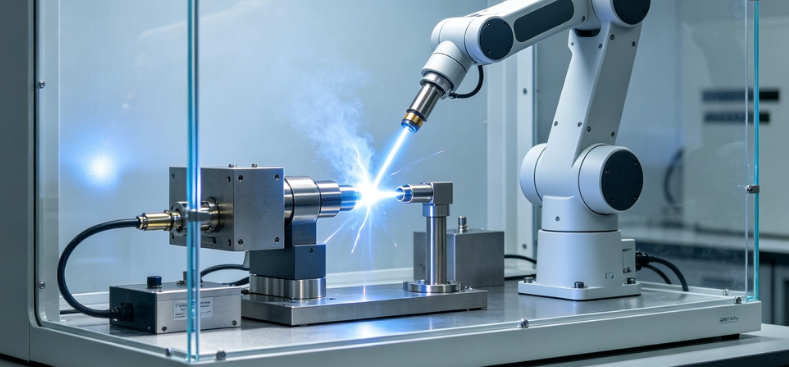
Precision Electrical and Arc Dynamics Measurement
The electrical characteristics of the arc—voltage, current, frequency, and fluctuation spectrum—directly influence the energy coupling efficiency, arc stability, and electrode erosion. We employ ultra‑wideband high‑voltage differential probes (up to 200 kV, 200 MHz) and precision Rogowski coils (DC to 50 MHz) to capture the instantaneous voltage and current at the heater input with sub‑microsecond resolution. From these signals, we compute the real power (integrated over multiple cycles), the power factor, and the harmonic distortion up to the 50th order using a high‑precision power analyser (class 0.02). For pulsed or DC‑discharge heaters, we measure the arc voltage ripple, current rise‑time, and arc reignition frequency using a deep‑memory oscilloscope (10 GS/s).
We also perform time‑frequency analysis (wavelet and short‑time Fourier transform) to detect transient arc instabilities, such as voltage spikes due to electrode sputtering or flow perturbations, which are precursors to nozzle erosion or test‑section contamination. Our arc tracking analysis uses a high‑speed camera (up to 500,000 fps) to visualise the arc root movement on the anode surface, quantifying the azimuthal rotation speed and the radial oscillation amplitude—both critical for predicting the anode life and the uniformity of the heat flux profile. All electrical data are synchronised with pressure and temperature measurements to establish a complete cause‑effect relationship.
Enthalpy and Heat Flux Mapping of the Plasma Stream
The primary output of a high‑enthalpy arc heater is the stagnation enthalpy of the exiting plasma stream, which determines the thermal load on the test article. We deploy a suite of complementary techniques to measure the spatial enthalpy distribution. The water‑cooled enthalpy probe (or calorimetric probe) is used to determine the total specific enthalpy (h0) by measuring the heat absorbed by the cooling water and the stagnation pressure, following the method of Grey and Jacobs. We use a multi‑position traversing system with a 2‑D translation stage to map the enthalpy and heat flux profiles across the nozzle exit plane, achieving a spatial resolution of 1 mm.
We also employ optical emission spectroscopy (OES) with a fibre‑optic probe that can be positioned at various radial and axial locations. By fitting the measured spectra (e.g., Hα, Hβ, O I, N I lines) to local thermodynamic equilibrium models, we derive rotational and vibrational temperatures and, with the use of Stark broadening, the electron number density. The enthalpy is then estimated from the population of excited states using the Boltzmann plot method, cross‑validated against the calorimetric probe data. For fast transient measurements, we use a fast‑framing camera with bandpass filters to capture time‑resolved emission intensity maps, which are then converted to temperature maps via a calibrated two‑colour pyrometry technique. Our enthalpy mapping provides the spatial uniformity index and the peak‑to‑average enthalpy ratio, which are essential for assessing the quality of the heater’s flow field.
Mass Flow, Pressure, and Gas Composition Analysis
The accurate determination of mass flow and its distribution is fundamental to the energy balance. We use critical flow venturis (or sonic nozzles) with precision pressure and temperature transducers (accuracy ±0.2 %) to measure the primary and secondary gas flow rates, covering a range from 1 g/s to several kg/s. For reactive gas mixtures (e.g., air with added oxygen or nitrogen), we monitor the composition using a residual gas analyser (RGA) and a Fourier‑transform infrared (FTIR) spectrometer downstream to detect any dissociation products (NO, NO₂, O₂, N₂) and to verify that the intended gas mixture is maintained. We also measure the static and stagnation pressures at multiple ports along the heater and nozzle using high‑frequency piezoelectric transducers (up to 100 kHz) to capture pressure fluctuations that may indicate flow separation or arc‑induced pressure oscillation.
Our mass balance closure calculates the total enthalpy output by multiplying the measured specific enthalpy (from the calorimetric probe) by the mass flow rate, and we compare this with the input electrical power to derive the heat transfer efficiency (ηth = Q̇gas / Pel). This overall efficiency is then decomposed into losses to cooling water, radiation, and wall heat transfer, providing a comprehensive loss breakdown that is invaluable for heater optimisation.
Thermal‑Mechanical Integrity of Critical Components
The constrictor, anode, cathode, and nozzle of a high‑enthalpy arc heater are subjected to extreme heat fluxes and thermal stresses. We monitor the surface temperature of these components using two‑colour pyrometry and infrared thermography (MWIR and LWIR cameras, with a spatial resolution of 0.2 mm) during operation, capturing transient temperature rises during start‑up and shut‑down. We also embed type‑C thermocouples (W‑Re) at discrete locations inside the cooled walls to measure the bulk temperature and to compute the local heat flux to the cooling water by solving the inverse heat conduction problem. The cooling water flow rate (measured by ultrasonic flowmeters) and the temperature rise across the cooling channels are used to calculate the heat removed by cooling water, which is a major loss pathway.
For life‑extension studies, we subject the heater to accelerated cyclic testing—starting, running at full power for a specified duration, and then shutting down—while continuously recording the electrical and thermal parameters. We periodically (every 50 cycles) inspect the electrodes and constrictor using visual borescope and surface profilometry to measure erosion depth and surface roughening. X‑ray radiography and ultrasonic thickness measurement are used to detect thinning of the copper wall or the formation of internal cracks. We provide a remaining life estimation based on the measured erosion rate and the empirical power‑law relationship between arc energy and material loss, enabling you to schedule maintenance and avoid unscheduled downtime.
Flow Field Imaging and Particle Diagnostics
For tests involving particle injection (e.g., simulating meteoroid impacts or for material ablation studies), we offer high‑speed schlieren/shadowgraph imaging to visualise the density gradients and shock structures in the plume. Laser‑induced fluorescence (LIF) is employed to map the spatial distribution of specific atoms or molecules (e.g., atomic oxygen, nitric oxide) with a spatial resolution of 100 µm. We also deploy particle image velocimetry (PIV) with alumina seeding particles (1‑10 µm) to measure the velocity field of the plasma flow, providing the axial and radial velocity components and the turbulence intensity. These optical diagnostics are synchronised with the electrical and thermal data to correlate the flow structure with arc input power and gas flow rate, allowing you to identify conditions that promote laminar versus turbulent flow, which affect the heat transfer to the test article.
Long‑Term Stability and Repeatability Assessment
A high‑enthalpy arc heater is often used for a series of tests that require reproducible conditions. We conduct repeatability studies by performing multiple runs (at least 10) at the same nominal operating parameters, and we quantify the variation in enthalpy, heat flux, and pressure using statistical methods (mean, standard deviation, and tolerance intervals). We also perform long‑duration endurance tests (up to 100 hours of cumulative operation) to monitor any drift in the electrical efficiency or flow characteristics caused by gradual electrode wear or changes in the nozzle throat diameter. Our drift correction algorithms provide real‑time adjustment of the set points to maintain a constant enthalpy, compensating for ageing effects and ensuring that each test condition is consistent with the previous one.
Customised Test Configurations and Application Emulation
We recognise that high‑enthalpy arc heaters are available in many power levels (from 50 kW to several MW) and configurations—segmented constrictors, vortex‑stabilised, or magnetically‑stabilised designs. Our test facility is equipped with interchangeable power supplies (DC, AC, and pulsed), custom gas mixing panels (up to 5 channels), and adjustable nozzle assemblies (with interchangeable throat inserts) to accommodate your specific heater. We can also integrate the heater with a vacuum chamber (up to 10⁻² mbar) for high‑altitude simulation, or with a pressurised vessel (up to 10 atm) for high‑pressure operation. For clients developing new heater designs, we offer parametric sweeps that vary current, gas flow, and gas composition, while automatically logging all diagnostic data. Our DoE‑based optimisation services identify the operating point that maximises enthalpy output or efficiency, and we provide comparative benchmarking against other heaters using our extensive reference database.
Standards, Accreditation, and Scientific Rigour
Our measurements are conducted in accordance with relevant international standards, including ASTM E2826 (thermal spraying parameter measurement), ISO 9245 (efficiency of arc welding equipment), and NASA‑SP‑2001‑3402 (arc heater testing guidelines). We are accredited under ISO/IEC 17025 for electrical, flow, and temperature measurements. All our reference instruments are calibrated by NIST‑ or PTB‑accredited laboratories, and we maintain a comprehensive uncertainty budget (GUM compliant) for every reported parameter. Our final report includes raw data, processed results, uncertainty analysis, and an executive summary with actionable recommendations.
Our Distinctive Expertise and Added Value
What sets our high‑enthalpy arc heater testing service apart is the synergistic combination of electrical diagnostics, optical spectroscopy, calorimetry, and computational validation. Our team includes plasma physicists, aerospace engineers, and instrumentation specialists who have worked on arc heater development for major space agencies and industrial clients. We do not merely measure the output; we interpret the data to build a physical model of the arc‐gas interaction, explaining, for instance, why a particular swirl injection pattern yields a 10 % higher enthalpy efficiency or why a certain cathode material extends the electrode life by 30 %.
We maintain a proprietary database containing performance data from over 20 different arc heater models, enabling us to benchmark your heater against industry norms and to quickly identify abnormal trends. Our predictive analytics tools can forecast the onset of arc instability based on the harmonic content of the voltage signal, allowing you to take corrective action before the test is compromised. We also offer remote monitoring and live data streaming through a secure portal, so you can follow the test in real time and adjust parameters as needed.
Furthermore, we provide training workshops for your operational and maintenance staff on the proper handling of diagnostic probes, interpretation of emission spectra, and calibration of heat flux sensors. Our rapid iteration service allows you to test a modified heater design—such as a new nozzle contour—within 48 hours of receiving the hardware, drastically shortening your development cycle. We also offer expert witness support for regulatory or contractual disputes, if required.
We invite you to engage our technical experts for a pre‑test consultation, where we will define your specific performance targets, test conditions, and measurement requirements, and design a tailored test matrix that balances depth, time, and cost. With our advanced diagnostic arsenal and deep scientific understanding, we transform the complexity of high‑enthalpy arc heater characterisation into clear, quantifiable, and actionable knowledge—empowering you to achieve reliable, repeatable, and efficient thermal testing for your most demanding aerospace and materials applications.