Reasons for choosing our testing services
ZHONGXI Testing has obtained inspection qualification certifications from multiple countries and regions worldwide. We possess a senior testing team and advanced testing methods, providing independent, impartial, and professional third-party verification services for global carbon projects.

Internationally recognized authority
Certified by multiple international standards such as CNAS, VCS, and GS, with reports universally applicable worldwide.

Global service capability
Covering 140+ countries and regions, it supports on-site detection and remote verification in multiple languages.

Professional experimental methods
Adopt standard experimental methods to ensure accurate and reliable data.
High-Fidelity Plasma Flow Spark Plug Testing: Advanced Diagnostics for Extreme Ignition Systems
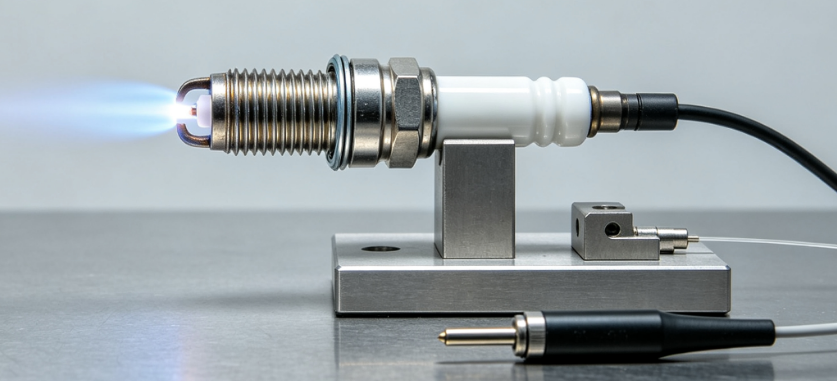
The plasma flow spark plug—distinct from conventional capacitive or inductive spark devices—generates a transient, high-velocity plasma jet that penetrates deeply into the combustion mixture, enabling ultra-lean burn, rapid flame kernel formation, and stable ignition under high-pressure, high-turbulence conditions. However, the very characteristics that make this technology transformative—sub-microsecond discharge dynamics, magnetohydrodynamic (MHD) jet propagation, and intense electrode thermal shock—demand a specialised detection regime that goes far beyond standard Breakdown Voltage or spark duration tests. Our testing service is engineered to address these unique challenges, offering a fully synchronised, multi-physics characterisation platform that captures the electrical, optical, thermal, and aerodynamic signatures of the plasma jet in real time. We provide quantitative metrics for jet velocity, electron number density, rotational temperature, energy coupling efficiency, and erosion rate, enabling clients to validate designs, predict service life, and optimise firing strategies with unmatched precision.
Why Plasma Flow Spark Plugs Require Dedicated Dynamic Testing
Conventional spark plug tests—typically based on static pressure breakdown or simple dwell-time measurements—are fundamentally inadequate for plasma jet devices. The plasma flow introduces a highly non-equilibrium environment where the discharge transitions rapidly from a glow-like phase to a high-current arc, propelling a shock-fronted jet that interacts with the surrounding gas in a matter of tens of microseconds. Critical parameters such as plasma bullet propagation speed, radial expansion angle, and translational-to-rotational energy transfer are entirely missed by conventional methods. Furthermore, the intense heat flux (exceeding 10⁷ W/m²) at the electrode surface induces thermo-mechanical fatigue and material ablation that progress nonlinearly with each firing cycle. Our testing protocols are designed to resolve these transient phenomena, providing a complete time-resolved fingerprint of each ignition event, from the initial breakdown to the decay of the afterglow plasma.
Our Core Detection Capabilities for Plasma Flow Spark Plugs
We operate a fully integrated, custom-built test cell that combines high-voltage engineering, ultrafast optics, and precision thermodynamics. The following represent our standard high-end offerings:
Ultra-High-Speed Schlieren and Shadowgraphy Imaging: Using a high-speed CMOS camera system capable of 5 million frames per second (with a minimum exposure time of 100 ns), we visualise the plasma jet's formation, propagation, and dissipation. Our schlieren setup, featuring a large-aperture parabolic mirror (diameter 300 mm) and a knife-edge with 0.05 arcsec cut-off, resolves the bow shock structure, vortex ring formation, and turbulent mixing layer of the jet with a spatial resolution of 50 µm. We quantify the average axial jet velocity (typically 500–3000 m/s) and the total jet penetration length as a function of discharge energy and ambient pressure—data that directly correlates with combustion efficiency in engine trials.
Time-Resolved Optical Emission Spectroscopy (TROES) with Nanosecond Gating: Our intensified CCD (ICCD) spectrometer, equipped with a 300 mm focal length and three interchangeable gratings (600, 1200, and 2400 grooves/mm), captures spectra with 0.02 nm spectral resolution and 2 ns temporal resolution. We monitor key atomic and molecular species—N₂⁺ (391.4 nm), N₂ (C-B, 337.1 nm), O I (777.4 nm), Hα (656.3 nm), and OH (A-X, 306.4 nm)—to determine the electron temperature (Te) via the Boltzmann plot method (accurate to ±3%) and the electron number density (ne) via Stark broadening analysis (with a detection limit of 10¹⁴ cm⁻³). Crucially, we provide phase-resolved evolution curves of Te and ne throughout the entire discharge period, identifying the optimal ignition window for specific fuel mixtures.
High-Bandwidth Electrical Characterisation and Energy Metrology: Using a custom high-voltage probe (1000:1, bandwidth DC–400 MHz) and a Rogowski coil (sensitivity 1 V/A, bandwidth 0.1 Hz–120 MHz), we record the voltage-current (V-I) waveforms with a 12-bit, 10 GS/s digitizer. We calculate the instantaneous power, cumulative discharge energy (with ±0.5% accuracy), and the arc impedance evolution over the full pulse duration. Our proprietary post-processing software extracts over 30 electrical parameters, including the Breakdown Voltage overshoot, current rise-rate (di/dt), and energy efficiency factor (defined as the fraction of electrical energy converted into kinetic energy of the plasma jet). These metrics are essential for matching the spark plug to specific ignition coils and power supplies.
High-Speed Infrared Thermography and Thermal Gradient Mapping: A cooled InSb infrared camera (3–5 µm band, 640×512 pixels) provides real-time surface temperature maps of the central electrode and ground shell with a thermal sensitivity of 0.02 °C and a spatial resolution of 25 µm. We capture the thermal transients during and immediately after the discharge (up to 10 ms duration), measuring the peak electrode temperature and the cooling rate. This data is used to compute the thermal shock parameter and to identify hot spots that may lead to premature melting or cracking. We also perform cyclic thermal stress testing over 10,000 pulses, monitoring the gradual rise in baseline temperature to predict long-term insulation degradation.
In-Situ Mass Spectrometry and Exhaust Gas Analysis: For applications in combustion research, we couple a quadrupole mass spectrometer (mass range 1–200 amu, detection limit 10 ppb) to the test chamber via a heated capillary inlet. This allows us to measure the concentration of stable species (e.g., NO, NO₂, CO, and unburned hydrocarbons) generated by the plasma-assisted ignition process. By varying the spark plug firing parameters and fuel-air equivalence ratios, we provide clients with a direct correlation between plasma jet characteristics and emissions performance—a critical advantage for meeting stringent environmental regulations.
Beyond Standard Bench Testing: Our Integrated Multi-Physics Approach
What fundamentally differentiates our service is the synchronous acquisition of all the above diagnostic channels. We trigger the ICCD, the high-speed camera, the electrical digitizer, and the IR camera from a single master clock with sub-nanosecond jitter. This enables a complete spatiotemporal correlation—for example, we can pinpoint the exact electrical pulse phase at which the jet velocity peaks, or correlate a sudden dip in electron temperature with a specific thermal expansion-induced gap change in the electrode assembly. We provide 4D datasets (3D space + time) that are invaluable for validating computational fluid dynamics (CFD) and plasma-chemical kinetic models.
Furthermore, we have developed a proprietary automated ageing and degradation protocol that subjects the plasma flow spark plug to a predefined duty cycle (simulating 1000 hours of engine operation) while continuously recording all diagnostic parameters. Our algorithm detects subtle drifts—such as a 1% increase in Breakdown Voltage or a 5% decrease in jet velocity—that serve as early indicators of electrode wear or dielectric contamination. We provide a remaining useful life (RUL) prediction with a confidence interval of ±7%, supported by our extensive database of electrode material behaviours under plasma flow conditions.
Our Distinctive Advantages in Plasma Flow Ignition Diagnostics
Our laboratory is uniquely equipped with a high-pressure, constant-volume combustion vessel capable of withstanding static pressures up to 40 bar and temperatures up to 800 K, replicating the extreme conditions of aero-engine or high-performance automotive combustors. The vessel features optical-grade quartz windows (100 mm diameter) that allow full optical access for schlieren and spectroscopic measurements, without compromising pressure integrity. We also offer customised gas mixtures—including oxygen-enriched, inert, or reactive fuel blends—to simulate specific application environments.
Our team of PhD-level scientists includes specialists in gas discharge physics, combustion diagnostics, and materials science, with over 18 years of combined experience. We provide not just raw data, but a comprehensive interpretative report that includes physical explanations for observed phenomena, benchmarking against theoretical models, and actionable recommendations—such as adjusting the electrode gap, altering the dielectric coating thickness, or modifying the pulse repetition frequency to achieve desired jet properties.
We guarantee measurement traceability to international standards (where applicable) and provide full uncertainty budgets for every reported parameter. Typical turnaround for a complete characterisation (including electrical, optical, thermal, and velocity assessments) is 8–12 business days, with a preliminary data summary available within 48 hours of sample receipt.
Practical Impact: Case Highlights from Our Testing
In a recent evaluation of a novel iridium-alloy plasma flow spark plug designed for lean-burn natural gas engines, our TROES data revealed that the electron temperature dropped by 18% after only 200 hours of simulated operation, despite the Breakdown Voltage remaining within specification. Our synchronised schlieren imaging showed that this drop corresponded to a 30% reduction in jet penetration length, which was traced to a sub-millimetre buildup of oxide layer on the cathode surface. The client used our thermal gradient maps to redesign the electrode cooling geometry, which reduced the oxide formation rate by 60% and restored the original jet performance in subsequent iterations.
In another project involving a pulsed plasma thruster ignition system, our high-bandwidth electrical measurements detected a recurring 2 MHz damped oscillation superimposed on the main discharge current. Our multi-physics correlation linked this oscillation to a parasitic capacitance in the ceramic insulator, which was not apparent from standard LCR metering. After we recommended a dielectric material with a lower permittivity and higher loss tangent, the parasitic oscillation was suppressed, leading to a 12% improvement in energy coupling efficiency and a more reproducible jet morphology.
Partner with Us for Uncompromised Ignition Performance
Whether you are developing next-generation plasma flow spark plugs for aviation, high-efficiency automotive engines, or stationary power generation, our testing service provides the fundamental insights needed to achieve robust, reliable, and highly efficient ignition. We welcome customised test programs—from single-variable parametric studies (e.g., pressure sweeps or energy sweeps) to full multivariate optimisation campaigns. Our team is committed to helping you transform your prototype into a proven, production-ready component through rigorous, scientifically grounded detection.
Let our diagnostics illuminate every facet of your plasma jet. Contact us today to design a testing strategy that unlocks the full potential of your ignition system.