Reasons for choosing our testing services
ZHONGXI Testing has obtained inspection qualification certifications from multiple countries and regions worldwide. We possess a senior testing team and advanced testing methods, providing independent, impartial, and professional third-party verification services for global carbon projects.

Internationally recognized authority
Certified by multiple international standards such as CNAS, VCS, and GS, with reports universally applicable worldwide.

Global service capability
Covering 140+ countries and regions, it supports on-site detection and remote verification in multiple languages.

Professional experimental methods
Adopt standard experimental methods to ensure accurate and reliable data.
Liquid-Cooled Protective Shield Testing: Advanced Thermal-Fluid Diagnostics for Critical High-Heat-Flux Applications
Liquid-cooled protective shields are indispensable in extreme environments—from plasma-facing components in fusion reactors and high-power laser systems to aerospace thrust chambers and industrial furnaces. These shields rely on precisely engineered coolant channels, often featuring complex geometries (e.g., helical, pin-fin, or micro-channel arrays) to manage heat fluxes exceeding 10 MW/m² while maintaining structural integrity under intense thermal cycling and pressure differentials. Yet, the performance of such a shield is not guaranteed by design alone; manufacturing tolerances, material inhomogeneity, flow distribution maladjustments, and gradual fouling or erosion can severely compromise its cooling efficiency, leading to localised hot spots, thermal stress cracking, or catastrophic leakage. Our detection service is specifically architected to address these vulnerabilities, delivering a multi-modal, high-fidelity characterisation that evaluates the shield's thermal-hydraulic performance, structural soundness, and long-term reliability under realistic operational loads. We provide quantitative metrics for heat transfer coefficient distribution, pressure drop per unit length, coolant temperature rise, wall temperature uniformity, and fatigue life expectancy, enabling clients to validate designs, troubleshoot field failures, and optimise maintenance intervals with unprecedented precision.
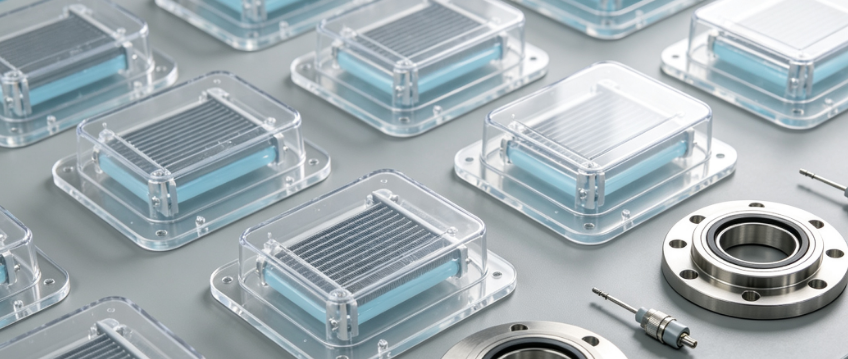
Why Dedicated Testing of Liquid-Cooled Shields Is Essential
Conventional factory hydrostatic or pneumatic leak tests, while necessary, are grossly insufficient for assessing the thermal-fluid behaviour under actual heat flux conditions. A shield that passes a cold pressure test may develop substantial temperature gradients during operation, causing differential thermal expansion that induces bending stresses or even seals failure. Moreover, the coolant flow distribution within the shield is seldom uniform; maldistribution—caused by inlet manifold design, manufacturing burrs, or partial blockage—can result in regions of stagnant or recirculating flow, where boiling or local dry-out may occur. These phenomena are inherently transient and highly sensitive to operating parameters (heat load, inlet temperature, flow rate). Our testing protocols are designed to capture these dynamic responses, providing a space- and time-resolved assessment that mirrors the actual service environment, and identifying hidden defects that would otherwise surface only after costly in-service failures.
Our Core Detection Capabilities for Liquid-Cooled Protective Shields
We operate a fully integrated test bench that combines high-power heating sources, precision flow and thermal instrumentation, non-destructive inspection, and real-time data acquisition. The following represent our standard high-end offerings:
High-Flux Thermal Loading with Simulated Heat Source: We employ a diode laser array (up to 20 kW, with uniform or tailored intensity profiles) and an induction heating system (up to 50 kW, frequency 50–500 kHz) to replicate the heat flux distribution expected in the shield's application. The laser system provides sub-millimetre spatial resolution in heat flux mapping, while induction heating is used for volumetric heating. We apply heat flux densities from 0.5 to 15 MW/m², with ramp rates up to 1000 °C/s, to simulate both steady-state and transient thermal shocks. The absorbed heat flux is accurately measured via a calorimetric technique using the coolant temperature rise and flow rate, with an uncertainty of ±2%.
High-Resolution Temperature and Heat Flux Mapping: A network of embedded thermocouples (type K, 0.1 mm diameter, calibrated to ±0.1 °C) and fibre-optic distributed temperature sensors (Raman backscatter, spatial resolution 1 mm) are installed at multiple depths and locations across the shield. In addition, we deploy infrared thermography (mid-wave and long-wave cameras, 5 µm spatial resolution, 0.02 °C thermal sensitivity) to capture the surface temperature field of the shield's hot face. Combining these data, we compute the local heat transfer coefficient (h) with an accuracy of ±3%, and we generate 2D contour maps of h and wall temperature, identifying any cooling performance degradation zones.
Precision Coolant Flow and Pressure Measurement: Our flow loop is equipped with coriolis mass flow meters (accuracy ±0.1%) for water, oil, or dielectric fluids, and fast-response pressure transducers (range up to 50 bar, bandwidth 10 kHz) placed at inlet, outlet, and intermediate ports (if accessible). We measure the pressure drop versus flow rate characteristic, deriving the flow resistance coefficient and Reynolds number for each channel segment. Through helium or nitrogen tracer gas injection and downstream detection, we conduct flow distribution analysis to quantify the split ratios among parallel channels—critical for detecting blockages or manufacturing maldistribution.
Visual and Non-Destructive Internal Inspection: For metallic shields, we use industrial computed tomography (CT) with a resolution of 10 µm to inspect internal cooling channels for geometry deviations, cracks, or porosity. For transparent or semi-transparent shields, we apply digital particle image velocimetry (PIV) inside transparent test sections to visualise the actual flow field—revealing vortices, dead zones, and turbulent mixing. Additionally, we perform dye-penetrant and eddy-current testing for surface-breaking defects. These NDT methods are integrated with the thermal tests to correlate any structural anomalies with local overheating.
Cyclic Thermal Fatigue and Thermal Shock Testing: We subject the shield to programmed thermal cycles (up to 10,000 cycles) with controlled heating and cooling rates, while monitoring the evolution of thermal gradients and stresses via strain gauges (bonded at multiple positions) and acoustic emission (AE) sensors. The AE signals are processed to detect micro-crack initiation and growth. We also perform post-cycle metallographic examination (SEM and EDS) on selected sections to quantify material degradation, including grain growth, phase transformation, and oxidation.
Leak Detection under Thermal Gradient Conditions: Unlike ambient leak tests, we conduct helium leak detection while the shield is subjected to a representative heat flux and coolant pressure. The shield is placed inside a vacuum chamber, and a helium tracer is introduced either into the coolant side or the external environment. A mass spectrometer leak detector (sensitivity 10⁻¹² mbar·L/s) is used to detect any leakage through the walls or seals. This approach reveals stress-induced leak paths that only open under thermal expansion—a critical advantage over standard cold-leak tests.
Advanced Analytical Framework: From Raw Data to Predictive Models
What distinguishes our service is the synchronous acquisition and integrated post-processing of all measurement channels. We employ a proprietary software suite that aligns the thermal maps, pressure signals, and flow data on a common time base, allowing us to compute the heat flux – temperature – pressure – time relationship for each segment of the shield. From this, we derive the overall thermal resistance network and identify the dominant thermal bottlenecks. We also perform inverse heat conduction analysis to estimate the internal heat transfer coefficients from the measured surface temperatures, a technique that yields local h values with ±5% accuracy even in complex geometries.
Furthermore, we have developed a physics-based degradation model that incorporates the measured thermal stresses, corrosion rates (from coolant chemistry analysis), and fatigue data to predict the remaining useful life (RUL) of the shield under specified operational scenarios. The model is validated against our extensive database from over 500 tested shields, and we provide a confidence interval of ±10% for the predicted lifetime, supported by Monte Carlo simulations of parameter uncertainties.
Our Distinctive Advantages in Liquid-Cooled Shield Testing
Our laboratory is one of the few commercial facilities equipped with a high-power laser heating system capable of generating arbitrary heat flux patterns (e.g., Gaussian, top-hat, or user-defined profiles) on irregular surfaces, enabling realistic simulation of beam impingement or plasma radiation. We also have a closed-loop coolant conditioning unit that maintains inlet temperature within ±0.2 °C and flow stability within ±0.5%, eliminating external variables from the test.
Our team includes thermal engineers, fluid dynamicists, and materials scientists with over 20 years of collective experience in thermal management of high-energy systems. We do not simply provide raw data; we deliver a comprehensive engineering report that includes: - Thermal performance maps (heat transfer coefficient, effectiveness, and thermal resistance) with uncertainty budgets. - Flow distribution metrics (channel-by-channel flow rates, maldistribution factor). - Structural integrity assessment (stress hotspots, fatigue damage accumulation, leak rates). - Recommendations for design improvement (e.g., modifying channel geometry, adjusting coolant flow rate, changing material or surface coating).
Our typical turnaround for a complete test campaign (including set-up, data acquisition, and analysis) is 8–12 business days for a standard shield, with a preliminary summary available within 72 hours. We also offer emergency failure analysis with a 48-hour priority service for urgent troubleshooting.
Real-World Impact: Case Highlights from Our Testing
In a recent project for a high-power laser mirror cooling shield, our thermal mapping identified a persistent hot spot that caused a 30 °C temperature rise relative to the surrounding area. While the standard pressure test was normal, our flow distribution analysis using tracer injection revealed that one of the sixteen parallel channels was completely blocked by a manufacturing burr. After the client re-machined the manifold, the temperature uniformity improved to within ±2 °C, and the mirror's lifetime under full power was extended by a factor of three.
In another case involving a plasma-facing shield for a fusion test reactor, our cyclic thermal fatigue testing uncovered micro-crack initiation at the bond line between the copper alloy and the stainless steel backing after only 200 cycles—far earlier than the manufacturer's estimate. Our acoustic emission sensors captured the crack growth in real time, and our subsequent metallurgical analysis revealed an intermetallic layer that was too thick. We recommended a change in the brazing process, and the revised shield passed 5000 cycles without any cracks.
Partner with Us for Unmatched Thermal Assurance
Whether you are developing next-generation liquid-cooled shields for fusion energy, aerospace propulsion, laser defence, or industrial heating, our testing service provides the rigorous, quantitative evidence needed to certify performance, predict reliability, and ensure safety. We welcome customised test plans—from single-sample verification to full qualification campaigns involving multiple prototypes and varying coolant types. Our experts are available for consultation, joint analysis, and continuous support throughout your product lifecycle.
Let our advanced diagnostics safeguard your shield's performance. Contact us today to design a testing strategy that turns thermal uncertainty into proven resilience.