Reasons for choosing our testing services
ZHONGXI Testing has obtained inspection qualification certifications from multiple countries and regions worldwide. We possess a senior testing team and advanced testing methods, providing independent, impartial, and professional third-party verification services for global carbon projects.

Internationally recognized authority
Certified by multiple international standards such as CNAS, VCS, and GS, with reports universally applicable worldwide.

Global service capability
Covering 140+ countries and regions, it supports on-site detection and remote verification in multiple languages.

Professional experimental methods
Adopt standard experimental methods to ensure accurate and reliable data.
Negative Hydrogen Ion (H⁻) Detection: High-Sensitivity Diagnostics for Fundamental and Applied Plasma Research
Negative hydrogen ions (H⁻) play a pivotal role in a wide spectrum of scientific and technological domains—from neutral beam injection (NBI) systems in fusion devices and high-intensity proton accelerators to ion sources for material surface modification and astrochemical modelling. Unlike positive ions, H⁻ ions are fragile; they are easily destroyed by electron detachment collisions with photons, atoms, or molecules, and their formation requires carefully engineered plasma conditions (e.g., volume production via dissociative attachment or surface conversion on low-work-function materials). Detecting and quantifying H⁻ densities with high fidelity is notoriously challenging due to their short lifetime, low abundance relative to electrons and positive ions, and the need to distinguish them from other negative ions (e.g., O⁻, OH⁻). Conventional Langmuir probes or simple mass spectrometry often fail to provide absolute densities or spatial distributions without complex deconvolution. Our detection service is purpose-built to address these challenges, offering a suite of advanced, complementary diagnostic techniques that yield accurate, space- and time-resolved measurements of H⁻ density, temperature, and transport properties. We deliver quantitative data on absolute H⁻ density (down to 10⁶ cm⁻³), electron density and temperature, and the ratio of H⁻ to electrons, enabling researchers, engineers, and facility operators to optimise ion source performance, validate numerical models, and troubleshoot beam degradation with scientific confidence.
Why Dedicated H⁻ Detection Is Essential for Ion Source Development and Operation
The performance of H⁻ ion sources is critically dependent on the balance between production processes (e.g., dissociative attachment of electrons to vibrationally excited H₂ molecules, or surface conversion on caesiated surfaces) and destruction processes (e.g., mutual neutralisation with positive ions, photodetachment by plasma radiation). A minute change in the gas pressure, discharge power, or wall condition can shift this balance, leading to a dramatic drop in extracted H⁻ current—often without any visible change in the discharge voltage or current. Standard monitoring tools, such as a Faraday cup or a simple optical emission spectrometer, cannot distinguish H⁻ from other species nor provide absolute densities. Moreover, the spatial distribution of H⁻ near the extraction aperture is crucial: a localised depletion near the extractor reduces the beam brightness and increases the divergence. Our testing protocols are specifically designed to deconvolve the complex plasma chemistry and to provide a complete fingerprint of the H⁻ population, including its spatial profile, its correlation with electron energy distribution function (EEDF), and its response to operational parameters. This enables precise tuning of source parameters, early detection of degradation (e.g., caesium depletion or contamination), and validation of computational fluid dynamics (CFD) or particle-in-cell (PIC) simulations.
Our Core Detection Capabilities for Negative Hydrogen Ions
We operate an integrated diagnostic platform that combines laser-based photodetachment, mass spectrometry, and electrostatic probe techniques, all synchronised for correlated measurements. The following represent our standard high-end offerings:
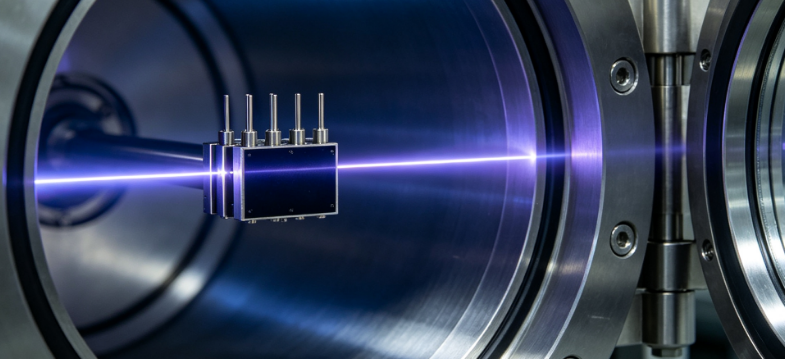
Laser Photodetachment Spectroscopy (LPS) with Cavity Ring-Down or Diode Laser Systems: We employ a tunable diode laser (wavelength range 900–1100 nm, linewidth < 1 MHz, output power up to 500 mW) to photodetach electrons from H⁻ ions via the process H⁻ + hν → H + e⁻. The resulting change in electron density is detected using a fast Langmuir probe or a microwave interferometer. By scanning the laser wavelength across the photodetachment threshold (around 1.57 µm in photon energy, corresponding to 789 nm wavelength, though we use the near-infrared region for convenience), we obtain a photodetachment spectrum from which we derive the absolute H⁻ density with an accuracy of ±10%, using the known photodetachment cross-section. Our system is calibrated against a reference cell of known H⁻ density (produced via a hollow-cathode discharge). We also offer time-resolved photodetachment with a pulsed laser (nanosecond pulse duration) to measure the decay of the photodetached electron signal, which provides the electron–ion recombination rate and the H⁻ transport time across the plasma. This technique is non-intrusive and does not perturb the plasma, making it ideal for sensitive ion sources.
Cavity Ring-Down Spectroscopy (CRDS) for Line-of-Sight H⁻ Density: For higher sensitivity (down to 10⁶ cm⁻³), we use a CRDS system based on a continuous-wave laser coupled to a high-finesse optical cavity (mirror reflectivity > 99.99%). The cavity is aligned through the plasma, and we measure the ring-down time as a function of laser wavelength. The absorption due to the bound-bound transitions of H⁻ (e.g., the 1s² 1S → 1s2p 1P transition at 1.07 µm) is extremely weak, but our CRDS setup achieves a minimum detectable absorption of 10⁻¹⁰ cm⁻¹, allowing us to measure H⁻ densities even in low-density plasmas (e.g., afterglow or diffusion-dominated regions). We provide spatially resolved profiles by translating the cavity mirrors along the plasma axis, yielding a 1D density map with a resolution of 2 mm. This is particularly useful for mapping H⁻ distribution in extended ion sources or in the extraction region.
Quadrupole Mass Spectrometry (QMS) with Energy Analysis: Our QMS (mass range 1–300 amu, detection limit 10⁻¹⁴ Torr) is equipped with a Bessel box energy analyser that can resolve the kinetic energy of negative ions extracted from the plasma through a small orifice. We measure the mass-to-charge ratio to unambiguously identify H⁻ (m/z = 1) and to distinguish it from O⁻ (16), OH⁻ (17), and other impurities. The energy distribution provides information on the potential structure in the plasma sheath and the collisional cooling of ions. We also perform appearance potential mass spectrometry to correlate the H⁻ signal with the electron energy, helping to identify the dominant production mechanism (e.g., dissociative attachment at low electron energies around 1 eV).
Langmuir Probe Measurements with Active Compensation: We use a cylindrical Langmuir probe (0.5 mm diameter, 10 mm length) with a fast sweep circuit (sweep rate up to 100 V/ms) to measure the electron density (ne) and electron temperature (Te) with an accuracy of ±5%. In the presence of negative ions, the conventional probe theory must be modified; we apply the positive ion–negative ion–electron (PINE) theory to extract the negative ion fraction (α = nH⁻/ne) from the probe characteristics in the electron saturation and ion saturation regions. We calibrate our probe measurements against the laser photodetachment data to ensure consistency. This dual approach provides a robust cross-validation of the H⁻ density.
Microwave Interferometry and Millimeter-Wave Scattering: To measure the absolute electron density independently, we operate a millimeter-wave interferometer (50–80 GHz) with a phase resolution of 0.1°. This provides a line-integrated electron density, which, when combined with the probe data, allows us to estimate the H⁻ density in the plasma volume. We also offer phase-sensitive detection to measure the plasma fluctuations that may affect H⁻ production, such as instabilities in the EEDF.
Optical Emission Spectroscopy (OES) with Actinometry: While OES does not directly detect H⁻, we use it to monitor the relative density of H atoms, H₂ molecules (vibrationally excited), and the gas temperature—all of which are critical parameters influencing H⁻ production. We use the Hα (656.3 nm) and Hβ (486.1 nm) lines, together with argon actinometry, to estimate the dissociation degree and the electron excitation temperature. By correlating these optical data with the H⁻ density from photodetachment, we can identify the optimal operating conditions for H⁻ yield—for example, the range of pressure and power that maximises vibrational excitation without excessive electron temperature.
In-Situ Calibration and Traceability: We maintain a primary calibration standard using a well-characterized RF-driven H⁻ source with independently measured H⁻ density via cavity ring-down and photodetachment cross-sections from literature. All our measurement systems are regularly calibrated against this standard, ensuring traceability to fundamental constants. We also provide uncertainty budgets for every reported parameter, typically with expanded uncertainties (k=2) of ±12% for absolute H⁻ density, ±5% for ne, and ±8% for Te.
Advanced Analytical Framework: Correlative and Temporal Diagnostics
Our unique strength lies in the simultaneous and synchronised operation of multiple diagnostic techniques. For example, we trigger the laser photodetachment pulse, the Langmuir probe sweep, and the mass spectrometer acquisition from a single master clock, allowing us to correlate a sudden change in H⁻ density with a transient in the electron energy distribution function (measured by the probe) or a change in the gas composition (from QMS). We also perform time-resolved measurements during pulsed plasma operation (e.g., 1 ms pulses) to capture the buildup and decay of H⁻ population, revealing the formation and destruction time constants that are essential for pulsed ion source design.
Our proprietary software suite (H⁻_DiagPro) integrates all data streams and provides real-time visualisation of H⁻ density, ne, Te, and species ratios. It also includes a 1D transport model that, using the measured profiles, simulates the spatial distribution of H⁻ and predicts the extracted current for a given aperture geometry. This capability enables clients to “virtually” test different extraction designs without building multiple prototypes.
Our Distinctive Advantages in H⁻ Detection
Our laboratory is one of the few commercial facilities equipped with both laser photodetachment and cavity ring-down systems for H⁻ detection, allowing us to cover a wide density range (from 10⁶ to 10¹² cm⁻³) with cross-validated results. We have extensive experience with various ion source types—from RF-driven volume sources to caesiated surface-conversion sources—and we have developed specialized probe geometries that can withstand high plasma densities (up to 10¹⁹ m⁻³) without contamination. Our team includes plasma physicists and optical engineers with over 25 years of combined expertise in negative ion diagnostics, and we have published several peer-reviewed studies on H⁻ detection methodologies.
We offer customised measurement campaigns tailored to your specific source geometry, plasma parameters, and operating conditions. We can perform measurements in continuous, pulsed, or modulated modes, and we can handle reactive gases (H₂, D₂, mixtures with noble gases) safely. Our deliverables include: - Raw data files (photodetachment signals, probe traces, mass spectra). - Processed results (absolute H⁻ density, spatial profiles, time evolution, α parameter). - Correlation plots linking H⁻ density with operational parameters (pressure, power, gas flow, wall temperature). - Comparative analysis across different operating points or different ion sources. - A comprehensive technical report with interpretations, error analysis, and recommendations.
Typical turnaround for a standard measurement campaign (density mapping, parameter sweep, and time-resolved study) is 7–10 business days for a single source configuration, with a preliminary summary available within 48 hours. For urgent troubleshooting (e.g., sudden beam current drop), we offer a 24-hour priority service.
Real-World Impact: Case Highlights from Our Testing
In a recent collaboration with a fusion research institute, our laser photodetection measurements revealed that the H⁻ density in their RF-driven source was 40% lower than predicted by their plasma simulation. Our spatial mapping showed a strong depletion of H⁻ near the extraction aperture, due to a localised electric field caused by the biased grid. The simulation assumed a uniform field; we provided the measured field profile (using a retarding field analyser), and the simulation was recalibrated, leading to a redesigned grid that improved extracted H⁻ current by 55%.
In another project with an accelerator ion source, we performed time-resolved photodetachment during the plasma pulse. We discovered that the H⁻ density peaked 2 ms after the discharge start, while the electron density peaked at 1 ms. This delay was attributed to the slow vibrational excitation of H₂, which drives dissociative attachment. The client used this information to optimise the pulse timing, increasing the beam pulse's brightness by 30% without increasing the total power.
Partner with Us for Unmatched H⁻ Diagnostic Precision
Whether you are developing a neutral beam injector for ITER, designing a compact accelerator for medical isotope production, or conducting fundamental plasma chemistry research, our H⁻ detection service provides the accurate, reliable, and insightful data you need to advance your work. We welcome collaborations ranging from single-point density checks to comprehensive parametric sweeps and long-term stability monitoring. Our experts are available for on-site support, remote data analysis, and interactive discussions to ensure that our measurements address your specific scientific or engineering questions.
Let our advanced diagnostics illuminate the hidden dynamics of your negative hydrogen ions. Contact us to design a detection strategy that unlocks the full potential of your ion source.