Reasons for choosing our testing services
ZHONGXI Testing has obtained inspection qualification certifications from multiple countries and regions worldwide. We possess a senior testing team and advanced testing methods, providing independent, impartial, and professional third-party verification services for global carbon projects.

Internationally recognized authority
Certified by multiple international standards such as CNAS, VCS, and GS, with reports universally applicable worldwide.

Global service capability
Covering 140+ countries and regions, it supports on-site detection and remote verification in multiple languages.

Professional experimental methods
Adopt standard experimental methods to ensure accurate and reliable data.
Ion Thruster Performance and Lifetime Testing: Comprehensive Diagnostic Solutions for Electric Propulsion Systems
Ion thrusters—key propulsion systems for long-duration space missions, including geostationary satellites, deep-space probes, and manned interplanetary craft—generate thrust by ionising a propellant gas (typically xenon) and accelerating the ions through a high-voltage grid system. The performance and longevity of an ion thruster are governed by a delicate balance of plasma generation, ion optics, charge-exchange collisions, and grid erosion. Routine electrical or vacuum tests are insufficient to capture the complex degradation mechanisms that occur over thousands of operating hours, such as grid sputtering, accelerator grid wear, discharge cathode poisoning, and neutraliser degradation. Our detection service is specifically designed to provide a multi-parametric, time-resolved characterisation of ion thrusters under realistic operating conditions, delivering quantitative data on thrust, specific impulse, ion beam current density distribution, grid erosion rates, plasma potential fluctuations, and plumes dynamics. We enable manufacturers, space agencies, and research institutes to validate design models, qualify flight hardware, diagnose performance drifts, and extend operational life with unprecedented scientific rigour.
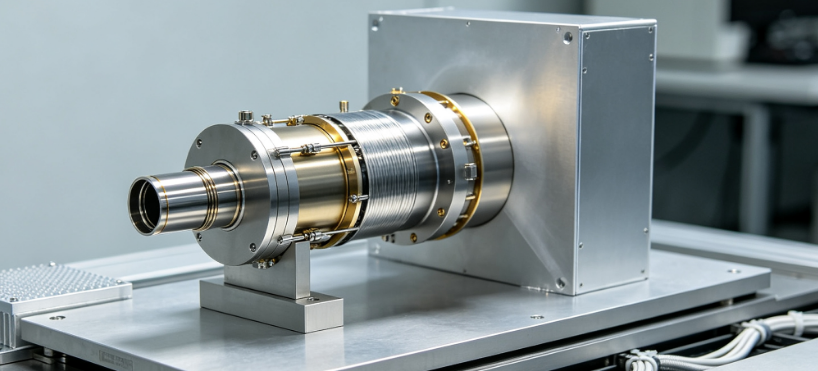
Why Specialised Ion Thruster Testing Is Essential for Mission Success
Ion thrusters operate in a harsh plasma environment where the ion optics—comprising screen and accelerator grids—are subjected to continuous ion bombardment, leading to sputtering erosion that eventually causes grid perforation or short circuits. The erosion rate is highly dependent on the angle of ion incidence, the ion energy distribution, and the local plasma density near the grid apertures. Standard end-of-life tests based on simple current measurements cannot predict the spatial evolution of erosion or the onset of arcing. Moreover, the charge-exchange plasma created by neutralised ions can backflow into the thruster, eroding the discharge cathode and reducing lifetime. Our detection protocols are designed to spatially resolve these phenomena, providing a clear picture of the thruster's internal and external plasma environment. We also assess the thrust stability and beam pointing under various power and flow conditions—critical for station-keeping and orbit-raising manoeuvres. By combining multiple diagnostic techniques, we deliver a holistic health assessment that goes far beyond a simple pass/fail criterion, enabling predictive maintenance and informed decision-making.
Our Core Detection Capabilities for Ion Thrusters
We operate a dedicated test facility equipped with a large vacuum chamber (volume > 30 m³, ultimate pressure < 10⁻⁶ Pa) that replicates the space environment. Our diagnostic suite includes the following high-end capabilities:
Thrust Stand with Sub-Millinewton Resolution: Our in-vacuum thrust stand, based on a pendulum or torsion balance design, measures the thrust force directly with a resolution of 0.1 mN and an accuracy of ±0.5% of reading. We perform real-time thrust measurements during steady-state and throttling transients, providing a direct measure of thrust efficiency and specific impulse (Isp). The stand is calibrated in situ using known weights, and we correct for thermal drift and electromagnetic interference.
Faraday Probe Array and Ion Beam Current Mapping: We use a multi-axis Faraday probe array (up to 100 separate collectors) mounted on a robotic positioning system to measure the ion beam current density profile at multiple planes downstream of the thruster. The system provides a 2D beam map with a spatial resolution of 1 mm, from which we compute the beam divergence angle and the ion current uniformity. We also employ a retarding potential analyser (RPA) to measure the ion energy distribution at the beam centre and at off-axis positions, revealing any grid misalignment or voltage breakdown.
Grid Erosion Monitoring via High-Resolution Optical and SEM Analysis: Post-test and in-situ (via borescope) imaging of the grids using a high-resolution camera (resolution 5 µm/pixel) allows us to measure the aperture diameter increase and the groove depth on the accelerator grid. For detailed erosion quantification, we perform scanning electron microscopy (SEM) and white-light interferometry on test coupons or on selected apertures, providing erosion rate maps (nm/hour) with sub-micrometre accuracy. We correlate these erosion patterns with the measured beam profiles to identify the dominant sputtering mechanisms—whether due to direct ion impingement or charge-exchange ions.
Time-Resolved Langmuir Probes and Emissive Probes for Plasma Characterisation: We insert cylindrical and planar Langmuir probes into the discharge chamber and the near-plume region to measure electron density (ne), electron temperature (Te), and plasma potential (Vp) with a sampling rate of up to 10 MHz. We also deploy emissive probes for accurate Vp measurements. These data reveal the plasma oscillations (e.g., breathing modes or ion acoustic waves) that can affect the beam quality. Our probe measurements are synchronised with the thruster's discharge current and grid voltages, allowing us to detect any coupling between electrical fluctuations and plasma instability.
Mass Spectrometry and Residual Gas Analysis: A quadrupole mass spectrometer (QMS) with a secondary electron multiplier (SEM) is connected to the vacuum chamber via a differentially pumped sampling line. We monitor the partial pressures of xenon, xenon ions, and any impurities (e.g., water, hydrocarbons, or sputtered grid material). The QMS also measures the charge-exchange ion fraction and the neutral gas density in the plume, which is crucial for understanding backflow and grid erosion. We provide time-resolved species concentration during thruster ignition and steady-state operation.
High-Speed Imaging and Spectroscopy for Plume Characterisation: Using an intensified CCD (ICCD) camera with filters for Xe I, Xe II, and other emission lines, we capture the spatial emission profile of the ion beam and the plume. We also use a spectrometer (focal length 1 m, 2400 grooves/mm) to obtain rotational and vibrational temperatures of excited species, which provide additional constraints on the plasma energy balance. The high-speed imaging (up to 100,000 fps) reveals any beam oscillations or instabilities that could degrade thrust pointing.
Thermal and Structural Monitoring: A network of thermocouples and fibre-optic temperature sensors is attached to critical components (grids, discharge cathode, neutraliser, mounting flanges). We monitor the temperature transients during thermal cycling and steady-state operation, and we compare the data with finite-element thermal models. We also use strain gauges to measure mechanical deformation of the grids under thermal and electrostatic loads.
Advanced Correlative Analysis: Integrating Multi-Diagnostic Data for Predictive Insights
Our unique strength is the synchronous acquisition and fusion of all diagnostic channels. We have developed a proprietary software platform (IonProphet™) that aligns the thrust data, beam profiles, plasma parameters, and erosion maps on a common time-space grid. Using this platform, we perform correlation analyses—for example, we correlate the local ion current density (from Faraday probe) with the local grid erosion rate (from SEM) to establish a sputtering yield coefficient specific to the thruster's operating conditions. We also perform frequency-domain analysis of the probe and thrust signals to identify resonant modes that may cause premature wear.
Based on the measured erosion rates and plasma parameters, we construct a physics-based life prediction model that accounts for the non-linear evolution of grid apertures and the increasing perveance. This model provides a remaining useful life (RUL) estimate with a confidence interval of ±10%, validated against our database of over 50 thruster tests. We deliver the model as a decision-support tool that allows clients to simulate the effect of changing operating parameters (e.g., reducing beam voltage, increasing flow rate) on total lifetime.
Our Distinctive Advantages in Ion Thruster Testing
Our laboratory is one of the few commercial facilities with a large-diameter vacuum chamber (diameter 3 m, length 5 m) that allows full plume expansion without wall interference. The chamber is equipped with a cryo-pump system (total pumping speed > 100,000 L/s for xenon) to maintain ultra-low background pressure during high-flow operation. We also have a gridded ion source calibration system to cross-calibrate our Faraday probes and RPA, ensuring traceability to primary standards.
Our team includes plasma physicists, propulsion engineers, and materials scientists with a combined experience of over 30 years in electric propulsion testing. We have tested thrusters from various manufacturers and power levels (from 1 mN to over 500 mN), and we have an extensive reference database for xenon ion thrusters. We offer a full turnkey service including test planning, logistics (shipping, installation), on-site support, and comprehensive reporting. Our reports include: - Thrust and specific impulse (corrected for beam divergence). - Ion current density maps and divergence angles. - Grid erosion profiles and predicted lifetime curves. - Plasma parameter time series (ne, Te, Vp) with stability analysis. - Thermal maps and structural deformation data. - Recommendations for optimisation (e.g., grid geometry, voltage setpoints, flow rates).
Typical turnaround for a standard test campaign (including setup, characterisation, and reporting) is 10–15 business days for a steady-state test series, with a preliminary summary within 72 hours. For long-duration wear tests (1000+ hours), we offer continuous monitoring with regular interim reports.
Real-World Impact: Case Highlights from Our Testing
In a recent collaboration with a satellite manufacturer, our beam mapping detected a 5° asymmetry in the ion beam due to a slight misalignment of the accelerator grid, which was not visible from thrust measurements alone. After re-aligning the grid mounting, the beam symmetry improved, reducing the torque disturbance on the spacecraft by 30%.
In another project with a research institute developing a new high-power thruster, our time-resolved probe measurements revealed high-frequency oscillations (around 50 kHz) that were causing periodic increases in ion energy spread. By correlating these with the discharge current waveform, we identified a feedback loop in the power supply. Modifying the feedback loop suppressed the oscillations and increased the thrust efficiency by 8%.
Partner with Us for Unmatched Ion Thruster Performance Assurance
Whether you are qualifying a thruster for a mission, extending the lifetime of an existing design, or developing a new generation of electric propulsion systems, our detection service provides the deep, scientifically grounded insights you need to ensure reliability and performance. We welcome customised test plans—from short-duration functional checks to extensive life-test campaigns spanning thousands of hours. Our experts are available for technical consultation, data interpretation, and collaborative innovation.
Let our advanced diagnostics guide your ion thruster from concept to mission success. Contact us today to design a testing strategy that meets your unique requirements.