Reasons for choosing our testing services
ZHONGXI Testing has obtained inspection qualification certifications from multiple countries and regions worldwide. We possess a senior testing team and advanced testing methods, providing independent, impartial, and professional third-party verification services for global carbon projects.

Internationally recognized authority
Certified by multiple international standards such as CNAS, VCS, and GS, with reports universally applicable worldwide.

Global service capability
Covering 140+ countries and regions, it supports on-site detection and remote verification in multiple languages.

Professional experimental methods
Adopt standard experimental methods to ensure accurate and reliable data.
Comprehensive Coliform Detection and Enumeration Services – Advanced Microbiological Analysis for Water, Food, and Environmental Matrices
The accurate detection and quantification of Coliform bacteria—comprising the total Coliform group, faecal Coliforms, and specifically Escherichia coli—constitute a cornerstone of public health protection, regulatory compliance, and industrial quality assurance. Coliforms are primary indicators of faecal contamination and the potential presence of enteric pathogens, and their reliable analysis is mandated by WHO, EPA, EU, and national drinking water and food safety regulations. However, the practical performance of a Coliform testing programme is not defined by a single method; it is critically dependent on the sample matrix, the expected concentration range, the presence of interfering background microbiota, and the required turnaround time. Routine screening methods, such as simple presence/absence tests, often fail to provide the quantitative data needed for risk assessment or process control. Our ISO/IEC 17025‑accredited microbiology laboratory offers a fully integrated, multi‑method testing platform specifically designed for Coliform analysis, covering the entire spectrum from culture‑based traditional techniques to rapid molecular and enzymatic approaches—delivering quantitative, traceable data that directly support regulatory reporting, corrective action, and public health decisions.
1. Scientific Rationale and Regulatory Framework for Coliform Testing
Coliforms are a heterotrophic group of Gram‑negative, facultatively anaerobic, non‑spore‑forming bacilli capable of fermenting lactose with gas production within 48 hours at 35 °C. The total Coliform group includes genera such as Enterobacter, Klebsiella, Citrobacter, and E. coli. Faecal Coliforms (thermotolerant Coliforms) are distinguished by their ability to ferment lactose at elevated temperatures (44.5 °C), and E. coli is the most specific indicator of recent faecal pollution, as it is rarely found in environmental sources without human or animal contamination. Regulatory limits vary: drinking water must have 0 CFU/100 mL for total Coliforms and E. coli (e.g., US EPA, EU Directive 2020/2184), while recreational waters and effluents have concentration‑based thresholds. The choice of analytical method—whether multiple‑tube fermentation (MTF), membrane filtration (MF), enzyme‑substrate tests (such as Colilert®), or polymerase chain reaction (PCR)—must be tailored to the sample type, the expected microbial load, and the urgency of the result. Our service is designed to navigate this complexity, offering a method‑selection consultation and validation for each unique matrix.
2. Our Comprehensive Analytical Platform – Classical and Rapid Methods
We maintain a full suite of reference and alternative methods, all performed under strictly controlled conditions (temperature, humidity, and Sterility) and with certified reference materials (e.g., E. coli ATCC 25922) for quality control. Our classical approach includes:
2.1 Multiple‑Tube Fermentation (MTF) – Most Probable Number (MPN) Technique
Following standard protocols (e.g., ISO 9308‑1, EPA Method 1680), we employ a series of lactose‑broth tubes with inverted Durham tubes for gas detection. The presumptive test is followed by confirmed test using brilliant green lactose bile (BGLB) broth for total Coliforms, and EC broth with incubation at 44.5 °C for faecal Coliforms. The MPN index is calculated using statistical tables, providing a quantitative estimate with a 95% confidence interval. This method is particularly suitable for turbid or particulate‑laden samples where membrane filtration is impractical.
2.2 Membrane Filtration (MF) – Colony Counting and Differentiation
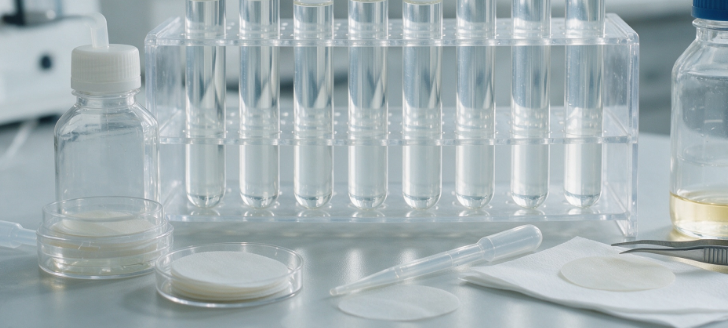
For clear liquids (e.g., drinking water, bottled water, treated effluents), we use 0.45‑µm grid membranes placed on selective media: mEndo agar (for total Coliforms, with typical red colonies with metallic sheen) and mFC agar (for faecal Coliforms, with blue colonies after incubation at 44.5 °C). For simultaneous enumeration of E. coli, we use CHROMagar™ ECC or mTEC agar, which allow differentiation by colour (blue for E. coli, pink for other Coliforms). We provide counts per 100 mL with statistical uncertainty based on Poisson distribution and method detection limits as low as 1 CFU/100 mL for large‑volume filtrations.
2.3 Enzyme‑Substrate Defined Substrate Technology (DST) – Colilert® and Quanti‑Tray®
For high‑throughput and rapid screening, we utilise Colilert® (IDEXX) which simultaneously detects total Coliforms (via β‑galactosidase activity, producing yellow colour from ONPG) and E. coli (via β‑glucuronidase activity, producing fluorescence from MUG). The sample is mixed with the reagent, poured into a Quanti‑Tray or Quanti‑Tray/2000, sealed, and incubated at 35 °C for 18–22 hours. The number of positive wells is converted to an MPN using the provided lookup table, with a range from 1 to > 2,419 MPN/100 mL. This method offers rapid results, reduced labour, and high specificity, and it is ISO 9308‑2 and EPA‑approved. We routinely perform this test for drinking water, swimming pool water, and food rinse samples, with a typical turnaround of 24 hours.
2.4 Molecular and Rapid Alternative – Real‑Time PCR and ATP Bioluminescence
For emergency response or when faster results are required (e.g., in a production halt situation), we offer real‑time PCR (targeting the uidA gene for E. coli and the lacZ or 16S rRNA for total Coliforms) with a detection limit of 1–10 CFU per reaction, providing results in 3‑4 hours after DNA extraction. We also offer ATP bioluminescence for rapid hygiene screening (though not a regulatory method), which can indicate total microbial activity in as little as 30 minutes. All rapid methods are validated against reference culture methods for each specific matrix to ensure correlation and reliability.
3. Advanced Capabilities – Beyond Presence/Absence: Speciation, Viability, and Source Tracking
For clients requiring detailed characterisation, we offer confirmation and speciation using biochemical test panels (e.g., API 20E, VITEK 2) to differentiate E. coli from Klebsiella, Enterobacter, Citrobacter, etc. We also perform viability staining (live/dead – using propidium monoazide coupled with PCR) to distinguish between culturable and viable‑but‑non‑culturable (VBNC) cells, which is essential for evaluating disinfection efficacy. For source tracking, we offer microbial source tracking (MST) using qPCR markers for human‑specific (e.g., HF183) and animal‑specific Bacteroides, which can identify the origin of faecal contamination—a service that goes far beyond routine Coliform enumeration.
4. Quality Assurance, Data Integrity, and Reporting
All analyses are performed under a strict quality management system with daily positive and negative controls, use of certified reference cultures, and participation in international proficiency testing schemes (e.g., ERA, FAPAS, and US EPA Water Microbiology PT). Our reports provide: - Detailed method description (including sample pre‑treatment, incubation conditions, media batch numbers). - Quantitative results with MPN or CFU values and expanded uncertainty (k=2) based on the statistical model used. - Differentiation between total Coliforms, faecal Coliforms, and E. coli. - Comparison with regulatory limits (US EPA, EU, national) and interpretative comments on the possible implications. - Chain‑of‑custody documentation and sample traceability.
Our senior microbiologists provide not just numerical data but also contextual interpretation, advising on the likelihood of a genuine contamination event versus environmental interference, and recommending appropriate corrective actions. We also offer method validation services for novel matrices, helping you to establish robust in‑house testing programmes.
Typical turnaround for the standard defined‑substrate test is 24 hours, for membrane filtration or MTF it is 48‑72 hours, and for PCR it is 4‑6 hours. Express services are available for emergency situations.
5. Our Distinctive Advantages – Why Choose Our Laboratory for Coliform Analysis
We are one of the few laboratories that maintain full accreditation for all major Coliform methods (ISO 17025 for ISO 9308‑1, ISO 9308‑2, EPA 1600, EPA 1603, and Standard Methods 9221, 9222). Our integrated facility houses both classical culture infrastructure and state‑of‑the‑art molecular platforms, enabling method triangulation and rapid cross‑verification of suspicious results. Our team includes PhD‑level microbiologists with expertise in environmental and food microbiology, and we have a proven track record of supporting regulatory audits and legal cases with defensible data.
We offer flexible sample acceptance—from a few millilitres of drinking water to large‑volume surface water or industrial effluents—and we provide customised sampling kits with preservatives and instructions to maintain sample integrity during transit. Our online result portal allows you to access your data in real time, download certificates, and track historical trends.
Our cost‑effective pricing is modular: you can select the method that best suits your needs—presence/absence, MPN quantification, membrane filtration, or molecular screening—with discounts for bulk or routine monitoring programmes. We also offer training and consultancy on method selection, trouble‑shooting, and laboratory setup.
With over 100 clients in water utilities, food production, environmental consulting, and healthcare, we have helped our partners to achieve regulatory compliance, rapidly respond to contamination events, and maintain public confidence. We invite you to experience our analytical excellence for your Coliform testing needs.
Contact our technical team today to discuss your specific sample types, required detection limits, and turnaround expectations. We will design a tailored testing programme and provide a detailed proposal within one business day.