Reasons for choosing our testing services
ZHONGXI Testing has obtained inspection qualification certifications from multiple countries and regions worldwide. We possess a senior testing team and advanced testing methods, providing independent, impartial, and professional third-party verification services for global carbon projects.

Internationally recognized authority
Certified by multiple international standards such as CNAS, VCS, and GS, with reports universally applicable worldwide.

Global service capability
Covering 140+ countries and regions, it supports on-site detection and remote verification in multiple languages.

Professional experimental methods
Adopt standard experimental methods to ensure accurate and reliable data.
Comprehensive Antifungal Testing Services – From Standard Efficacy Screening to Mechanistic Profiling and Advanced Material Evaluation
The reliable and systematic evaluation of Antifungal activity is a critical requirement for a wide range of industries, including pharmaceuticals, medical devices, cosmetics, paints and coatings, textiles, plastics, and food packaging. The ability to prevent the growth and proliferation of moulds, yeasts, and other fungi is essential for product safety, preservation, and performance. Regulatory guidelines, such as ISO 16869 (for plastics), ASTM G21 (for synthetic polymeric materials), ASTM D5590 (for paints), and USP chapters for antimicrobial effectiveness, require that Antifungal efficacy be demonstrated using validated, standardised, and reproducible methods. However, a robust Antifungal testing strategy extends far beyond a simple disc‑diffusion test; it must consider the fungal species of concern, the growth conditions, the duration of the test, the quantification of the effect, and the mechanism of the Antifungal action. Moreover, the increasing incidence of Antifungal resistance and the need to evaluate novel Antifungal compounds, coatings, and materials demand advanced analytical capabilities beyond conventional growth inhibition assays. Our ISO/IEC 17025‑accredited and GMP‑compliant laboratory offers a fully integrated Antifungal testing platform, encompassing a broad portfolio of standardised methods – from the classic agar diffusion and broth dilution (MIC/MFC) assays to the more comprehensive time‑kill kinetics, biofilm eradication studies, and material‑specific tests (e.g., fungal growth on paints, textiles, and plastics). We deliver quantitative, traceable data, including minimum inhibitory concentrations (MICs), minimum fungicidal concentrations (MFCs), zone of inhibition sizes, and fungal growth ratings (according to standard scales). Our expert microbiologists provide detailed interpretation and actionable recommendations, enabling you to validate product efficacy, comply with regulations, and develop high‑quality, fungal‑resistant products.
1. The Scientific and Regulatory Rationale for Rigorous Antifungal Testing
Antifungal testing serves multiple essential purposes: (a) to evaluate the efficacy of Antifungal compounds (e.g., active pharmaceutical ingredients, preservatives, biocides); (b) to determine the MIC and MFC of new drug candidates, which are critical parameters for drug development and for establishing susceptibility profiles; (c) to assess the fungicidal or fungistatic nature of a product; (d) to verify the resistance profile of fungal strains; (e) to determine the Antifungal activity of materials (coatings, textiles, polymers) and to ensure that they meet the required standards for their intended use; and (f) to support regulatory submissions for product registration. The choice of the method – whether agar diffusion (disc or well), broth macrodilution or microdilution (for MIC/MFC), time‑kill kinetics, or specific material testing (e.g., fungal growth on surfaces, zone of inhibition around the material) – must be guided by the nature of the test article (soluble compound, extract, coating, or solid material), the fungal species of concern, and the required sensitivity and throughput. A poorly designed test can lead to misclassification of susceptibility, underestimation of the Antifungal activity, or failure to detect resistance. Our service begins with a comprehensive consultation to define the optimal Antifungal testing strategy, ensuring that the data are scientifically robust and compliant with the relevant standards.
2. Our Comprehensive Antifungal Testing Platform – Standardised Methods and Advanced Analytics
We maintain a complete suite of validated Antifungal test methods, all performed in a dedicated mycology facility with stringent quality controls, and using certified reference fungal strains (e.g., Candida albicans ATCC 10231, Aspergillus brasiliensis ATCC 16404, Penicillium chrysogenum ATCC 10106, and Trichoderma virens ATCC 9645) for method validation. Our portfolio includes:
2.1 Minimum Inhibitory Concentration (MIC) and Minimum Fungicidal Concentration (MFC) – Broth Microdilution (CLSI M27, M38)
We perform the gold‑standard broth microdilution method in 96‑well microtiter plates, using the appropriate medium (e.g., RPMI‑1640 for yeasts, or RPMI‑1640 with MOPS for moulds). A standardised inoculum (0.5‑2.5×10³ CFU/mL for yeasts, or 0.4‑5×10⁴ CFU/mL for moulds) is added to wells containing a two‑fold dilution series of the Antifungal agent. After incubation (24‑48 hours for yeasts, 48‑72 hours for moulds), the MIC is read as the lowest concentration that inhibits visible growth. To determine the MFC, we sub‑culture the wells showing no growth onto Sabouraud dextrose agar, and the MFC is defined as the lowest concentration that yields no growth (≥ 99.9% killing). We provide the MIC and MFC values in μg/mL, with a clear interpretation of the fungicidal vs. fungistatic nature.
2.2 Agar Diffusion (Disc and Well) Assays – Qualitative and Semi‑Quantitative Screening
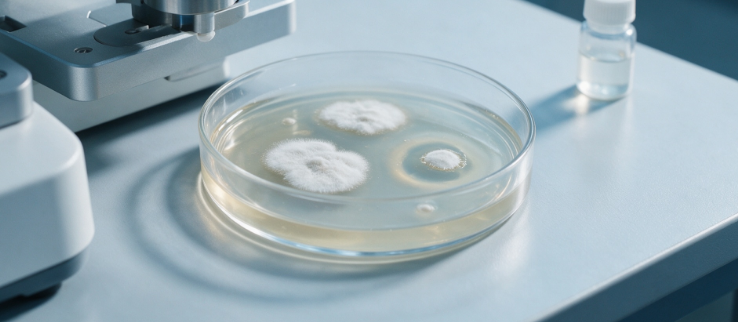
We use the disc diffusion method (Kirby‑Bauer for Antifungals) and the well diffusion method for a rapid, qualitative assessment of Antifungal activity. A lawn of the test fungus is inoculated onto agar plates, and paper discs or wells containing the Antifungal agent are placed on the surface. After incubation, the zone of inhibition is measured. We provide the zone diameter (mm) and a semi‑quantitative interpretation (susceptible, intermediate, or resistant) based on the relevant standard (e.g., CLSI M44 for yeasts).
2.3 Time‑Kill Kinetics – Rate and Extent of Fungicidal Activity
We perform time‑kill kinetics to characterise the rate and time‑course of the fungicidal activity. The fungus is exposed to multiple concentrations of the Antifungal (e.g., 0.5×, 1×, 2×, 4× MIC), and samples are taken at defined time points (0, 1, 2, 4, 6, 12, and 24 hours). The samples are plated onto Sabouraud dextrose agar, and the surviving colonies are counted. From this, we construct kill‑curves and calculate the rate of killing, the regrowth time, and the post‑Antifungal effect (PAFE). This method is essential for evaluating the pharmacodynamic profile of new Antifungal agents.
2.4 Biofilm Antifungal Susceptibility – MBEC and MBIC for Biofilm‑Embedded Cells
For infections associated with biofilm formation, we perform minimum biofilm eradication concentration (MBEC) and minimum biofilm inhibitory concentration (MBIC) assays using the Calgary biofilm device or a microtiter plate‑based model. We assess the Antifungal activity against sessile (biofilm) cells, which may show significantly higher tolerance compared to planktonic cells. We provide the MBEC and MBIC values and, if required, the biofilm eradication kinetics.
2.5 Antifungal Susceptibility Testing of Moulds (Filamentous Fungi) – CLSI M38
We specialise in the Antifungal susceptibility testing of moulds, including Aspergillus, Penicillium, Fusarium, and Mucorales, using the CLSI M38 reference method. We use RPMI‑1640 with MOPS, a standardised inoculum (0.4‑5×10⁴ CFU/mL), and a 48‑72 hour incubation. We determine the MIC, and, where appropriate, the minimum effective concentration (MEC) for moulds (based on the detection of morphological changes).
2.6 Material‑Specific Antifungal Testing – ISO 16869, ASTM G21, ASTM D5590, and Others
We provide specialised testing for the evaluation of Antifungal activity in materials, coatings, textiles, and polymers. We follow the relevant standard methods, including: - ISO 16869 – Determination of the resistance of plastics to fungal growth. - ASTM G21 – Standard practice for determining resistance of synthetic polymeric materials to fungi. - ASTM D5590 – Standard test method for determining the resistance of paint films and related coatings to fungal defacement by accelerated four‑week agar plate assay. - ISO 20743 – Antibacterial and Antifungal activity of textile products. We incubate the test specimens with a defined fungal inoculum under controlled conditions and then assess the fungal growth using a rating scale (e.g., 0‑4, where 0 = no growth and 4 = heavy growth) or by quantifying the fungal biomass (e.g., by ATP or ergosterol measurement).
2.7 Combination and Synergy Studies – Checkerboard and Time‑Kill Combination Assays
We evaluate the synergy, additivity, or antagonism of two Antifungal agents using the checkerboard method, where a two‑dimensional dilution of the two agents is performed, and the fractional inhibitory concentration index (FICI) is calculated. We also perform combination time‑kill assays to confirm the synergy findings. This service is essential for the development of combination therapies.
3. Advanced Capabilities – Mechanistic Deep‑Dive, Resistance Profiling, and Custom Model Development
For clients requiring a deeper understanding of the Antifungal activity or a high‑level validation of their product, we offer a suite of customised, research‑grade services that go beyond routine testing:
3.1 Fungal Resistance Profiling – Phenotypic and Genotypic Characterisation
We perform Antifungal susceptibility testing on a panel of fungal isolates (including clinical, environmental, and reference strains) to determine the species‑specific susceptibility profile. In case of high MICs, we perform genotypic resistance detection by sequencing the target genes (e.g., ERG11 for azole resistance, FKS1 for echinocandin resistance) to identify specific mutations and to distinguish between acquired and intrinsic resistance.
3.2 Mechanism of Action Studies – Microscopy and Flow Cytometry
We use fluorescence microscopy (with viability dyes, such as SYTO9/PI, or with specific membrane probes) and flow cytometry to assess the mechanism of action of an Antifungal agent (e.g., membrane disruption, metabolic inhibition, or induction of apoptosis). We provide a detailed description of the morphological changes and the loss of viability.
3.3 Custom Antifungal Panel Design – For Novel Antifungals and Combination Assays
We can develop and validate custom Antifungal panels for novel compounds, including the determination of the MIC, MFC, and time‑kill kinetics. We can also design combination studies to evaluate the effect of novel agents in combination with existing drugs.
3.4 Long‑Term Stability and Accelerated Ageing Testing
We assess the long‑term stability of the Antifungal activity of materials and formulations by testing the Antifungal efficacy before and after exposure to accelerated ageing conditions (e.g., elevated temperature, humidity, and UV radiation). This is critical for product qualification and for establishing shelf‑life.
3.5 Method Validation and Regulatory Submission Support
We provide full method validation for your Antifungal test, including the demonstration of: (a) specificity (no interference from the test article); (b) linearity (for MIC/MFC); (c) accuracy (by comparing the results with a reference method); (d) precision (intra‑ and inter‑assay); (e) robustness to variations in inoculum and incubation conditions; and (f) limit of detection. The validation report is structured to meet the requirements of the FDA, EMA, or other regulatory agencies.
4. Data Integrity, Standardisation, and Comprehensive Reporting
All assays are conducted under a strict quality management system that includes the use of certified reference strains, routine controls, and participation in proficiency testing schemes (e.g., UK NEQAS for mycology). Our reports provide:
- Full method description – detailing the fungal species, the inoculum preparation, the test medium, the incubation conditions, and the endpoint reading.
- Detailed results – including the MIC, MFC, zone of inhibition, fungal growth rating, or specific kill‑curve data, with the relevant statistical uncertainty (expanded uncertainty at k=2).
- Quality control data – the results of the concurrent QC strains, confirming the validity of the test run.
- Graphical outputs – including kill‑curves, dose‑response curves, and microscopy images, if required.
- Interpretative comments – on the susceptibility or resistance, the clinical significance, and the recommendations for further testing.
Our reports are authored by senior clinical mycologists and pharmacologists who provide not just raw data, but contextual insights to guide your clinical, research, or regulatory decisions.
Turnaround times: 2‑3 days for MIC determination, 3‑5 days for MFC and time‑kill kinetics, and 1‑2 weeks for material‑specific testing. Express services are available for urgent projects.
5. Our Unmatched Expertise – Why Choose Our Laboratory for Antifungal Testing
We are one of the few laboratories that hold ISO/IEC 17025 accreditation and GMP compliance for the full spectrum of Antifungal test methods, including CLSI M27, M38, and M44, as well as ISO 16869, ASTM G21, and ASTM D5590. Our integrated infrastructure combines a state‑of‑the‑art mycology laboratory, a molecular diagnostics unit, and a material testing facility – enabling cross‑verification of results and a comprehensive understanding of the Antifungal activity. Our team comprises PhD‑level clinical mycologists, pharmacologists, and material scientists with extensive experience in method development, validation, and regulatory submissions, and we have a proven track record of supporting product development and regulatory approvals.
We offer unparalleled flexibility: we accept a wide range of test articles – soluble compounds, extracts, formulations, coatings, textiles, plastics, and other materials – and we provide customised testing protocols to meet your specific regulatory requirements. Our secure online portal enables real‑time tracking, access to raw data, and downloadable certificates of analysis.
Our modular pricing ensures cost‑effectiveness: you select the level of analysis – from a simple MIC determination to a full time‑kill plus material testing and mechanism study – with discounts for routine monitoring programmes and bulk submissions. We also provide training, method transfer, and technical consultancy to help you build or strengthen your internal Antifungal testing capabilities.
With a proven history of serving over 80 clients in the pharmaceutical, medical device, paint, textile, and polymer sectors, we have enabled our partners to achieve regulatory compliance, prevent fungal contamination, and improve product performance. We invite you to leverage our expertise for your Antifungal testing needs.
Contact our technical experts today to discuss your test articles, fungal species of concern, and specific requirements. We will design a tailored testing plan and provide a detailed proposal within one business day.