Reasons for choosing our testing services
ZHONGXI Testing has obtained inspection qualification certifications from multiple countries and regions worldwide. We possess a senior testing team and advanced testing methods, providing independent, impartial, and professional third-party verification services for global carbon projects.

Internationally recognized authority
Certified by multiple international standards such as CNAS, VCS, and GS, with reports universally applicable worldwide.

Global service capability
Covering 140+ countries and regions, it supports on-site detection and remote verification in multiple languages.

Professional experimental methods
Adopt standard experimental methods to ensure accurate and reliable data.
Comprehensive Foodborne Pathogen Detection Services – From Conventional Culture to Advanced Molecular Identification and Genomic Surveillance
The reliable and rapid detection of foodborne pathogens is a fundamental pillar of public health protection, food safety management, and regulatory compliance across the global food supply chain. Pathogens such as Salmonella, Listeria monocytogenes, Escherichia coli (including STEC), Campylobacter, Vibrio, Clostridium perfringens, and Bacillus cereus are responsible for millions of cases of foodborne illness annually, with significant economic and healthcare burdens. Consequently, regulatory frameworks – including those of the FDA, USDA‑FSIS, EFSA, Codex Alimentarius, and national food safety authorities – mandate rigorous testing for these organisms in a wide range of food matrices, from raw materials and ingredients to finished products and environmental samples. However, a successful foodborne pathogen testing strategy is not defined by a single method; it requires a carefully orchestrated, multi‑tiered approach that integrates sample preparation, pre‑enrichment and selective enrichment, isolation on differential and chromogenic media, biochemical and immunological confirmation, and, increasingly, rapid molecular and genomic methods. Traditional culture‑based methods, while still the gold standard for regulatory compliance, are time‑consuming and may fail to detect stressed or injured cells. Advanced molecular techniques, such as real‑time PCR (qPCR), droplet digital PCR (ddPCR), whole‑genome sequencing (WGS), and metagenomics, offer enhanced sensitivity, faster turnaround, and the ability to differentiate between strains, track outbreaks, and detect virulence and antibiotic resistance genes. Our ISO/IEC 17025‑accredited and GMP‑compliant laboratory offers a fully integrated foodborne pathogen detection platform, encompassing the complete spectrum of classical and rapid methods. We deliver quantitative and qualitative results, strain‑level identification, and comprehensive interpretative reports, including source‑tracking and risk assessment. Our expert food microbiologists provide actionable recommendations, enabling you to ensure product safety, comply with regulations, and protect your brand reputation.
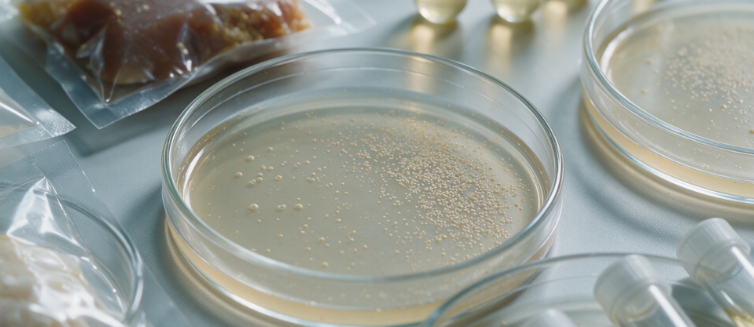
1. The Scientific and Regulatory Imperative for Foodborne Pathogen Testing
Foodborne pathogen testing serves multiple critical purposes: (a) to verify the microbiological safety of raw materials, ingredients, and finished products; (b) to validate the effectiveness of food processing and preservation steps (e.g., pasteurisation, cooking, irradiation); (c) to assess the hygienic status of food production environments through environmental monitoring; (d) to support outbreak investigations and root‑cause analysis; (e) to meet the zero‑tolerance or low‑level requirements for specific pathogens (e.g., L. monocytogenes in ready‑to‑eat foods); and (f) to ensure compliance with export and import regulations. The choice of analytical approach – whether conventional culture (ISO, FDA‑BAM, USDA‑MLG), immunomagnetic separation (IMS)‑based methods, enzyme‑linked immunoassays (ELISA), or nucleic acid amplification (PCR, qPCR) – must be tailored to the matrix (e.g., high‑fat, low‑water‑activity, or processed foods), the pathogen of interest, the required detection limit, and the urgency of the result. A poorly chosen or executed method can lead to false negatives, false positives, or incorrect enumeration, with severe consequences for public health and business operations. Our service begins with a comprehensive consultation to define the optimal testing strategy for your product, process, and regulatory jurisdiction, ensuring both scientific rigour and operational efficiency.
2. Our Comprehensive Foodborne Pathogen Testing Platform – Classical and Rapid Methods
We maintain a complete suite of validated foodborne pathogen detection and enumeration methods, all performed in a dedicated food microbiology laboratory with stringent quality controls, and using certified reference cultures (e.g., ATCC or NCTC strains) for method validation and daily quality assurance. Our portfolio includes:
2.1 Conventional Culture‑Based Methods – ISO, FDA‑BAM, and USDA‑MLG Protocols
We perform the gold‑standard culture methods for the isolation and identification of major foodborne pathogens. Our protocols include: (a) pre‑enrichment in non‑selective broth (e.g., Buffered Peptone Water) to resuscitate injured cells; (b) selective enrichment in media such as Rappaport‑Vassiliadis (for Salmonella), Fraser or Half‑Fraser broth (for Listeria), or modified tryptone soy broth (for E. coli); (c) plating on selective and differential agars (e.g., XLD, BGA, Chromogenic Listeria agar, MacConkey, CHROMagar™ ECC) to isolate presumptive colonies; and (d) biochemical and serological confirmation using API, VITEK, MALDI‑TOF MS, or specific antisera. We report the presence or absence in a defined sample weight (e.g., 25 g), or, for quantitative assays, the count (CFU/g or CFU/mL) with full statistical uncertainty. All methods are compliant with the relevant ISO, FDA, and USDA standards.
2.2 Immunomagnetic Separation (IMS) and Enzyme‑Linked Immunoassays (ELISA)
For rapid screening of large numbers of samples, we use IMS to concentrate target pathogens from complex matrices, followed by ELISA (with specific antibodies) or lateral flow devices for qualitative or semi‑quantitative detection. These methods provide results within 18‑24 hours and are particularly useful for high‑throughput monitoring and for detecting pathogens in processed foods where culturability may be impaired.
2.3 Real‑Time Polymerase Chain Reaction (qPCR) – Rapid Molecular Detection and Quantification
We perform validated qPCR assays targeting species‑specific genes (e.g., invA for Salmonella, hly for Listeria, stx and eae for STEC, mapA for Campylobacter). Our assays include an internal amplification control (IAC) to monitor inhibition and are calibrated using standard curves or by using the ΔΔCt method for relative quantification. We offer both qualitative (presence/absence) and quantitative (genomic copies per gram) results, with a detection limit as low as ≤ 10 CFU per reaction. We also apply PMA‑qPCR to selectively amplify DNA from viable cells, reducing false positives from dead cells, which is critical for evaluating the efficacy of antimicrobial treatments.
2.4 Droplet Digital PCR (ddPCR) – Absolute Quantification Without a Standard Curve
For precise enumeration of pathogen DNA in challenging matrices (e.g., where inhibitors are present or where absolute copy numbers are required), we offer ddPCR. This method partitions the sample into thousands of droplets, providing an absolute count of target copies without the need for a standard curve, with superior precision at low concentrations. It is particularly valuable for low‑level contamination detection and for validation studies.
2.5 Whole‑Genome Sequencing (WGS) and Metagenomic Analysis – High‑Resolution Typing and Source Tracking
We provide WGS of isolated pathogens for high‑resolution subtyping, including core‑genome MLST (cgMLST), single‑nucleotide polymorphism (SNP) analysis, and resistome and virulome profiling. This enables precise identification of strain relatedness, links to outbreak clusters, and detection of antimicrobial resistance genes. For complex samples (e.g., mixed cultures, environmental swabs), we also offer shotgun metagenomic sequencing to identify all pathogens and their associated resistance markers in a single run, providing a comprehensive microbial risk profile.
2.6 Multiplex and Panel‑Based Detection – Simultaneous Screening for Multiple Pathogens
We use multiplex qPCR and commercial multiplex assay systems (e.g., Bio‑Fire, SureTect, or QIAstat‑Dx) to screen for up to 10‑20 foodborne pathogens in a single reaction, including combinations of bacteria, viruses, and parasites. This is particularly cost‑effective and time‑efficient for routine monitoring and for initial risk screening.
2.7 Environmental Monitoring – Swab, Air, and Surface Testing
We provide dedicated testing for environmental samples from food production facilities (e.g., floors, drains, conveyors, air handling systems). We use specialised swabs, contact plates, and air samplers to collect samples, and we apply both culture and molecular methods to detect pathogen presence and to assess the overall hygiene status, supporting your HACCP and environmental monitoring programmes.
3. Advanced Capabilities – Mechanistic Insight, Resistance Profiling, and Custom Assay Development
For clients requiring a deeper level of characterisation or a high‑level validation of their testing programme, we offer a suite of customised, research‑grade services that go beyond routine detection:
3.1 Quantitative Pathogen Risk Assessment – Combining Detection with Exposure Modelling
We integrate the pathogen detection data with product and process parameters to provide a quantitative microbiological risk assessment (QMRA). This includes dose‑response modelling, prevalence estimation, and the calculation of the probability of illness per serving, providing a robust scientific basis for food safety decisions.
3.2 Antimicrobial Resistance (AMR) Profiling – Phenotypic and Genotypic Analysis
We determine the minimum inhibitory concentrations (MICs) of isolated pathogens against a panel of clinically relevant antibiotics, following CLSI and EUCAST guidelines. We also perform whole‑genome sequencing to identify the full resistome, including the detection of plasmid‑mediated resistance genes, providing comprehensive data for AMR surveillance and risk assessment.
3.3 Virulence Gene Profiling – Pathogenicity and Severity Assessment
We screen for virulence markers such as Shiga toxins, intimin, invasion proteins, and enterotoxins using PCR or WGS. This enables the differentiation between pathogenic and non‑pathogenic strains and provides a refined risk assessment for specific isolates.
3.4 Strain Typing for Source Tracking – PFGE, MLVA, and WGS‑Based Approaches
We provide high‑resolution typing of isolated pathogens using Pulsed‑Field Gel Electrophoresis (PFGE), Multi‑Locus Variable‑number Tandem‑repeat Analysis (MLVA), and WGS‑based cgMLST. These methods are essential for linking clinical cases to food products, for tracing contamination back to the source, and for confirming the equivalence of strains in comparator studies.
3.5 Custom Method Development and Validation – For Novel Matrices and Target Organisms
We design and validate custom detection methods for pathogens that are not covered by standard protocols, or for matrices that are known to be difficult (e.g., spices, chocolate, processed meat, highly acidic foods). We provide a full validation report according to AOAC, ISO, or ICH Q2 guidelines, ensuring that the method is fit‑for‑purpose and defensible for regulatory submission.
3.6 Shelf‑Life Studies and Challenge Testing – Assessing Pathogen Growth Potential
We conduct challenge tests by inoculating a known concentration of a pathogen into the product and monitoring its growth (or decline) under defined storage conditions. This provides essential data for determining product shelf‑life and for verifying the effectiveness of the preservation system.
4. Data Integrity, Standardisation, and Comprehensive Reporting
All analyses are conducted under a strict quality management system that includes the use of certified reference cultures, routine positive and negative controls, and participation in proficiency testing schemes (e.g., FAPAS, APHL). Our reports provide:
- Full method description – detailing the sample preparation, enrichment protocols, media used, incubation conditions, and the endpoint measurement.
- Detailed results – including the detection status (presence/absence) with the relevant sample weight, the quantitative count (CFU/g or CFU/mL) where applicable, and the statistical uncertainty (expanded uncertainty at k=2).
- Molecular and genomic data – if performed, including the Ct values, copy numbers, serotypes, sequence types, and the presence of virulence and resistance genes.
- Quality control data – the results of the concurrent controls, confirming the validity of the test run.
- Interpretative comments – by our senior food microbiologists, including an assessment of the public health significance, the likely source of contamination, and recommended corrective actions.
Our reports are structured to meet the requirements of regulatory audits, customer inspections, and internal quality assurance.
Turnaround times: 3‑5 working days for conventional culture‑based methods, 24‑48 hours for qPCR screening, and 2‑3 weeks for WGS and advanced characterisation. Express services are available for urgent cases.
5. Why Choose Our Laboratory for Foodborne Pathogen Detection
We are one of the few laboratories that hold ISO/IEC 17025 accreditation and GMP compliance for the full spectrum of foodborne pathogen detection methods, including both conventional and molecular techniques, for a wide range of food matrices. Our integrated infrastructure combines a state‑of‑the‑art microbiology laboratory, a molecular biology unit, a sequencing facility, and a bioinformatics core – enabling cross‑verification of results and a comprehensive understanding of the pathogen profile. Our team comprises PhD‑level food microbiologists, molecular biologists, bioinformaticians, and food safety experts with extensive experience in method development, validation, and regulatory submissions, and we have a proven track record of supporting food producers, retailers, and regulatory bodies.
We offer unparalleled flexibility: we accept all types of food, feed, and environmental samples, and we provide customised sampling kits with preservatives and clear instructions to maintain sample integrity. Our secure online portal enables real‑time tracking, access to raw data, and downloadable certificates of analysis.
Our modular pricing ensures cost‑effectiveness: you select the level of analysis – from a simple screening to a full genomic characterisation – with discounts for routine monitoring programmes and bulk submissions. We also provide training, method transfer, and technical consultancy to help you build or strengthen your internal food safety testing capabilities.
With a proven history of serving over 150 clients in the food, beverage, and feed industries, we have enabled our partners to ensure product safety, achieve regulatory compliance, and protect consumer health. We invite you to leverage our expertise for your foodborne pathogen detection needs.
Contact our technical experts today to discuss your products, target pathogens, and regulatory requirements. We will design a tailored testing plan and provide a detailed proposal within one business day.
```