Reasons for choosing our testing services
ZHONGXI Testing has obtained inspection qualification certifications from multiple countries and regions worldwide. We possess a senior testing team and advanced testing methods, providing independent, impartial, and professional third-party verification services for global carbon projects.

Internationally recognized authority
Certified by multiple international standards such as CNAS, VCS, and GS, with reports universally applicable worldwide.

Global service capability
Covering 140+ countries and regions, it supports on-site detection and remote verification in multiple languages.

Professional experimental methods
Adopt standard experimental methods to ensure accurate and reliable data.
Comprehensive Moisture Heat (Steam) Sterilisation Validation Services – Full‑Cycle Qualification, D‑Value Determination, and Regulatory‑Ready Process Assurance
The validation of moisture heat (steam) sterilisation is a fundamental requirement for the assurance of Sterility in pharmaceutical manufacturing, medical device production, and healthcare sterilisation practices. Steam sterilisation, typically performed in autoclaves using saturated steam under pressure, is one of the most reliable and widely used methods for inactivating microbial life, including the most resistant bacterial spores. Regulatory authorities – including the FDA, EMA, ISO (17665, 11138), USP, and EP – mandate that steam sterilisation processes be validated to demonstrate that they consistently achieve the required Sterility assurance level (SAL), typically 10⁻⁶. A robust validation study is not merely a cycle run; it involves a comprehensive, multi‑phase approach that integrates process design and characterisation, physical and biological qualification, and ongoing performance monitoring. A poorly designed or executed validation can lead to inadequate sterilisation, non‑compliant products, and severe regulatory repercussions. Our ISO/IEC 17025‑accredited and GMP‑compliant laboratory offers a fully integrated steam sterilisation validation platform, encompassing the entire spectrum from D‑value determination of biological indicators (BIs) and heat distribution studies to full‑scale cycle development, performance qualification (PQ), and routine monitoring. We utilise a wide range of validated biological indicators (including Geobacillus stearothermophilus), high‑precision temperature and pressure data loggers, and advanced statistical analysis tools. Our expert team of sterilisation scientists and microbiologists provides comprehensive study design, flawless execution, and clear, defensible reports, enabling you to validate your steam sterilisation processes, meet the most stringent regulatory requirements, and ensure the highest level of product and patient safety.
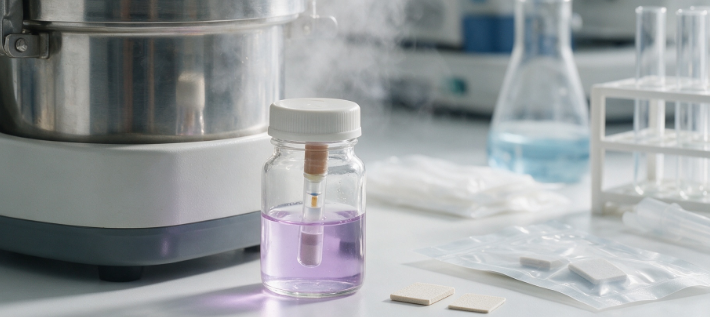
1. The Scientific and Regulatory Rationale for Moisture Heat Sterilisation Validation
Steam sterilisation validation serves multiple essential purposes: (a) to demonstrate that the sterilisation cycle consistently delivers the required lethal effect to all parts of the load, including the most difficult‑to‑reach areas; (b) to determine the cycle parameters (temperature, pressure, time) that are necessary to achieve the desired SAL; (c) to establish the worst‑case conditions (e.g., minimum temperature, shortest exposure time, maximum load size) that still result in a validated cycle; (d) to support regulatory submissions by providing quantitative, traceable efficacy data; (e) to justify the routine use of the cycle and the associated process parameters; and (f) to monitor the ongoing consistency of the sterilisation process through routine re‑validation and performance qualification. The validation must be performed using a combination of physical (temperature, pressure) and biological (biological indicator) measurements, and it must account for the specific product, packaging, and load configuration. The standard biological indicator for steam sterilisation is Geobacillus stearothermophilus (ATCC 7953), which has a high resistance to moist heat (D‑value of approximately 1.5‑3.0 minutes at 121 °C). Our service begins with a comprehensive consultation to define the optimal validation strategy, including the selection of appropriate BIs, the determination of the cycle parameters, and the design of the qualification studies, ensuring both scientific rigor and regulatory compliance.
2. Our Comprehensive Moisture Heat Sterilisation Validation Platform – From D‑Value Determination to Full Cycle Qualification
We maintain a complete, validated workflow for steam sterilisation validation, all performed in a dedicated resistance‑testing and autoclave facility with stringent quality controls. Our portfolio includes:
2.1 Biological Indicator (BI) D‑Value Determination – Establishing the Resistance Baseline
We determine the D‑value (decimal reduction time) of the biological indicator under the specific conditions of your process (temperature, pressure, and steam quality). We use the survivor curve method or the fractional negative (Spearman‑Karber) method to accurately calculate the D‑value, which is essential for establishing the required exposure time and for validating the cycle’s lethality. We provide the D‑value with a 95% confidence interval and a full survivor curve.
2.2 Heat Distribution and Penetration Studies – Physical Qualification (PQ)
We perform heat distribution studies to map the temperature profile throughout the empty sterilisation chamber, identifying the coldest and hottest zones (using calibrated temperature sensors). We then perform heat penetration studies with the actual product load (or a representative surrogate) to determine the temperature profile inside the product (or package), accounting for the heat‑up time and the thermal lag. We use a sufficient number of sensors (typically ≥ 10‑20) to cover all critical locations, and we record the temperature data at high frequency. We analyse the data to identify the slowest‑to‑heat location (the “coldest spot”), which is the critical point for ensuring Sterility.
2.3 Cycle Development and Optimisation – Determining the Minimum Effective Exposure
Based on the D‑value of the BI and the heat penetration data, we develop and optimise the sterilisation cycle. We establish the minimum exposure time required to achieve the target SAL (e.g., 10⁻⁶) at the coldest spot, using the formula: exposure time = D‑value × (log₁₀ initial Bioburden + 6). We also determine the safe operating window (minimum and maximum temperatures and pressures) to ensure robustness. We test multiple cycles to confirm the reproducibility and to define the worst‑case conditions.
2.4 Biological Qualification – BI Challenge and Lethality Demonstration
We perform biological qualification using biological indicators (BIs) with a defined population (typically 10⁵‑10⁶ CFU) placed at the coldest locations (identified during the heat penetration study). We run the sterilisation cycle (under the specified conditions) and then recover the BIs and perform Sterility testing to confirm the absence of viable organisms. We include positive and negative controls to validate the test. A successful run (all BIs negative) demonstrates that the cycle achieves the required SAL.
2.5 Performance Qualification (PQ) – Full‑Scale Validation with Product Load
We perform the performance qualification (PQ) using the actual product, packaging, and load configuration, under the worst‑case conditions (e.g., minimum temperature, maximum load, and shortest exposure time). We run three consecutive successful cycles (or more, as required) with both physical and biological monitoring (BIs at all critical locations) to confirm the reproducibility and robustness of the process. We also include the relevant release tests (e.g., product Sterility, stability, and integrity).
2.6 Quality Assurance and Integrity Testing – Pre‑ and Post‑Cycle Checks
We perform pre‑cycle checks (e.g., chamber integrity, steam quality, and filter integrity) and post‑cycle checks (e.g., chamber integrity, load drying, and package integrity) to ensure the overall process reliability. We also document all parameters, deviations, and corrective actions.
2.7 Re‑validation and Routine Monitoring – Ongoing Process Assurance
We provide re‑validation services following any significant change to the process, the product, or the packaging, and we support routine performance monitoring by re‑qualifying the cycle at defined intervals (typically annually). We also provide trend analysis and statistical process control for the critical parameters (temperature, pressure, and exposure time).
3. Advanced Capabilities – Complex Loads, Combination Products, and Customised Studies
For clients requiring specialised validation studies, we offer a suite of customised, research‑grade services that go beyond the standard validation package:
3.1 Validation of Complex Loads – Mixed Products, Porous Loads, and Liquid Loads
We have extensive experience in validating steam sterilisation cycles for complex load configurations, including mixed loads (combining different products), porous loads (textiles, filters, and other materials), and liquid loads (ampoules, vials, and bags). We adapt the sensor placement and the validation protocol to account for the unique heat‑up and cooling characteristics of each load type, ensuring that the coldest spot is correctly identified and challenged.
3.2 Validation of New and Emerging Technologies – Flash Sterilisation, Continuous Sterilisation, and Low‑Temperature Steam
We validate novel steam sterilisation technologies, including flash sterilisation (short‑exposure), continuous sterilisation (in‑line autoclaves), and low‑temperature steam (with formaldehyde or other additives). We design custom validation protocols that address the specific critical parameters of these processes.
3.3 Integration of Computational Modelling – Predictive Lethality Calculations
We use mathematical modelling (e.g., finite element analysis, or Z‑value based lethality calculations) to predict the sterilisation efficacy under different conditions and to support the design of the validation study. This is particularly useful for scaling up or for adapting the process to new products.
3.4 Biological Indicator (BI) Preparation and Customisation – Using Your Own Bioburden Isolates
We can prepare custom BIs from the most resistant isolates found in your product’s Bioburden, providing the highest level of relevance for the validation. We characterise the D‑value of these isolates under your process conditions and use them in the validation run.
3.5 Validation for Sterilisation of Medical Devices and Combination Products
We specialise in the validation of steam sterilisation for medical devices and combination products (drug‑device combinations), including the assessment of material compatibility, packaging integrity, and the effect of the sterilisation process on the drug component.
3.6 Support for Regulatory Submissions – Complete Documentation Package
We provide a comprehensive validation report that includes the full study protocol, the physical and biological data, the statistical analysis, and a clear conclusion on the validated cycle parameters. Our reports are structured to meet the expectations of the FDA, EMA, and other regulatory agencies, and we can provide the necessary support for responding to regulatory queries.
4. Data Integrity, Standardisation, and Comprehensive Reporting
All studies are conducted under a strict quality management system that includes the use of certified reference cultures, calibrated sensors, and participation in proficiency testing schemes (where available). Our reports provide:
- Full study protocol – detailing the product, the load configuration, the autoclave, the BIs, the sensors, and the acceptance criteria.
- Detailed results – including the temperature and pressure profiles (with summary statistics), the D‑value determination, the BI recovery results, and the overall pass/fail determination.
- Quality control data – the results of the concurrent controls, confirming the validity of the study.
- Graphical outputs – including temperature contour maps, time‑temperature profiles, and a summary of the worst‑case locations.
- Interpretative comments – by our senior sterilisation scientists, providing an assessment of the process robustness, the safety margin, the critical process parameters, and any recommendations for routine monitoring and re‑validation.
Our reports are structured to meet the requirements of regulatory audits and to facilitate a smooth review process. All data are stored in a secure, auditable environment.
Turnaround times: 4‑6 weeks for a standard validation study (including D‑value determination, heat distribution, and PQ), 2‑3 weeks for a screening study, and 6‑8 weeks for complex studies (e.g., mixed loads, custom BIs). Expedited services are available for urgent regulatory submissions.
5. Why Choose Our Laboratory for Moisture Heat Sterilisation Validation
We are one of the few laboratories that hold ISO/IEC 17025 accreditation and GMP compliance for steam sterilisation validation, covering the full range of autoclave types and load configurations. Our integrated infrastructure combines state‑of‑the‑art resistometry, high‑precision data logging, and dedicated microbiological facilities – enabling cross‑verification of results and a comprehensive, fully defensible validation package. Our team comprises PhD‑level sterilisation scientists, microbiologists, and regulatory specialists with extensive experience in study design, execution, and the interpretation of steam sterilisation data, and we have supported more than 60 successful product registrations across the globe.
We offer unparalleled flexibility: we work with all types of products (pharmaceuticals, medical devices, biological products, and combinations) and all types of load configurations – and we can adapt to your specific autoclave, product, and regulatory requirements. Our secure online portal enables real‑time tracking, access to raw data, and downloadable reports.
Our modular pricing ensures cost‑effectiveness: you select the level of analysis – from a simple D‑value determination to a full, multi‑cycle validation package – with discounts for long‑term partnerships and multiple product validation programmes. We also provide training, method transfer, and technical consultancy to help you build or strengthen your internal sterilisation validation capabilities.
With a proven history of serving over 90 clients in the pharmaceutical, medical device, and healthcare sectors, we have enabled our partners to achieve regulatory compliance, ensure product Sterility, and maintain market access. We invite you to leverage our expertise for your moisture heat sterilisation validation needs.
Contact our technical experts today to discuss your product, your autoclave, and your specific regulatory requirements. We will design a tailored validation plan and provide a detailed proposal within one business day.