Reasons for choosing our testing services
ZHONGXI Testing has obtained inspection qualification certifications from multiple countries and regions worldwide. We possess a senior testing team and advanced testing methods, providing independent, impartial, and professional third-party verification services for global carbon projects.

Internationally recognized authority
Certified by multiple international standards such as CNAS, VCS, and GS, with reports universally applicable worldwide.

Global service capability
Covering 140+ countries and regions, it supports on-site detection and remote verification in multiple languages.

Professional experimental methods
Adopt standard experimental methods to ensure accurate and reliable data.
Comprehensive Disinfectant Residue Testing Services – Advanced Analytical Solutions for Surface, Water, and Product Residue Detection
The reliable detection and quantification of disinfectant residues is an essential quality control and safety assurance measure across pharmaceutical, healthcare, food processing, and industrial manufacturing environments. While disinfectants are critical for microbial control, their residues can pose significant risks to product quality, patient safety, and equipment integrity. Regulatory bodies, including FDA, EMA, USP, and ISO, require that cleaning validation programmes include thorough testing for residual disinfectants to ensure that they are effectively removed from surfaces, equipment, and water systems. A robust disinfectant residue testing strategy is not a simple “presence/absence” screen; it demands a sophisticated, multi‑method analytical approach that integrates high‑performance liquid chromatography (HPLC), liquid chromatography‑tandem mass spectrometry (LC‑MS/MS), gas chromatography‑mass spectrometry (GC‑MS), and validated sample preparation techniques to detect and quantify a wide range of active ingredients – including quaternary ammonium compounds, phenolics, chlorine‑based agents, peroxides, aldehydes, and alcohols – at trace levels (typically µg/L or µg/cm²). A poorly designed testing protocol can lead to false‑negative results, under‑estimation of residue levels, and non‑compliance with regulatory limits, compromising product safety and increasing the risk of recalls. Our ISO/IEC 17025‑accredited and GMP‑compliant laboratory offers a fully integrated disinfectant residue testing platform, covering the entire spectrum from sample collection (swab, rinse, or direct surface extraction) and method development to quantitative analysis, data interpretation, and regulatory reporting. We utilise state‑of‑the‑art analytical instrumentation, validated extraction procedures, and strict quality controls to deliver accurate, traceable, and defensible results. Our expert team of analytical chemists and regulatory specialists provides comprehensive study design, flawless execution, and clear, actionable reports, enabling you to demonstrate the effectiveness of your cleaning procedures, meet regulatory requirements, and ensure the highest levels of product and patient safety.
1. The Scientific and Regulatory Rationale for Disinfectant Residue Testing
Disinfectant residue testing serves multiple essential purposes: (a) to demonstrate that the cleaning process effectively removes disinfectant residues to levels that are safe and do not interfere with product quality; (b) to establish scientifically justified residue limits based on toxicological data (e.g., acceptable daily intake, or ADI) and process capability; (c) to support cleaning validation programmes by providing quantitative data on the residual load; (d) to monitor the consistency of the cleaning process over time; (e) to detect deviations that could indicate a cleaning failure; and (f) to provide data for risk assessment and for ongoing verification. The choice of analytical method – whether HPLC‑UV, LC‑MS/MS, GC‑MS, or ion chromatography – must be tailored to the specific disinfectant active ingredient, the residue concentration range, and the sample matrix (e.g., surfaces, rinse water, or product contact parts). The method must be validated to demonstrate that it is specific, sensitive, accurate, and robust over the required concentration range, and that the extraction and recovery procedures are effective (typically > 70% recovery). Our service begins with a comprehensive consultation to define the optimal testing strategy, including the selection of the appropriate analytical method, the development of the extraction protocol, and the establishment of the residue acceptance criteria, ensuring both scientific rigor and regulatory compliance.
2. Our Comprehensive Disinfectant Residue Testing Platform – From Sample Collection to Quantitative Analysis
We maintain a complete, validated workflow for disinfectant residue testing, all performed in a dedicated analytical chemistry facility with stringent quality controls, and using certified reference standards for method validation and daily quality assurance. Our portfolio includes:
2.1 Sample Collection and Preparation – Swab, Rinse, and Surface Extraction
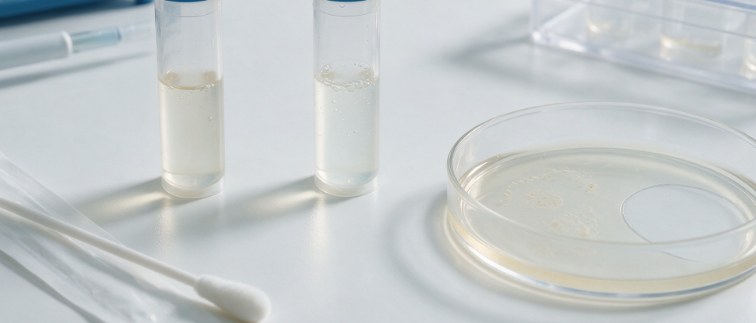
We provide validated sample collection protocols for disinfectant residue testing. For surfaces, we use swabbing techniques with sterile swabs and a defined extraction solvent (e.g., water, methanol, or a specific buffer) to recover residues from a specified area (e.g., 25 cm²). For equipment with complex geometries, we recommend rinse sampling using a defined volume of sterile rinse solution. We also offer direct surface extraction (e.g., by applying a known volume of solvent and scraping) for non‑porous surfaces. We provide detailed instructions for sample handling, preservation (e.g., acidification to stabilise the residues), and transport, ensuring that the sample integrity is maintained.
2.2 Analytical Method Development and Validation – Tailored to Your Disinfectant and Matrix
We develop and validate custom analytical methods for each disinfectant active ingredient. Our method development includes the selection of the optimal chromatographic conditions (column, mobile phase, gradient), detection parameters (UV wavelength, MS/MS transitions), and sample preparation steps (extraction, clean‑up, concentration). We perform a full validation according to ICH Q2(R1) and USP <1225>, including the determination of: (a) specificity (ability to distinguish the target residue from matrix interferences); (b) linearity (over the expected concentration range); (c) accuracy (recovery by spiking known amounts); (d) precision (intra‑ and inter‑assay variability); (e) limit of detection (LOD) and limit of quantification (LOQ); (f) robustness to variations in method parameters; and (g) stability of the residues in the sample and in the extract. We provide a comprehensive validation report that is directly usable for regulatory submissions.
2.3 Quantitative Analysis – HPLC‑UV, LC‑MS/MS, and GC‑MS
We perform quantitative analysis using a range of state‑of‑the‑art instruments, selected based on the properties of the disinfectant and the required sensitivity:
- High‑Performance Liquid Chromatography with UV/Vis Detection (HPLC‑UV) – for the quantification of UV‑absorbing disinfectants (e.g., phenolics, benzalkonium chloride) at concentrations typically ≥ 0.1 µg/mL.
- Liquid Chromatography‑Tandem Mass Spectrometry (LC‑MS/MS) – for the most sensitive and specific quantification of disinfectants (including quaternary ammonium compounds, chlorhexidine, and many others) at sub‑ppb levels (≤ 0.01 µg/mL).
- Gas Chromatography‑Mass Spectrometry (GC‑MS) – for volatile and semi‑volatile disinfectants (e.g., alcohols, aldehydes) after derivatisation, if required.
- Ion Chromatography – for ionic disinfectants (e.g., chlorine‑based agents, peracetic acid, and their breakdown products).
We use internal standards (isotopically labelled or structurally similar) to correct for matrix effects and extraction losses, ensuring the highest accuracy. We provide the concentration of the disinfectant residue in µg per swab, µg per cm², or µg/mL, as appropriate.
2.4 Surface Residue Limits (SRL) and Toxicity‑Based Limit Setting
We assist you in establishing scientifically justified surface residue limits (SRLs) for disinfectants, based on toxicological data (e.g., the acceptable daily intake, or ADI, from the manufacturer’s safety data sheet or from published literature) and the surface area of the equipment. We apply the standard formula: SRL = (ADI × Safety Factor × Surface Area) / (Dose) to derive a permissible residue level. We provide a detailed justification report that is suitable for regulatory submission.
2.5 Carry‑Over and Cross‑Contamination Studies – Multi‑Product and Multi‑Residue Assessments
For facilities that use multiple disinfectants, we perform carry‑over studies to detect the presence of one disinfectant residue in samples from another product (or from a different disinfectant). We develop multi‑residue methods that can simultaneously quantify several active ingredients in a single run, saving time and cost. We provide a report on the potential for cross‑contamination and the effectiveness of the cleaning procedures in preventing it.
2.6 Stability and Degradation Studies – Assessing Residue Persistence
We assess the stability of disinfectant residues under different conditions (e.g., time, temperature, light, and pH) to determine the maximum holding time between sampling and analysis, and to assess the potential for degradation during the cleaning process. We provide a degradation profile and, if necessary, recommendations for sample preservation.
2.7 Data Review and Regulatory Submission Support
Our team of experienced analytical chemists and regulatory specialists can assist you in the interpretation of the residue data, in the preparation of the required documentation for regulatory submissions, and in responding to queries from authorities. We provide a full data package, including the raw chromatograms, the calibration curves, the recovery data, and the statistical analysis.
3. Advanced Capabilities – Novel Disinfectants, Complex Matrices, and Real‑Time Monitoring
For clients requiring specialised or high‑level residue characterisation, we offer a suite of customised, research‑grade services that go beyond routine testing:
3.1 Unknown Residue Identification – Suspect and Non‑Targeted Screening
If the identity of the disinfectant residue is unknown, or if you suspect the presence of unexpected residues (e.g., degradation products, impurities, or cross‑contaminants), we perform suspect screening using high‑resolution mass spectrometry (HRMS) with a comprehensive database of disinfectants and common contaminants. We provide a tentative identification and, if possible, a semi‑quantitative estimate of the concentration.
3.2 Validation of Novel Disinfectant Formulations – Custom Method Development
For new or proprietary disinfectant formulations, we develop custom analytical methods from scratch. We work with you to identify the active ingredients, determine their physico‑chemical properties, and design a robust, validated method for residue testing. We provide a full development and validation report.
3.3 Residue Testing in Complex Matrices – High‑Protein, Lipid, and Polymeric Samples
We specialise in residue testing in complex matrices (e.g., protein‑rich biological products, lipid‑based formulations, or polymeric materials). We apply appropriate extraction and clean‑up procedures (e.g., protein precipitation, solid‑phase extraction, or liquid‑liquid extraction) to overcome matrix interferences and to achieve the required sensitivity.
3.4 On‑Line and At‑Line Monitoring – Real‑Time Residue Detection
For continuous manufacturing or for rapid process control, we can implement on‑line or at‑line monitoring using portable or in‑line analytical systems (e.g., portable UV‑Vis, Raman, or near‑infrared (NIR) spectroscopy) that are calibrated against the reference method. We provide a correlation study and a validation of the on‑line method.
3.5 Comparative Filter and Material Compatibility Studies – Assessing Residue Adsorption
We can evaluate the adsorption of disinfectant residues onto different materials (e.g., stainless steel, glass, polymers, and elastomers) by performing recovery studies on spiked surfaces. This data is essential for understanding the potential for residue retention and for optimising the cleaning procedures.
3.6 Data Integrity and Automated Reporting – Secure, Traceable Results
We use validated electronic data capture and reporting systems that comply with 21 CFR Part 11 and EU Annex 11, ensuring the integrity and traceability of the data. We provide automated, standardised reports that are directly usable for regulatory submissions.
4. Data Integrity, Standardisation, and Comprehensive Reporting
All analyses are conducted under a strict quality management system that includes the use of certified reference standards, routine system suitability tests, and participation in proficiency testing schemes (where available). Our reports provide:
- Full method description – detailing the sample collection, extraction, chromatographic conditions, detection parameters, and data processing.
- Detailed results – including the residue concentration, the recovery rates, the limit of detection/quantification, and the comparison to the acceptance criteria.
- Quality control data – the results of the concurrent controls and the system suitability tests, confirming the validity of the run.
- Graphical outputs – including representative chromatograms, calibration curves, and, where applicable, degradation profiles.
- Interpretative comments – by our senior analytical chemists, providing an assessment of the residue levels, the effectiveness of the cleaning process, and any recommendations for corrective actions.
Our reports are structured to meet the requirements of regulatory audits and to facilitate a smooth review process. All data are stored in a secure, auditable environment.
Turnaround times: 3‑5 working days for routine HPLC/UV analysis, 5‑7 working days for LC‑MS/MS and GC‑MS analysis, and 1‑2 weeks for method development and validation. Expedited services are available for urgent projects.
5. Why Choose Our Laboratory for Disinfectant Residue Testing
We are one of the few laboratories that hold ISO/IEC 17025 accreditation and GMP compliance for disinfectant residue testing, covering a wide range of active ingredients, matrices, and analytical platforms. Our integrated infrastructure combines state‑of‑the‑art HPLC‑UV, LC‑MS/MS, GC‑MS, and HRMS systems, along with validated sample preparation workflows – enabling cross‑verification of results and a comprehensive, fully defensible testing package. Our team comprises PhD‑level analytical chemists, toxicologists, and regulatory specialists with extensive experience in method development, validation, and regulatory submissions, and we have supported more than 80 successful cleaning validation programmes across the pharmaceutical, biotech, and medical device industries.
We offer unparalleled flexibility: we work with all types of disinfectants – quaternary ammonium compounds, phenolics, chlorine‑based agents, peroxides, aldehydes, alcohols, and many others – and all types of surfaces (stainless steel, glass, polymers, and elastomers). We can adapt to your specific sampling locations, residue limits, and regulatory requirements. Our secure online portal enables real‑time tracking, access to raw data, and downloadable reports.
Our modular pricing ensures cost‑effectiveness: you select the level of analysis – from a simple residue screen to a full method development and validation package – with discounts for long‑term partnerships and multi‑product cleaning validation programmes. We also provide training, method transfer, and technical consultancy to help you build or strengthen your internal residue testing capabilities.
With a proven history of serving over 90 clients in the pharmaceutical, biotech, and medical device sectors, we have enabled our partners to demonstrate cleaning effectiveness, ensure product safety, and achieve regulatory compliance. We invite you to leverage our expertise for your disinfectant residue testing needs.
Contact our technical experts today to discuss your disinfectant, your equipment, and your specific regulatory requirements. We will design a tailored testing plan and provide a detailed proposal within one business day.