Reasons for choosing our testing services
ZHONGXI Testing has obtained inspection qualification certifications from multiple countries and regions worldwide. We possess a senior testing team and advanced testing methods, providing independent, impartial, and professional third-party verification services for global carbon projects.

Internationally recognized authority
Certified by multiple international standards such as CNAS, VCS, and GS, with reports universally applicable worldwide.

Global service capability
Covering 140+ countries and regions, it supports on-site detection and remote verification in multiple languages.

Professional experimental methods
Adopt standard experimental methods to ensure accurate and reliable data.
Comprehensive Antibiotic Potency (Bioassay) Testing Services – Microbiological and Physicochemical Assays for Quality Assurance and Regulatory Compliance
The accurate determination of antibiotic potency is an essential quality attribute for the manufacturing, release, and stability monitoring of antibiotic drug substances, drug products, and feed additives. Antibiotic potency is a measure of the biological activity of the antibiotic, expressed in terms of its ability to inhibit the growth of a susceptible microorganism. This biological activity, often expressed in units (e.g., µg/mg, IU/mg, or Units/mg), must be established using validated, pharmacopoeial methods to ensure product safety, efficacy, and consistency. Regulatory authorities, including the FDA, EMA, USP, EP, and WHO, require that antibiotic potency be determined using validated microbiological or physico‑chemical assays, with the results being traceable to international reference standards. A robust potency testing programme is not merely a simple plate reading; it requires a sophisticated, multi‑method approach that integrates microbiological agar diffusion assays (cylinder‑plate or disc‑plate), turbidimetric (broth) assays, and, increasingly, high‑performance liquid chromatography (HPLC) and mass spectrometry (MS) methods that have been correlated with the biological response. A poorly designed or executed potency assay can lead to incorrect potency assignment, product release failures, stability issues, and regulatory non‑compliance. Our ISO/IEC 17025‑accredited and GMP‑compliant laboratory offers a fully integrated antibiotic potency testing platform, encompassing the entire spectrum from official pharmacopoeial microbiological assays (USP <81>, EP 2.7.2, and related chapters) to advanced HPLC‑based methods for potency determination, with full method validation and traceability to certified reference standards. We deliver quantitative, traceable potency results, with comprehensive statistical analysis, strict quality control, and expert interpretation, enabling you to ensure product quality, meet regulatory requirements, and maintain the highest standards of patient safety.
1. The Scientific and Regulatory Rationale for Antibiotic Potency Testing
Antibiotic potency testing serves multiple essential purposes: (a) to determine the biological activity of the antibiotic drug substance or drug product, which is a critical quality attribute; (b) to monitor the stability of the antibiotic over its shelf‑life, by tracking any loss of potency due to degradation; (c) to support the release of batches by confirming that the potency meets the specification; (d) to provide a measure of the intrinsic activity of the antibiotic against its target organism; (e) to support the development of new formulations and to compare the potency of different batches; and (f) to comply with the pharmacopoeial requirements for the specific antibiotic. The choice of the test method – whether microbiological (agar diffusion or turbidimetric) or physico‑chemical (HPLC) – must be tailored to the antibiotic, the required sensitivity, and the regulatory expectations. The method must be validated to demonstrate that it is specific, accurate, precise, linear, and robust over the required concentration range, and that it is capable of distinguishing the active antibiotic from its degradation products and other impurities. Our service begins with a comprehensive consultation to define the optimal potency testing strategy for your antibiotic, ensuring both scientific rigor and regulatory compliance.
2. Our Comprehensive Antibiotic Potency Testing Platform – Microbiological and Analytical Methods
We maintain a complete, validated workflow for antibiotic potency testing, all performed in a dedicated microbiology and analytical chemistry facility with stringent quality controls, and using certified reference standards (e.g., from the USP, EP, or WHO) for method validation and daily quality assurance. Our portfolio includes:
2.1 Microbiological Agar Diffusion Assay (Cylinder‑Plate or Disc‑Plate Method) – USP <81>, EP 2.7.2
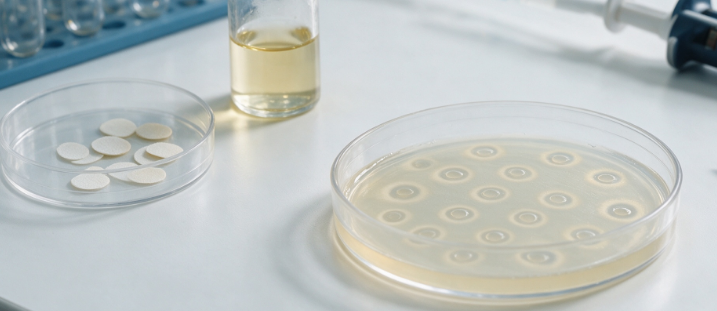
We perform the agar diffusion assay using a validated microbiological system (with a standardised seed layer of the test organism, typically Staphylococcus aureus, Bacillus subtilis, or Klebsiella pneumoniae, depending on the antibiotic). The antibiotic is diffused from a cylinder (or disc) into the agar, producing a zone of inhibition. The zone diameter is directly proportional to the logarithm of the concentration, and we use a 5‑point or 6‑point standard curve (with concentrations spanning the response range) to interpolate the potency of the test sample. We perform the assay in a randomised design to minimise systematic error, and we apply the statistical analysis required by the pharmacopoeia (e.g., the parallel‑line assay, with the appropriate F‑tests for linearity, parallelism, and validity). We provide the potency in units/mg or µg/mg, with a full statistical report.
2.2 Turbidimetric (Broth) Assay – USP <81>, EP 2.7.2
For antibiotics that are not suitable for the agar diffusion method (e.g., those with poor diffusion), we perform the turbidimetric assay. In this method, the antibiotic is incubated with a liquid culture of the test organism, and the inhibition of growth is measured as a reduction in turbidity (or optical density). We use a validated broth system with a defined inoculum and growth medium. We construct a standard curve (from a series of dilutions of the reference standard) and we interpolate the potency of the test sample. We apply the required statistical analysis (the parallel‑line assay) and we provide the potency with the associated statistics.
2.3 High‑Performance Liquid Chromatography (HPLC) – For Potency Determination by Physico‑Chemical Method
For many antibiotics, the potency can be determined by HPLC using a validated method that correlates with the biological activity. We develop and validate stability‑indicating HPLC methods that are capable of separating the active antibiotic from its degradation products and impurities. We use the appropriate detection (UV, DAD, or MS) and we quantify the active component against a certified reference standard. We correlate the HPLC result with the microbiological assay to confirm the relationship between the chemical concentration and the biological potency. We provide the potency as a weight/weight percentage or as a specific activity.
2.4 LC‑MS/MS and HRMS – For High‑Sensitivity and Specificity Potency Determination
For antibiotics that are present at low concentrations (e.g., in formulations or in stability studies), or for complex mixtures where high specificity is required, we use LC‑MS/MS or high‑resolution mass spectrometry (HRMS) to quantify the active antibiotic. We use the appropriate internal standards (isotopically labelled or structurally similar) and we provide the concentration and potency with a full uncertainty budget.
2.5 Method Validation and Statistical Analysis – Full Pharmacopoeial Compliance
We provide full method validation for all potency assays, according to the requirements of USP <81>, EP 2.7.2, and ICH Q2. This includes: (a) specificity (ability to distinguish the active antibiotic from related substances); (b) linearity (over the specified concentration range); (c) accuracy (by recovery of the reference standard); (d) precision (intra‑assay, inter‑assay, and inter‑operator); (e) range (the concentration range over which the method is valid); and (f) robustness to variations in the assay parameters. We also perform the statistical analysis required by the pharmacopoeia, including the assessment of linearity, parallelism, and validity, and we provide a full, documented report.
2.6 Reference Standard Management – Traceability and Quality Control
We maintain a validated system for the management of certified reference standards (e.g., USP, EP, or in‑house standards). We perform the necessary quality control checks on the standards (e.g., identity, purity, and potency) and we ensure that they are stored and handled under the appropriate conditions to preserve their integrity. We provide a certificate of analysis for each reference standard used.
2.7 Potency Expression and Reporting – Units, µg/mg, and International Units
We report the potency in the appropriate units, as defined by the pharmacopoeia or your product specification. This may include units per mg (U/mg), micrograms per mg (µg/mg), or international units per mg (IU/mg). We clearly indicate the reference standard used and the statistical confidence intervals (typically 95%) for the potency determination.
3. Advanced Capabilities – Complex Matrices, Novel Antibiotics, and Multi‑Component Assays
For clients requiring specialised or high‑level potency characterisation, we offer a suite of customised, research‑grade services that go beyond routine testing:
3.1 Potency Testing in Complex Formulations – Combined Drug Products, Feeds, and Premixes
We have validated methods for the determination of antibiotic potency in complex matrices, including finished drug products (tablets, capsules, suspensions), feeds, premixes, and veterinary products. We apply appropriate extraction and sample preparation procedures to recover the antibiotic from the matrix and to eliminate any interfering substances. We validate the recovery and we provide a potency result that is representative of the product.
3.2 Novel Antibiotics – Method Development and Validation for New Chemical Entities
For novel antibiotics (or for new formulations of existing antibiotics), we develop and validate custom potency methods from scratch. We work with you to design the appropriate microbiological assay (agar diffusion or turbidimetric) or HPLC method, and we perform a full validation to ensure that the method is fit‑for‑purpose. We provide a comprehensive development and validation report that is suitable for regulatory submission.
3.3 Multi‑Component Assays – Simultaneous Potency Determination of Multiple Antibiotics
For combination products that contain more than one antibiotic, we develop multi‑component assays using HPLC‑UV or LC‑MS/MS. We separate the active components and determine the potency of each component individually, using the appropriate reference standards and validation procedures. We provide the potency for each component and the total potency (if required).
3.4 Stability‑Indicating Potency Testing – For Shelf‑Life Studies
We perform stability‑indicating potency testing on samples from your stability studies. We use validated methods that can separate the active antibiotic from its degradation products. We provide the potency as a function of time and, if required, we calculate the degradation rate and the projected shelf‑life.
3.5 Potency and Content Uniformity – Combined Testing
We can combine potency testing with content uniformity testing for solid dosage forms, by determining the potency of multiple individual units (e.g., 10 tablets) and reporting the mean, the range, and the relative standard deviation. This provides a comprehensive assessment of the quality of the batch.
3.6 Data Review and Regulatory Submission Support
Our team of experienced pharmaceutical scientists and regulatory specialists can assist you in the interpretation of the potency data, in the preparation of the required documentation for regulatory submissions, and in responding to queries from authorities. We provide a full data package, including the raw data, the statistical analysis, and the validation reports.
4. Data Integrity, Standardisation, and Comprehensive Reporting
All analyses are conducted under a strict quality management system that includes the use of certified reference standards, routine system suitability tests, and participation in proficiency testing schemes (where available). Our reports provide:
- Full method description – detailing the assay type, the test organism, the reference standard, the test conditions, and the statistical analysis.
- Detailed results – including the potency (in the required units), the confidence intervals (typically 95%), the recovery rates (where applicable), and the pass/fail determination according to the specification.
- Quality control data – the results of the concurrent controls and the system suitability tests, confirming the validity of the assay.
- Graphical outputs – including standard curves, zone‑diameter plots, and, where applicable, chromatograms.
- Interpretative comments – by our senior scientists, providing an assessment of the potency, the batch quality, and any recommendations for further action.
Our reports are structured to meet the requirements of regulatory audits and to facilitate a smooth review process. All data are stored in a secure, auditable environment.
Turnaround times: 3‑5 working days for routine microbiological assays, 2‑4 working days for HPLC‑based assays, and 1‑2 weeks for method development and validation. Expedited services are available for urgent projects.
5. Why Choose Our Laboratory for Antibiotic Potency Testing
We are one of the few laboratories that hold ISO/IEC 17025 accreditation and GMP compliance for antibiotic potency testing, covering both microbiological and physico‑chemical methods, for a wide range of antibiotic classes (penicillins, cephalosporins, macrolides, aminoglycosides, tetracyclines, and many others). Our integrated infrastructure combines a state‑of‑the‑art microbiology facility, a dedicated analytical chemistry suite (HPLC, LC‑MS/MS, and HRMS), and a specialised statistical analysis unit – enabling cross‑verification of results and a comprehensive, fully defensible testing package. Our team comprises PhD‑level microbiologists, analytical chemists, and regulatory specialists with extensive experience in method development, validation, and regulatory submissions, and we have supported more than 100 successful product registrations across the globe.
We offer unparalleled flexibility: we work with all types of antibiotics – from the most common drug substances to novel, complex, and combination products – and we can adapt to your specific formulation, matrix, and regulatory requirements. Our secure online portal enables real‑time tracking, access to raw data, and downloadable reports.
Our modular pricing ensures cost‑effectiveness: you select the level of analysis – from a simple, pharmacopoeial assay to a full method development and validation package – with discounts for long‑term partnerships and multi‑product testing programmes. We also provide training, method transfer, and technical consultancy to help you build or strengthen your internal potency testing capabilities.
With a proven history of serving over 80 clients in the pharmaceutical, veterinary, and biotechnology sectors, we have enabled our partners to determine antibiotic potency accurately, ensure product quality, and achieve regulatory compliance. We invite you to leverage our expertise for your antibiotic potency testing needs.
Contact our technical experts today to discuss your antibiotic, your formulation, and your specific regulatory requirements. We will design a tailored testing plan and provide a detailed proposal within one business day.