Reasons for choosing our testing services
ZHONGXI Testing has obtained inspection qualification certifications from multiple countries and regions worldwide. We possess a senior testing team and advanced testing methods, providing independent, impartial, and professional third-party verification services for global carbon projects.

Internationally recognized authority
Certified by multiple international standards such as CNAS, VCS, and GS, with reports universally applicable worldwide.

Global service capability
Covering 140+ countries and regions, it supports on-site detection and remote verification in multiple languages.

Professional experimental methods
Adopt standard experimental methods to ensure accurate and reliable data.
Comprehensive Industrial Spoilage Microorganism Testing – Advanced Detection, Identification, and Risk Assessment for Product Preservation and Process Integrity
The reliable detection and characterisation of industrial spoilage microorganisms is a critical requirement for maintaining product quality, extending shelf‑life, and ensuring process safety across a wide range of industries, including food and beverage, cosmetics and personal care, pharmaceuticals, paints and coatings, lubricants, and pulp and paper. Spoilage organisms – ranging from bacteria and yeasts to moulds and bio‑film formers – can cause product degradation, off‑odours, discolouration, package swelling, and significant economic losses. Moreover, the presence of certain spoilage microbes can indicate a breach in hygiene, a failure in preservation, or a contamination source that could escalate to a full‑scale product recall. A robust spoilage microorganism testing programme is not a generic microbial screen; it requires a targeted, multi‑method approach that integrates rapid screening, selective isolation, phenotypic characterisation, and, where needed, molecular identification and metabolic profiling to pinpoint the spoilage agent, understand its physiology, and recommend effective countermeasures. A superficial analysis that fails to distinguish between harmless environmental flora and true spoilage organisms, or that does not identify the specific species, can lead to ineffective corrective actions, recurring spoilage incidents, and unnecessary financial loss. Our ISO/IEC 17025‑accredited and GMP‑compliant laboratory offers a fully integrated industrial spoilage testing platform, encompassing the entire spectrum from rapid ATP‑based hygiene monitoring and plate counting to advanced molecular identification (sequencing, MALDI‑TOF, and PCR) and physiological characterisation (pH tolerance, osmotolerance, and preservative resistance). We deliver quantitative, traceable data, including total viable counts, identification of the predominant spoilage flora, and an assessment of the spoilage potential under your specific product conditions. Our expert team of industrial microbiologists provides comprehensive study design, flawless execution, and clear, actionable reports, enabling you to identify the root cause of spoilage, validate your preservation strategies, and ensure product integrity and consumer safety.
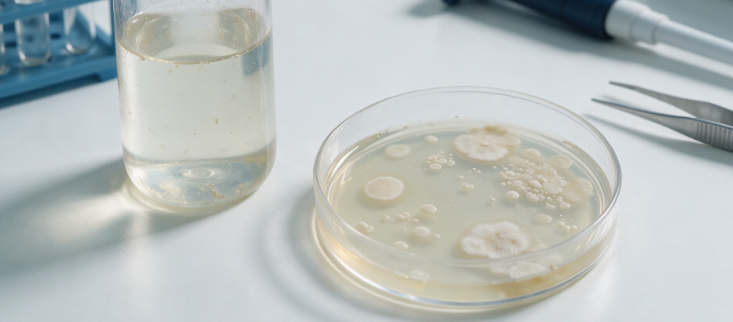
1. The Scientific and Economic Rationale for Industrial Spoilage Microorganism Testing
Industrial spoilage testing serves multiple essential purposes: (a) to identify the specific microorganisms responsible for a spoilage event, distinguishing between primary spoilage agents and secondary contaminants; (b) to characterise the spoilage potential of the isolate – its ability to grow under the specific product conditions (e.g., pH, water activity, temperature, preservative concentration); (c) to evaluate the efficacy of the preservation system against the isolated spoilage organisms; (d) to monitor the microbiological quality of raw materials, in‑process samples, and finished products; (e) to support the investigation of customer complaints and to provide a root‑cause analysis; and (f) to validate the effectiveness of cleaning and disinfection procedures in the production environment. The choice of analytical approach – whether culture‑based enumeration (plate count, MPN), rapid screening (ATP, impedance), selective isolation, biochemical identification, or molecular identification (16S/ITS sequencing, MALDI‑TOF, or qPCR) – must be tailored to the product, the suspected spoilage agent, and the required resolution (e.g., genus‑level vs. species‑level). A method that is adequate for a routine hygiene check may be insufficient for a full spoilage investigation. Our service begins with a comprehensive consultation to define the optimal testing strategy, ensuring both scientific rigor and operational relevance.
2. Our Comprehensive Industrial Spoilage Detection Platform – Rapid Screening, Enumeration, and Identification
We maintain a complete, validated workflow for industrial spoilage testing, all performed in a dedicated microbiology and molecular biology facility with stringent quality controls, and using certified reference cultures (e.g., ATCC, NCTC) for method validation and quality assurance. Our portfolio includes:
2.1 Rapid Screening and Hygiene Monitoring – ATP Bioluminescence and Impedance
We provide rapid screening services using ATP bioluminescence (for surface hygiene) and impedance‑based systems (for rapid growth detection). These methods provide a qualitative or semi‑quantitative result within minutes to a few hours, enabling immediate corrective action. We correlate the ATP results with the plate count for your specific product or surface, providing a validated action‑limit system.
2.2 Total Viable and Selective Plate Counts – Enumeration of the Spoilage Flora
We perform total viable counts (TVC) using a range of media (e.g., Plate Count Agar for mesophilic bacteria, Sabouraud Dextrose Agar for yeasts and moulds, and specialised media for specific organism groups). We also perform selective and differential counts to target specific spoilage groups: (a) lactic acid bacteria (MRS agar); (b) thermophilic and psychrotrophic organisms; (c) osmotolerant yeasts; (d) sulphate‑reducing bacteria (for oil and water systems); and (e) biofilm‑forming bacteria. We provide the count in CFU/g or CFU/mL, with the relevant statistical uncertainty.
2.3 Isolation and Purification – Obtaining Pure Cultures of the Spoilage Agent
If a specific spoilage organism is suspected, we perform isolation and purification of the organism from the product. We use selective and differential media, streak‑plating, and sub‑culturing to obtain a pure culture, which is essential for definitive identification and for subsequent characterisation studies.
2.4 Phenotypic Characterisation – Physiology and Spoilage Potential
We characterise the isolated spoilage organism to understand its potential to cause spoilage under your specific product conditions. This includes: (a) growth temperature range and optimum (psychrotrophic, mesophilic, or thermophilic); (b) pH tolerance and optimum; (c) water activity (aw) tolerance; (d) osmotolerance (for high‑sugar or high‑salt products); (e) oxygen requirement (aerobic, anaerobic, or facultative); (f) enzyme production (e.g., proteases, lipases, amylases, and pectinases) that can cause product degradation; and (g) preservative resistance (challenge testing against the specific preservatives in your product). We provide a detailed physiological profile of the isolate, enabling the prediction of its spoilage potential under different storage conditions.
2.5 Biochemical and Proteomic Identification – API, VITEK, and MALDI‑TOF
We perform definitive identification of the spoilage isolate using a combination of: (a) biochemical profiling (e.g., API strips, or VITEK 2 cards) to determine the carbohydrate assimilation and enzymatic profile; and (b) Matrix‑Assisted Laser Desorption/Ionisation Time‑of‑Flight Mass Spectrometry (MALDI‑TOF MS) for rapid, high‑throughput species‑level identification. We provide the identification (species and, where possible, subspecies) with a confidence score, and we confirm the identity by 16S or ITS sequencing if required.
2.6 Molecular Identification – 16S rRNA, ITS, and Whole‑Genome Sequencing
For definitive identification, for non‑culturable organisms, or for strains that are not recognised by the proteomic databases, we perform 16S rRNA gene sequencing (for bacteria) or ITS region sequencing (for fungi). We also offer whole‑genome sequencing (WGS) for the most comprehensive characterisation, including strain‑level identification, detection of virulence and resistance genes, and the determination of the evolutionary context. We provide the sequence, the BLAST results, and a phylogenetic tree.
2.7 Spoilage Investigation and Root‑Cause Analysis – Integrated Report
We provide a comprehensive spoilage investigation report that integrates the results of the enumeration, isolation, identification, and characterisation. The report includes: (a) a clear identification of the spoilage organism(s); (b) a description of their physiological and spoilage potential; (c) an assessment of whether the product’s preservation system is adequate to control this organism; (d) the likely source of the contamination; (e) recommendations for corrective actions (e.g., changes to the formulation, the process, or the cleaning/sanitation procedures); and (f) a plan for monitoring the effectiveness of the corrective actions.
3. Advanced Capabilities – Preservative Efficacy, Challenge Testing, and Biofilm Assessment
For clients requiring a deeper understanding of the spoilage potential or for the development of robust preservation strategies, we offer a suite of customised, research‑grade services that go beyond routine spoilage detection:
3.1 Preservative Efficacy and Challenge Testing – USP, EP, and ISO Methods
We perform preservative efficacy testing (PET) according to USP <51>, EP 5.1.3, and ISO 11930. We challenge the product with a defined inoculum of the spoilage organism (and with other relevant organisms) and measure the log reduction over time. We provide a pass/fail determination and, if the product fails, we identify the specific organism(s) responsible and provide recommendations for formulation adjustments.
3.2 Minimum Inhibitory Concentration (MIC) and Minimum Bactericidal Concentration (MBC)
We determine the MIC and MBC of the spoilage isolate against the preservatives used in your product (or against a panel of potential preservatives). This provides the quantitative data needed to optimise the preservative concentration and to validate the efficacy of the preservation system.
3.3 Biofilm Assessment – Adhesion, Biofilm Formation, and Eradication
We assess the ability of the spoilage organism to form a biofilm on product‑contact surfaces (e.g., stainless steel, plastics, and rubber). We quantify the biofilm using crystal violet staining and, if required, we evaluate the effectiveness of cleaning and disinfecting agents against the biofilm (MBEC and MBIC).
3.4 Stress Tolerance and resilience Testing – Assessing the Survival of the Spoilage Organism
We assess the survival and recovery of the spoilage organism under different stress conditions (e.g., heat, cold, low pH, high osmotic pressure). This provides a more realistic assessment of the organism’s ability to survive in the product and in the environment.
3.5 Development of Predictive Models – Growth Prediction and Shelf‑Life Estimation
Using the physiological data, we can develop predictive microbiological models to predict the growth of the spoilage organism under different storage conditions (e.g., time, temperature, pH). This enables the estimation of the product’s shelf‑life and the optimisation of the distribution and storage conditions.
3.6 Data Review and Regulatory Submission Support
Our team of experienced industrial microbiologists and regulatory specialists can assist you in the interpretation of the data, in the preparation of the required documentation for regulatory submissions (e.g., for product registration or for the validation of a new preservation strategy), and in responding to queries from authorities.
4. Data Integrity, Standardisation, and Comprehensive Reporting
All analyses are conducted under a strict quality management system that includes the use of certified reference cultures, routine positive and negative controls, and participation in proficiency testing schemes (where available). Our reports provide:
- Full method description – detailing the sampling, the enumeration, the isolation, the identification, and the characterisation procedures.
- Detailed results – including the TVC, the selective counts, the identity of the isolate (with confidence), the physiological profile, and the results of any further testing (e.g., MIC, biofilm).
- Quality control data – the results of the concurrent controls, confirming the validity of the test run.
- Graphical outputs – including growth curves, survival curves, and, where appropriate, dendrograms.
- Interpretative comments – by our senior industrial microbiologists, providing an assessment of the spoilage potential, the root cause of the spoilage, and the recommended corrective actions.
Our reports are structured to meet the requirements of regulatory audits, customer inspections, and internal quality assurance. All data are stored in a secure, auditable environment.
Turnaround times: 1‑2 working days for rapid screening and hygiene monitoring, 2‑3 working days for enumeration and isolation, 3‑5 working days for identification and physiological characterisation, and 1‑2 weeks for full challenge testing and predictive modelling. Expedited services are available for urgent spoilage investigations.
5. Why Choose Our Laboratory for Industrial Spoilage Microorganism Testing
We are one of the few laboratories that hold ISO/IEC 17025 accreditation and GMP compliance for the full spectrum of industrial spoilage testing, covering rapid screening, enumeration, isolation, identification, and physiological characterisation. Our integrated infrastructure combines a state‑of‑the‑art microbiology facility, advanced identification systems (MALDI‑TOF, sequencing), and a dedicated research and development unit – enabling cross‑verification of results and a comprehensive, fully defensible testing package. Our team comprises PhD‑level industrial microbiologists, food scientists, and regulatory specialists with extensive experience in spoilage investigation, method development, and regulatory submissions, and we have supported more than 100 clients in the food, beverage, cosmetic, pharmaceutical, and industrial sectors.
We offer unparalleled flexibility: we work with all types of products (liquids, solids, semi‑solids, coatings, and lubricants) and all types of spoilage organisms – and we can adapt to your specific product, your suspected spoilage agent, and your regulatory requirements. Our secure online portal enables real‑time tracking, access to raw data, and downloadable reports.
Our modular pricing ensures cost‑effectiveness: you select the level of analysis – from a simple hygiene check to a full spoilage investigation and preservative validation – with discounts for long‑term partnerships and multi‑product testing programmes. We also provide training, method transfer, and technical consultancy to help you build or strengthen your internal industrial microbiology capabilities.
With a proven history of serving over 120 clients in the food, beverage, cosmetic, pharmaceutical, and industrial sectors, we have enabled our partners to identify the root cause of spoilage, validate their preservation systems, and protect their products and brand reputation. We invite you to leverage our expertise for your industrial spoilage microorganism testing needs.
Contact our technical experts today to discuss your product, your specific spoilage concerns, and your regulatory requirements. We will design a tailored testing plan and provide a detailed proposal within one business day.