Reasons for choosing our testing services
ZHONGXI Testing has obtained inspection qualification certifications from multiple countries and regions worldwide. We possess a senior testing team and advanced testing methods, providing independent, impartial, and professional third-party verification services for global carbon projects.

Internationally recognized authority
Certified by multiple international standards such as CNAS, VCS, and GS, with reports universally applicable worldwide.

Global service capability
Covering 140+ countries and regions, it supports on-site detection and remote verification in multiple languages.

Professional experimental methods
Adopt standard experimental methods to ensure accurate and reliable data.
Comprehensive textile Antimicrobial Performance Testing – Advanced Quantitative and Qualitative Assessments for Hygiene, Durability, and Regulatory Compliance
The reliable evaluation of antimicrobial properties in textiles has become an essential requirement for a wide array of applications, including medical textiles, sportswear, intimate apparel, home furnishings, protective clothing, and personal protective equipment (PPE). The ability of a textile to inhibit the growth of bacteria, fungi, and other microorganisms directly impacts product hygiene, odour control, durability, and infection prevention. Regulatory and industry standards – including AATCC 100, ASTM E2149, ISO 20743, JIS L 1902, and ISO 13629 – mandate that antimicrobial efficacy be demonstrated using validated, standardised, and quantitative test methods. However, a robust antimicrobial assessment of textiles is not a simple “zone of inhibition” screen; it requires a carefully designed, multi‑method approach that accounts for the fibre composition, fabric construction (woven, knitted, non‑woven), finishing type (leaching, bound, or durable), the specific microorganisms of concern (bacteria, yeasts, moulds), the exposure conditions (contact time, humidity, temperature, agitation), and the required level of performance. Moreover, the increasing demand for durable, reusable, and environmentally friendly antimicrobial textiles, coupled with the need to evaluate novel finishes and to distinguish between different mechanisms of action, requires advanced analytical capabilities that go beyond the basic plate‑based assays. Our ISO/IEC 17025‑accredited and GMP‑compliant laboratory offers a fully integrated textile antimicrobial testing platform, covering the entire spectrum of standardised methods – from the classic absorption (AATCC 100) and transfer (AATCC 147) methods to the advanced shake‑flask (ASTM E2149) and quantitative suspension (ISO 20743) assays – as well as customised tests for specific applications. We deliver quantitative, traceable data, including percentage reduction values, logarithmic reductions, and pass/fail determinations according to the specific requirements of your product, market, and regulatory authority. Our expert team of textile microbiologists and material scientists provides comprehensive study design, flawless execution, and clear interpretative reporting, enabling you to validate product claims, meet regulatory standards, and ensure the highest level of consumer safety and product performance.
1. The Scientific and Commercial Rationale for textile Antimicrobial Testing
textile antimicrobial testing serves multiple critical purposes: (a) to quantify the antimicrobial efficacy of a finished textile against specific test organisms, expressed as a percentage reduction or log reduction; (b) to differentiate between leachable (diffusible) and bound (non‑leaching) finishes, which has implications for durability and safety; (c) to monitor the durability of the antimicrobial effect after laundering, abrasion, or other simulated use conditions; (d) to support product claims for hygiene, odour control, infection prevention, or freshness; (e) to comply with regulatory and industry standards for specific applications (e.g., medical devices, sportswear); and (f) to guide the optimisation of finishing processes and the selection of antimicrobial agents. The choice of test method – whether absorption (AATCC 100), transfer (AATCC 147), or suspension (ASTM E2149, ISO 20743) – must be tailored to the fabric type, the finish, the target organism, and the required performance criteria. A method that is appropriate for a non‑leaching bound finish may be insufficient for a leachable agent; a method that works for bacteria may need to be adapted for fungi or yeasts. Our service begins with a comprehensive consultation to define the optimal test strategy, ensuring both scientific rigor and regulatory compliance.
2. Our Comprehensive textile Antimicrobial Testing Platform – Standardised Methods and Beyond
We maintain a complete suite of validated antimicrobial test methods, all performed in a dedicated textile microbiology facility with stringent quality controls, and using certified reference cultures (e.g., ATCC strains) for method validation and daily quality assurance. Our portfolio includes:
2.1 Quantitative Absorption Method – AATCC 100 (USA) and ISO 20743 (International)
We perform the standard absorption method (AATCC 100) and its international equivalents (ISO 20743). In this test, a specified number of test organisms (typically 10⁵‑10⁶ CFU) are inoculated directly onto the test fabric, and after a defined contact time (e.g., 24 hours), the surviving organisms are recovered and quantified by plate count. The result is expressed as the percentage reduction in viable cells relative to the untreated control. We provide the count (CFU/mL), the percentage reduction, and a clear pass/fail determination according to your specification (e.g., ≥ 99% reduction).
2.2 Qualitative Transfer (Agar Plate) Method – AATCC 147 and ISO 20645
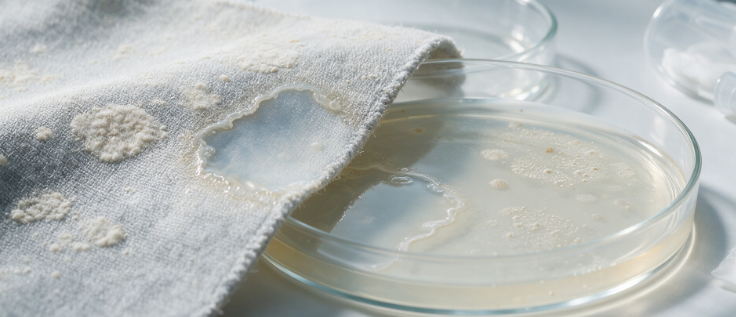
We use the transfer (agar plate) method for a rapid, qualitative assessment of antimicrobial activity. The test fabric is placed on an agar plate that has been inoculated with the test organism, and after incubation, the zone of inhibition (for leachable finishes) and the growth under the fabric (for bound finishes) are assessed. We provide the zone of inhibition (in mm, for leachable finishes) and a rating of growth under the fabric (e.g., no growth, partial growth, or full growth).
2.3 Shake‑Flask (Suspension) Method – ASTM E2149
For materials that are difficult to test by absorption (e.g., loose fibres, powders, or materials that do not absorb well), we perform the shake‑flask method (ASTM E2149). The test fabric is agitated in a liquid suspension of the test organism, and the reduction in viable cells over a defined contact time is measured. We provide the percentage reduction and the log reduction, with the appropriate statistical uncertainty.
2.4 Quantitative Suspension Method for textiles – ISO 20743 and JIS L 1902
We perform the quantitative suspension method (ISO 20743) and the equivalent Japanese Industrial Standard (JIS L 1902) for the evaluation of antibacterial and Antifungal activity. This method uses a liquid‑based system, with the fabric immersed in a bacterial suspension. The result is expressed as the log reduction value, which provides a more robust measure for highly active finishes. We also determine the bacteriostatic (inhibition of growth) and bactericidal (killing) activity, depending on the test conditions.
2.5 Antifungal Testing of textiles – AATCC 30 and ISO 13629
We offer specialised Antifungal testing for textiles, using methods such as AATCC 30 (for mould resistance) and ISO 13629 (for Antifungal activity). We use a panel of moulds and yeasts (e.g., Aspergillus niger, Penicillium chrysogenum, Candida albicans) and determine the growth rating (0‑4) or the percentage reduction, depending on the method.
2.6 Durability and Laundering Studies – Simulated Use and Wash Tests
We provide durability testing by performing repeated laundering cycles (according to AATCC 61 or ISO 6330) before the antimicrobial test. We assess the retention of antimicrobial activity after 5, 10, 25, or 50 wash cycles. We also simulate the effect of abrasion (e.g., Martindale), dry cleaning, or other treatments, to provide a realistic assessment of the product’s performance in service.
2.7 Method Validation and Quality Assurance – Full Compliance with Standards
We provide full method validation for your antimicrobial test, including: (a) specificity (against a panel of target organisms); (b) repeatability and reproducibility (within and between runs); (c) sensitivity (the ability to detect differences in performance); and (d) robustness to variations in inoculum, contact time, and other parameters. The validation report is structured to meet the requirements of regulatory submissions (e.g., for EPA or BPR registration).
3. Advanced Capabilities – Mechanistic Profiling, Biofilm Assessment, and Customised Study Design
For clients requiring a deeper understanding of the antimicrobial mechanism or a high‑level validation of their textile product, we offer a suite of customised, research‑grade services that go beyond routine testing:
3.1 Leaching vs. Bound Finish Differentiation – Assessing the Mode of Action
We perform leaching studies to determine whether the antimicrobial effect is due to a leachable agent or a bound finish. We test the fabric after multiple washes and after extraction, and we use both the zone of inhibition and the quantitative reduction methods to determine whether the activity persists.
3.2 Biofilm Inhibition and Eradication – Testing Against Surface‑Associated Bacteria
We perform biofilm inhibition and biofilm eradication assays on textile surfaces, using methods based on the Calgary Biofilm Device or a modified microtiter plate system. We assess the ability of the antimicrobial finish to prevent the formation of a biofilm and to kill the cells in an established biofilm.
3.3 Real‑Time Efficacy Monitoring – Time‑Kill Kinetics
We perform time‑kill kinetics to monitor the rate of bacterial inactivation on the textile surface. We take samples at multiple time points (e.g., 0, 1, 2, 4, 8, and 24 hours) and determine the time required for a 1‑log, 2‑log, or 3‑log reduction.
3.4 Antimicrobial Activity Against Clinical and Resistant Strains
In addition to the standard ATCC strains, we can test the antimicrobial efficacy against clinical isolates or antibiotic‑resistant strains (e.g., MRSA, VRE, ESBL‑producing E. coli). This is essential for medical textiles and for applications where the control of drug‑resistant bacteria is a priority.
3.5 Customised Organism Panels – For Specific Applications
We can design custom organism panels to match the specific microbial challenges of your application. For example, for sportswear, we might include Staphylococcus aureus and Klebsiella pneumoniae, while for medical textiles, we might include Staphylococcus aureus, Enterococcus faecalis, and Pseudomonas aeruginosa.
3.6 Data Review and Regulatory Submission Support
Our team of experienced textile microbiologists and regulatory specialists can assist you in the interpretation of the data, in the preparation of the required documentation for regulatory submissions (e.g., for a biocidal product registration, or for product certification), and in responding to queries from authorities. We provide a full data package, including the raw data, the statistical analysis, and the supporting evidence.
4. Data Integrity, Standardisation, and Comprehensive Reporting
All analyses are conducted under a strict quality management system that includes the use of certified reference cultures, routine positive and negative controls, and participation in proficiency testing schemes (where available). Our reports provide:
- Full method description – detailing the standard used, the test organism, the inoculum preparation, the test conditions (contact time, temperature, agitation), and the enumeration procedure.
- Detailed results – including the viable counts, the percentage reduction, the log reduction, the zone of inhibition (if applicable), and a clear pass/fail determination.
- Quality control data – the results of the concurrent controls, confirming the validity of the test run.
- Graphical outputs – including growth curves, zone images, and, where appropriate, the kill kinetics.
- Interpretative comments – by our senior textile microbiologists, providing an assessment of the antimicrobial efficacy, the durability of the effect, and any recommendations for product improvement or claim support.
Our reports are structured to be directly usable for regulatory submissions, for internal quality assurance, and for marketing claims.
Turnaround times: 3‑5 working days for the standard quantitative methods, 2‑3 working days for the qualitative transfer method, and 1‑2 weeks for durability and laundering studies. Express services are available for urgent projects.
5. Why Choose Our Laboratory for textile Antimicrobial Performance Testing
We are one of the few laboratories that hold ISO/IEC 17025 accreditation and GMP compliance for the full spectrum of textile antimicrobial test methods, including AATCC, ASTM, ISO, and JIS standards. Our integrated infrastructure combines a state‑of‑the‑art textile microbiology facility, advanced imaging systems, and a dedicated material science unit – enabling cross‑verification of results and a comprehensive understanding of the antimicrobial performance. Our team comprises PhD‑level textile microbiologists, material scientists, and regulatory specialists with extensive experience in method development, validation, and regulatory submissions, and we have a proven track record of supporting product development and market approvals for major textile brands and manufacturers.
We offer unparalleled flexibility: we work with all types of textile materials – woven, knitted, non‑woven, and fibres – and we can adapt to your specific finishing type, your target organisms, and your regulatory requirements. Our secure online portal enables real‑time tracking, access to raw data, and downloadable certificates of analysis.
Our modular pricing ensures cost‑effectiveness: you select the level of analysis – from a simple qualitative screen to a full quantitative, durable, and mechanistic evaluation – with discounts for routine monitoring programmes and bulk submissions. We also provide training, method transfer, and technical consultancy to help you build or strengthen your internal antimicrobial testing capabilities.
With a proven history of serving over 120 clients in the textile, apparel, and medical device industries, we have enabled our partners to validate their antimicrobial claims, comply with international standards, and bring high‑quality, protective products to market. We invite you to leverage our expertise for your textile antimicrobial performance testing needs.
Contact our technical experts today to discuss your textile product, your target microorganisms, and your specific performance and regulatory requirements. We will design a tailored testing plan and provide a detailed proposal within one business day.